Ch 44: Particle Physics and Cosmology
Young & Freedman Calc - University Physics 14th Edition
Young & Freedman Calc14th EditionUniversity PhysicsISBN: 9780321973610Non è quello che usi tu?Cambia libro di testo
Capitolo 44, Problema 31a

The spectrum of the sodium atom is detected in the light from a distant galaxy. If the 590.0590.0-nm line is redshifted to 658.5658.5 nm, at what speed is the galaxy receding from the earth?

Guida verificata passo dopo passo
1
Identify the redshift formula, which relates the observed wavelength (λ_observed), the emitted wavelength (λ_emitted), and the velocity of the galaxy (v) relative to the speed of light (c). The formula is: vc = λobserved - λemittedλemitted.
Substitute the given values into the formula: λ_observed = 658.5 nm and λ_emitted = 590.0 nm. This gives: vc = 658.5 - 590.0590.0.
Simplify the numerator of the fraction in the formula to find the difference between the observed and emitted wavelengths: 658.5 - 590.0 = 68.5 nm.
Divide the difference in wavelengths (68.5 nm) by the emitted wavelength (590.0 nm) to calculate the ratio: 68.5590.0.
Multiply the resulting ratio by the speed of light (c ≈ 3.00 × 10⁸ m/s) to find the velocity of the galaxy relative to Earth: v = c × 68.5590.0.

Risposta video verificata per un problema simile:

Questa soluzione video è stata consigliata dai nostri tutor come utile per risolvere questo problema.

Concetti chiave

Ecco i concetti essenziali che devi comprendere per rispondere correttamente alla domanda.

Redshift

Redshift refers to the phenomenon where light from an object moving away from an observer is shifted to longer wavelengths. In astronomy, this is often observed in the light from distant galaxies, indicating their motion away from Earth. The amount of redshift can be quantified and is directly related to the speed of the object relative to the observer, following the Doppler effect.

Doppler Effect

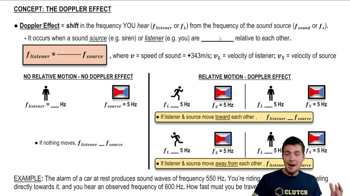
The Doppler Effect is the change in frequency or wavelength of a wave in relation to an observer moving relative to the wave source. For light waves, if the source is moving away, the observed wavelength increases (redshift), while if it is moving towards the observer, the wavelength decreases (blueshift). This effect is crucial in astrophysics for determining the velocities of celestial objects.
Video consigliato:
Percorso guidato
07:40
The Doppler Effect

Speed Calculation

To calculate the speed of a receding galaxy based on redshift, one can use the formula derived from the Doppler effect for light. The formula relates the observed wavelength (λ') to the emitted wavelength (λ) and the speed of light (c). The speed of the galaxy can be determined using the equation v = c * (λ' - λ) / λ, where v is the speed of the galaxy, λ' is the observed wavelength, and λ is the original wavelength.
Video consigliato:
Percorso guidato
07:59
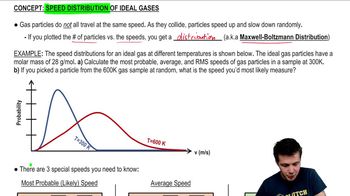
Speed Distribution & Special Speeds of Ideal Gases