The spectrum of the sodium atom is detected in the light from a distant galaxy. If the -nm line is redshifted to nm, at what speed is the galaxy receding from the earth?
Ch 44: Particle Physics and Cosmology
Young & Freedman Calc14th EditionUniversity PhysicsISBN: 9780321973610Non è quello che usi tu?Cambia libro di testo
Tutti i libri di testo
Young & Freedman Calc 14th Edition
Ch 44: Particle Physics and Cosmology
Problema 25
Young & Freedman Calc 14th Edition
Ch 44: Particle Physics and Cosmology
Problema 25Capitolo 44, Problema 25
In which of the following reactions or decays is strangeness conserved? In each case, explain your reasoning.
(a)
(b)
(c)
(d)
Guida verificata passo dopo passo1
Step 1: Understand the concept of strangeness conservation. Strangeness is a quantum number associated with the presence of strange quarks in particles. In strong and electromagnetic interactions, strangeness is conserved. However, in weak interactions, strangeness can change by ±1.
Step 2: Analyze reaction (a): K⁺ + μ⁺ + ν_μ. The K⁺ meson contains a strange quark (s) and an up antiquark (u̅). The muon (μ⁺) and neutrino (ν_μ) are leptons and do not carry strangeness. This reaction involves the weak interaction (due to the presence of neutrinos), so strangeness may not be conserved. Check the initial and final states to confirm.
Step 3: Analyze reaction (b): n + K⁺ → p + π⁰. The neutron (n) and proton (p) are baryons, while K⁺ and π⁰ are mesons. The K⁺ meson has a strangeness of +1, while the neutron, proton, and π⁰ have a strangeness of 0. Since the initial state has a total strangeness of +1 and the final state has a total strangeness of 0, strangeness is not conserved. This reaction likely involves the weak interaction.
Step 4: Analyze reaction (c): K⁺ + K⁻ → π⁰ + π⁰. The K⁺ meson has a strangeness of +1, and the K⁻ meson has a strangeness of -1. The π⁰ mesons have a strangeness of 0. The total strangeness in the initial state is 0 (+1 + -1), and the total strangeness in the final state is also 0. Strangeness is conserved, so this reaction likely occurs via the strong interaction.
Step 5: Analyze reaction (d): p + K⁻ → Λ⁰ + π⁰. The proton (p) has a strangeness of 0, the K⁻ meson has a strangeness of -1, the Λ⁰ baryon has a strangeness of -1, and the π⁰ meson has a strangeness of 0. The total strangeness in the initial state is -1 (0 + -1), and the total strangeness in the final state is also -1 (-1 + 0). Strangeness is conserved, so this reaction likely occurs via the strong interaction.

Risposta video verificata per un problema simile:
Questa soluzione video è stata consigliata dai nostri tutor come utile per risolvere questo problema.
Concetti chiave
Ecco i concetti essenziali che devi comprendere per rispondere correttamente alla domanda.
Strangeness
Strangeness is a quantum number that reflects the presence of strange quarks in a particle. It is defined as the negative of the number of strange quarks minus the number of anti-strange quarks. In particle interactions, strangeness is conserved in strong and electromagnetic processes, but can change in weak interactions. Understanding how strangeness behaves in different reactions is crucial for determining whether it is conserved.
Video consigliato:
Percorso guidato
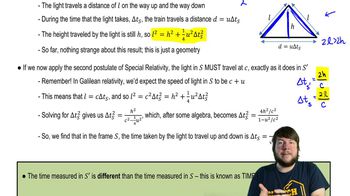
Time Dilation
Conservation Laws in Particle Physics
Conservation laws are fundamental principles in physics that state certain properties of isolated systems remain constant over time. In particle physics, key conservation laws include those for energy, momentum, charge, baryon number, and strangeness. These laws help predict the outcomes of particle interactions and decays, guiding physicists in analyzing which reactions can occur and under what conditions.
Video consigliato:
Percorso guidato
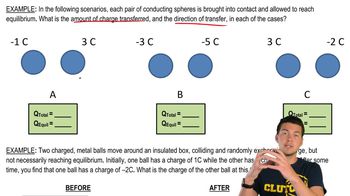
Conservation of Charge
Types of Interactions
In particle physics, interactions can be classified into three main types: strong, weak, and electromagnetic. Strong interactions govern the behavior of quarks and gluons, while weak interactions are responsible for processes like beta decay and can change strangeness. Electromagnetic interactions involve charged particles and photons. Recognizing the type of interaction involved in a reaction is essential for understanding whether certain quantum numbers, like strangeness, are conserved.
Video consigliato:
Percorso guidato
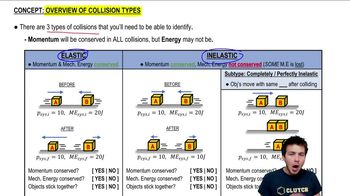
Overview of Collision Types
Pratica correlata
Domanda del libro di testo
259
views
Domanda del libro di testo
What is the total kinetic energy of the decay products when an upsilon particle at rest decays to ?
1398
views
Domanda del libro di testo
The spectrum of the sodium atom is detected in the light from a distant galaxy. Use the Hubble law to calculate the distance of the galaxy from the earth.
250
views
Domanda del libro di testo
Table shows that a decays into a and a photon. What is the magnitude of the momentum of the photon? Is it reasonable to ignore the final momentum and kinetic energy of the ? Explain.
1312
views
Domanda del libro di testo
If a at rest decays into a proton and a , what is the total kinetic energy of the decay products?
1307
views
Domanda del libro di testo
Table shows that a decays into a and a photon. Calculate the energy of the photon emitted in this decay, if the is at rest.
1237
views