Ch. 5 - Complex Numbers, Polar Coordinates and Parametric Equations
Blitzer - Trigonometry 3rd Edition
Blitzer3rd EditionTrigonometryISBN: 9780137316601Non è quello che usi tu?Cambia libro di testo
Capitolo 5, Problema 21

In Exercises 13–34, test for symmetry and then graph each polar equation. r = 1 + 2 cos θ

Guida verificata passo dopo passo
1
Recall the three common tests for symmetry in polar coordinates: symmetry about the polar axis (x-axis), symmetry about the line \( \theta = \frac{\pi}{2} \) (y-axis), and symmetry about the pole (origin).
To test symmetry about the polar axis, replace \( \theta \) with \( -\theta \) in the equation \( r = 1 + 2 \cos \theta \) and check if the equation remains unchanged.
To test symmetry about the line \( \theta = \frac{\pi}{2} \), replace \( \theta \) with \( \pi - \theta \) and check if the equation remains unchanged.
To test symmetry about the pole, replace \( r \) with \( -r \) and \( \theta \) with \( \theta + \pi \) and check if the equation remains unchanged.
After determining the symmetries, plot points for various values of \( \theta \) (for example, \( 0, \frac{\pi}{6}, \frac{\pi}{4}, \frac{\pi}{2}, \pi \), etc.) by calculating \( r \) and then sketch the graph accordingly.

Risposta video verificata per un problema simile:

Questa soluzione video è stata consigliata dai nostri tutor come utile per risolvere questo problema.
Durata del video:
12m

Concetti chiave

Ecco i concetti essenziali che devi comprendere per rispondere correttamente alla domanda.

Polar Coordinates and Equations

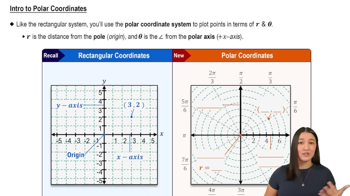
Polar coordinates represent points using a radius and an angle (r, θ) instead of Cartesian (x, y). Understanding how to interpret and plot polar equations like r = 1 + 2 cos θ is essential for graphing curves in the polar plane.
Video consigliato:
Percorso guidato
05:32
Intro to Polar Coordinates

Symmetry Tests in Polar Graphs

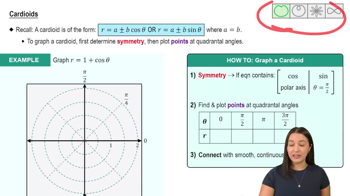
Testing symmetry in polar graphs involves checking if the equation remains unchanged under transformations: θ → -θ (symmetry about the polar axis), θ → π - θ (symmetry about the line θ = π/2), and r → -r with θ → θ + π (symmetry about the pole). This helps simplify graphing by identifying mirrored parts.
Video consigliato:

Graphing Polar Equations Involving Cosine

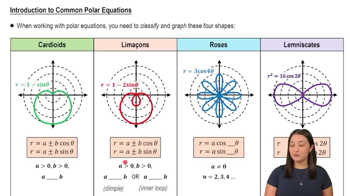
Polar equations with cosine terms, such as r = 1 + 2 cos θ, often produce limaçon shapes. Recognizing how the cosine function affects the radius for different angles allows for accurate plotting and understanding of the curve's features like loops or dimpled shapes.
Video consigliato:
Percorso guidato
3:47
Introduction to Common Polar Equations