In Exercises 21–40, eliminate the parameter t. Then use the rectangular equation to sketch the plane curve represented by the given parametric equations. Use arrows to show the orientation of the curve corresponding to increasing values of t. (If an interval for t is not specified, assume that −∞ < t < ∞. x = t, y = 2t
Ch. 5 - Complex Numbers, Polar Coordinates and Parametric Equations

Tutti i libri di testo
Blitzer 3rd Edition
Ch. 5 - Complex Numbers, Polar Coordinates and Parametric Equations
Problema 23
Blitzer 3rd Edition
Ch. 5 - Complex Numbers, Polar Coordinates and Parametric Equations
Problema 23Capitolo 5, Problema 23
In Exercises 22–24, find the quotient z₁/z₂ of the complex numbers. Leave answers in polar form.
z₁ = 5 (cos 4π/3 + i sin 4π/3)
z₂ = 10 (cos π/3 + i sin π/3)
Guida verificata passo dopo passo1
Recall that when dividing two complex numbers in polar form, \( z_1 = r_1 (\cos \theta_1 + i \sin \theta_1) \) and \( z_2 = r_2 (\cos \theta_2 + i \sin \theta_2) \), the quotient \( \frac{z_1}{z_2} \) is given by \( \frac{r_1}{r_2} \left( \cos(\theta_1 - \theta_2) + i \sin(\theta_1 - \theta_2) \right) \).
Identify the magnitudes and angles from the given complex numbers: \( r_1 = 5 \), \( \theta_1 = \frac{4\pi}{3} \), \( r_2 = 10 \), and \( \theta_2 = \frac{\pi}{3} \).
Calculate the quotient of the magnitudes: \( \frac{r_1}{r_2} = \frac{5}{10} \).
Find the difference of the angles: \( \theta_1 - \theta_2 = \frac{4\pi}{3} - \frac{\pi}{3} \).
Write the quotient \( \frac{z_1}{z_2} \) in polar form using the results from steps 3 and 4: \( \frac{5}{10} \left( \cos \left( \frac{4\pi}{3} - \frac{\pi}{3} \right) + i \sin \left( \frac{4\pi}{3} - \frac{\pi}{3} \right) \right) \).

Risposta video verificata per un problema simile:
Questa soluzione video è stata consigliata dai nostri tutor come utile per risolvere questo problema.
Durata del video:
3mConcetti chiave
Ecco i concetti essenziali che devi comprendere per rispondere correttamente alla domanda.
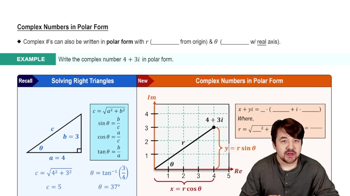
Polar Form of Complex Numbers
A complex number can be expressed in polar form as r(cos θ + i sin θ), where r is the magnitude and θ is the argument (angle). This form is useful for multiplication and division because it separates the magnitude and angle components.
Video consigliato:
Percorso guidato
Complex Numbers In Polar Form
Division of Complex Numbers in Polar Form
To divide two complex numbers in polar form, divide their magnitudes and subtract the angles: (r₁/r₂) [cos(θ₁ - θ₂) + i sin(θ₁ - θ₂)]. This simplifies the operation compared to Cartesian form.
Video consigliato:
Percorso guidato
Complex Numbers In Polar Form
Trigonometric Identities for Cosine and Sine
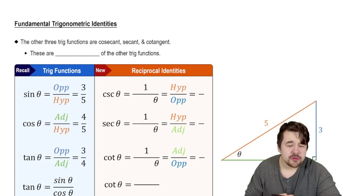
Understanding the values of cosine and sine at standard angles (like π/3 and 4π/3) helps in simplifying the final expression. These identities allow you to interpret or convert the polar form results accurately.
Video consigliato:
Percorso guidato
Fundamental Trigonometric Identities
Pratica correlata
Domanda del libro di testo
753
views
Domanda del libro di testo
In Exercises 13–34, test for symmetry and then graph each polar equation. r = 2 − 3 sin θ
702
views
Domanda del libro di testo
In Exercises 11–26, plot each complex number. Then write the complex number in polar form. You may express the argument in degrees or radians. −3 + 4i
528
views
Domanda del libro di testo
In Exercises 21–28, divide and express the result in standard form. 2 / 3 - i
670
views
Domanda del libro di testo
In Exercises 21–28, divide and express the result in standard form.
3 / 4+i
495
views
Domanda del libro di testo
In Exercises 21–28, divide and express the result in standard form. 8i / 4−3i
643
views