Ch. 4 - Graphs of the Circular Functions
Lial - Trigonometry 12th Edition
Lial12th EditionTrigonometryISBN: 9780136552161, 9780135440780, 9780136881117, 9780135440827, 9780135924891Non è quello che usi tu?Cambia libro di testo
Capitolo 5, Problema 1

An object in simple harmonic motion has position function s(t), in inches, from an equilibrium point, as follows, where t is time in seconds.
𝒮(t) = 5 cos 2t
What is the amplitude of this motion?

Guida verificata passo dopo passo
1
Identify the general form of the position function for simple harmonic motion, which is given by \(s(t) = A \cos(\omega t + \phi)\), where \(A\) is the amplitude, \(\omega\) is the angular frequency, and \(\phi\) is the phase shift.
Compare the given function \(s(t) = 5 \cos 2t\) to the general form. Notice that the coefficient in front of the cosine function corresponds to the amplitude \(A\).
Recognize that the amplitude represents the maximum displacement from the equilibrium position, which is the absolute value of the coefficient multiplying the cosine function.
Conclude that the amplitude of the motion is the absolute value of 5, which is simply 5 inches.
Remember that the amplitude is always a positive quantity, indicating the peak distance from the equilibrium point regardless of direction.

Risposta video verificata per un problema simile:

Questa soluzione video è stata consigliata dai nostri tutor come utile per risolvere questo problema.

Concetti chiave

Ecco i concetti essenziali che devi comprendere per rispondere correttamente alla domanda.

Simple Harmonic Motion (SHM)

Simple Harmonic Motion describes oscillatory motion where an object moves back and forth around an equilibrium position in a sinusoidal pattern. The position function is typically expressed using sine or cosine functions, representing periodic motion with constant amplitude and frequency.
Video consigliato:
Percorso guidato
04:46
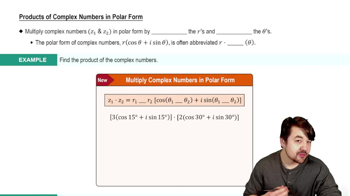
Products of Complex Numbers in Polar Form

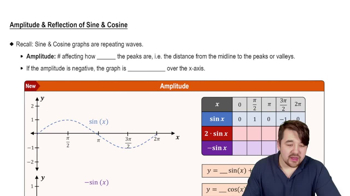
Amplitude in SHM

Amplitude is the maximum displacement of the object from its equilibrium position in simple harmonic motion. It corresponds to the coefficient in front of the cosine or sine function in the position equation, indicating the peak value the object reaches during oscillation.
Video consigliato:
Percorso guidato
5:05
Amplitude and Reflection of Sine and Cosine

Trigonometric Functions in Motion

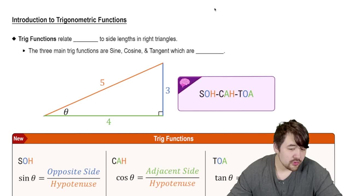
Cosine and sine functions model periodic phenomena like SHM, where the argument of the function (e.g., 2t) relates to angular frequency. Understanding how these functions describe oscillations helps interpret the motion's characteristics, such as period, frequency, and amplitude.
Video consigliato:
Percorso guidato
6:04
Introduction to Trigonometric Functions