Ch. 4 - Graphs of the Circular Functions
Lial - Trigonometry 12th Edition
Lial12th EditionTrigonometryISBN: 9780136552161, 9780135440780, 9780136881117, 9780135440827, 9780135924891Non è quello che usi tu?Cambia libro di testo
Capitolo 5, Problema 1

Fill in the blank(s) to correctly complete each sentence.
The graph of y = sin (x + π/4) is obtained by shifting the graph of y = sin x ______ unit(s) to the ________ (right/left).

Guida verificata passo dopo passo
1
Recall that the function y = sin(x + c) represents a horizontal shift of the basic sine function y = sin x, where c is a constant.
If the function is y = sin(x + \(\frac{\pi}{4}\)), the graph is shifted horizontally by \(\frac{\pi}{4}\) units.
Since the argument inside the sine function is (x + \(\frac{\pi}{4}\)), this corresponds to a shift to the left by \(\frac{\pi}{4}\) units (because adding inside the function shifts the graph left).
Therefore, the graph of y = sin(x + \(\frac{\pi}{4}\)) is obtained by shifting the graph of y = sin x \(\frac{\pi}{4}\) unit(s) to the left.
This is a standard property of function transformations: y = sin(x + c) shifts the graph left by c units, and y = sin(x - c) shifts it right by c units.

Risposta video verificata per un problema simile:

Questa soluzione video è stata consigliata dai nostri tutor come utile per risolvere questo problema.

Concetti chiave

Ecco i concetti essenziali che devi comprendere per rispondere correttamente alla domanda.

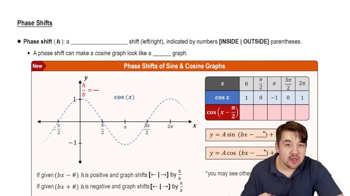
Phase Shift in Trigonometric Functions

Phase shift refers to the horizontal translation of a trigonometric graph caused by adding or subtracting a constant inside the function's argument. For y = sin(x + π/4), the graph shifts horizontally by π/4 units. The sign inside the function determines the direction of the shift.
Video consigliato:

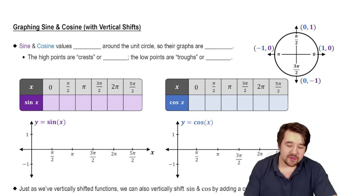
Graph of the Sine Function

The sine function y = sin x is periodic with period 2π and oscillates between -1 and 1. Understanding its basic shape and key points helps in visualizing transformations like shifts, stretches, and reflections applied to the graph.
Video consigliato:
Percorso guidato
5:53
Graph of Sine and Cosine Function

Effect of Adding a Positive Constant Inside the Function Argument

Adding a positive constant inside the argument of sine, as in sin(x + c), shifts the graph to the left by c units. This is because the input values that produce the same output occur earlier on the x-axis, effectively moving the graph leftward.
Video consigliato: