Ch. 7 - Applications of Trigonometry and Vectors
Lial - Trigonometry 12th Edition
Lial12th EditionTrigonometryISBN: 9780136552161, 9780135440780, 9780136881117, 9780135440827, 9780135924891Non è quello che usi tu?Cambia libro di testo
Capitolo 8, Problema 29a

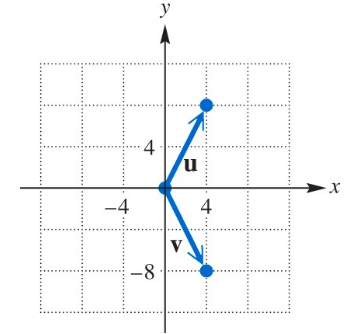
Use the figure to find each vector: u + v. Use vector notation as in Example 4.


Guida verificata passo dopo passo
1
Identify the components of vectors \( \mathbf{u} \) and \( \mathbf{v} \) from the figure. Typically, each vector can be broken down into its horizontal (x) and vertical (y) components. For example, \( \mathbf{u} = (u_x, u_y) \) and \( \mathbf{v} = (v_x, v_y) \).
Write down the components of \( \mathbf{u} \) and \( \mathbf{v} \) explicitly. If the figure provides magnitudes and directions (angles), use trigonometric functions to find components: \( u_x = |\mathbf{u}| \cos \theta_u \), \( u_y = |\mathbf{u}| \sin \theta_u \), and similarly for \( \mathbf{v} \).
Add the corresponding components of the vectors to find the resultant vector \( \mathbf{u} + \mathbf{v} \):
\[ \mathbf{u} + \mathbf{v} = (u_x + v_x, \; u_y + v_y) \]
Express the resultant vector \( \mathbf{u} + \mathbf{v} \) in vector notation, typically as \( \langle u_x + v_x, \; u_y + v_y \rangle \).
If needed, find the magnitude and direction of the resultant vector using:
\[ |\mathbf{u} + \mathbf{v}| = \sqrt{(u_x + v_x)^2 + (u_y + v_y)^2} \]
and
\[ \theta = \tan^{-1} \left( \frac{u_y + v_y}{u_x + v_x} \right) \]

Risposta video verificata per un problema simile:

Questa soluzione video è stata consigliata dai nostri tutor come utile per risolvere questo problema.

Concetti chiave

Ecco i concetti essenziali che devi comprendere per rispondere correttamente alla domanda.

Vector Addition

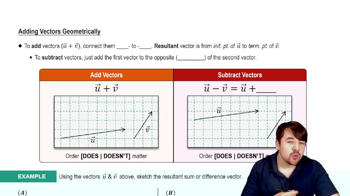
Vector addition involves combining two vectors to form a resultant vector by adding their corresponding components or by placing them head-to-tail graphically. The sum vector u + v represents the combined effect of vectors u and v.
Video consigliato:
Percorso guidato
05:29
Adding Vectors Geometrically

Vector Notation

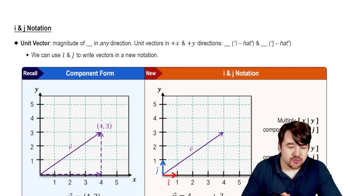
Vector notation expresses vectors typically as ordered pairs or triplets (e.g., <x, y>) representing their components along coordinate axes. This notation simplifies calculations and clearly shows the direction and magnitude of vectors.
Video consigliato:

Graphical Representation of Vectors

Vectors can be represented graphically as arrows with direction and length proportional to magnitude. Understanding how to interpret and draw vectors on a coordinate plane is essential for visualizing vector addition and verifying results.
Video consigliato:
Percorso guidato
04:19
Finding Direction of a Vector Example 1