Ch. 7 - Applications of Trigonometry and Vectors
Lial - Trigonometry 12th Edition
Lial12th EditionTrigonometryISBN: 9780136552161, 9780135440780, 9780136881117, 9780135440827, 9780135924891Non è quello che usi tu?Cambia libro di testo
Capitolo 8, Problema 29c

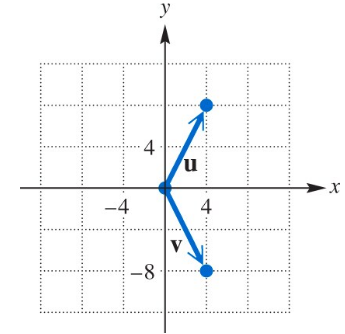
Use the figure to find each vector: - u. Use vector notation as in Example 4.


Graph showing vectors u and v originating from the origin with u pointing to (3,4) and v pointing to (3,-6) on an xy-plane.

Guida verificata passo dopo passo
1
Identify the vector \( \mathbf{u} \) from the figure, noting its direction and magnitude relative to the coordinate axes or reference points given.
Recall that the negative of a vector \( \mathbf{u} \), denoted \( -\mathbf{u} \), has the same magnitude as \( \mathbf{u} \) but points in the exact opposite direction.
Express the vector \( \mathbf{u} \) in component form, typically as \( \mathbf{u} = \langle u_x, u_y \rangle \), where \( u_x \) and \( u_y \) are the horizontal and vertical components respectively.
To find \( -\mathbf{u} \), multiply each component of \( \mathbf{u} \) by \( -1 \), resulting in \( -\mathbf{u} = \langle -u_x, -u_y \rangle \).
Write the final answer in vector notation, clearly indicating the components of \( -\mathbf{u} \) as derived from the previous step.

Risposta video verificata per un problema simile:

Questa soluzione video è stata consigliata dai nostri tutor come utile per risolvere questo problema.

Concetti chiave

Ecco i concetti essenziali che devi comprendere per rispondere correttamente alla domanda.

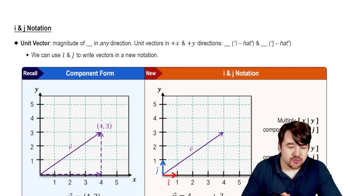
Vector Notation

Vector notation represents vectors using components along coordinate axes, typically written as ⟨x, y⟩. This concise form shows the horizontal and vertical parts of a vector, making it easier to perform operations like addition or scalar multiplication.
Video consigliato:

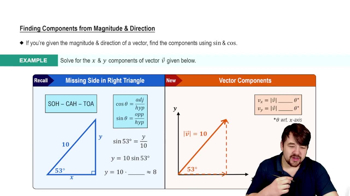
Vector Components and Direction

A vector's components correspond to its projections on the coordinate axes, determined by its magnitude and direction. Understanding how to resolve a vector into horizontal and vertical parts using trigonometric functions is essential for accurate representation.
Video consigliato:
Percorso guidato
04:55
Finding Components from Direction and Magnitude

Using Reference Figures for Vectors

Interpreting vectors from a figure involves identifying their initial and terminal points, direction, and length. This visual information helps translate the vector into component form, which is necessary for expressing it in vector notation.
Video consigliato:
Percorso guidato
5:31
Reference Angles on the Unit Circle