Ch. 7 - Applications of Trigonometry and Vectors
Lial - Trigonometry 12th Edition
Lial12th EditionTrigonometryISBN: 9780136552161, 9780135440780, 9780136881117, 9780135440827, 9780135924891Non è quello che usi tu?Cambia libro di testo
Capitolo 8, Problema 30a

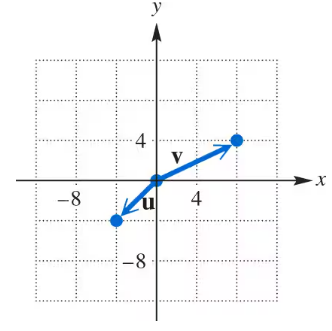
Use the figure to find each vector: u + v. Use vector notation as in Example 4.


Graph showing vectors u and v on an xy-plane with arrows from origin to points (-4,-4) and (4,4) respectively.

Guida verificata passo dopo passo
1
Identify the components of vectors \( \mathbf{u} \) and \( \mathbf{v} \) from the figure. Typically, each vector can be broken down into its horizontal (x) and vertical (y) components. For example, \( \mathbf{u} = (u_x, u_y) \) and \( \mathbf{v} = (v_x, v_y) \).
Write down the components of \( \mathbf{u} \) and \( \mathbf{v} \) explicitly. If the figure provides magnitudes and directions, use trigonometric functions to find components: \( u_x = |\mathbf{u}| \cos \theta_u \), \( u_y = |\mathbf{u}| \sin \theta_u \), and similarly for \( \mathbf{v} \).
Add the corresponding components of the two vectors to find the components of \( \mathbf{u} + \mathbf{v} \): \( (u_x + v_x, u_y + v_y) \). This is the vector sum in component form.
Express the resulting vector \( \mathbf{u} + \mathbf{v} \) in vector notation as \( \langle u_x + v_x, u_y + v_y \rangle \). This notation clearly shows the horizontal and vertical components of the sum.
Optionally, if needed, find the magnitude and direction of \( \mathbf{u} + \mathbf{v} \) using the formulas: magnitude \( = \sqrt{(u_x + v_x)^2 + (u_y + v_y)^2} \) and direction \( = \tan^{-1} \left( \frac{u_y + v_y}{u_x + v_x} \right) \).

Risposta video verificata per un problema simile:

Questa soluzione video è stata consigliata dai nostri tutor come utile per risolvere questo problema.

Concetti chiave

Ecco i concetti essenziali che devi comprendere per rispondere correttamente alla domanda.

Vector Addition

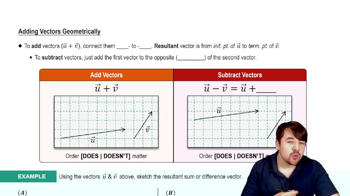
Vector addition involves combining two vectors to produce a resultant vector. This is done by adding their corresponding components or by placing the tail of the second vector at the head of the first and drawing the resultant from the tail of the first to the head of the second.
Video consigliato:
Percorso guidato
05:29
Adding Vectors Geometrically

Vector Notation

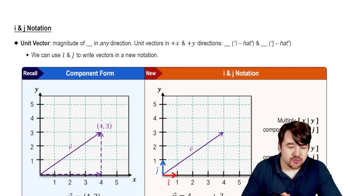
Vector notation typically represents vectors as ordered pairs or triples, such as u = <x, y>, indicating their components along coordinate axes. This notation simplifies calculations and clearly shows the direction and magnitude of vectors.
Video consigliato:

Component-wise Addition of Vectors

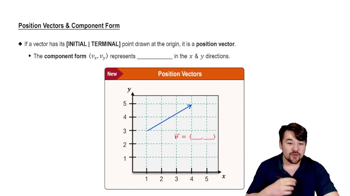
When adding vectors in component form, add their corresponding x-components and y-components separately. For example, if u = <u_x, u_y> and v = <v_x, v_y>, then u + v = <u_x + v_x, u_y + v_y>, which yields the resultant vector.
Video consigliato:
Percorso guidato
03:55
Position Vectors & Component Form