 뒤로
Bone Tissue Physiology: Structure, Function, Growth, and Repair
스터디 가이드 - 스마트 노트
 자료에 맞춘 맞춤형 노트, 핵심 정의, 예시, 맥락을 확장해 제공합니다.
Bone Tissue Physiology
Functions of Bones
Bones serve multiple essential functions in the human body, contributing to both structural integrity and physiological processes.
Support: Bones provide a framework that supports the body and maintains its shape.
Protection: Bones protect vital organs, such as the brain (protected by the skull) and heart/lungs (protected by the rib cage).
Assistance in Movement: Bones act as levers for muscles, enabling movement at joints.
Blood Cell Production: Red bone marrow is the site of hemopoiesis, producing red blood cells (RBCs), white blood cells (WBCs), and platelets.
Mineral Homeostasis: Bones store minerals, especially calcium and phosphorus, and release them into the bloodstream as needed.
Triglyceride Storage: Yellow bone marrow stores fat as triglycerides, serving as an energy reserve.
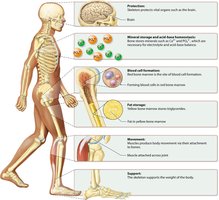
Storage & Blood Cell Production
Bones are critical for both mineral storage and blood cell production.
Red Bone Marrow: Site of hemopoiesis, producing RBCs, WBCs, and platelets.
Yellow Bone Marrow: Stores triglycerides (fat).
Mineral Storage: Bones store approximately 99% of the body's calcium and phosphorus.
Bone Matrix
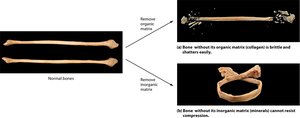
The bone matrix is a composite material that determines the strength and flexibility of bone.
Mineral Content: 50% calcium phosphate (), with other minerals like magnesium phosphate ().
Water: 25% of the matrix is water.
Collagen Fibers: 25% of the matrix is collagen, which provides flexibility and holds minerals in place.
Bone Cell Types
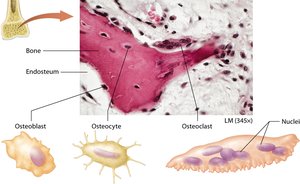
Bone tissue contains several specialized cell types, each with distinct functions.
Osteogenic Cells: Immature cells that differentiate into osteoblasts.
Osteoblasts: Bone-forming cells; remove calcium and phosphates from blood and deposit them into the extracellular matrix.
Osteocytes: Mature bone cells; former osteoblasts that have become embedded in bone, maintaining bone tissue and connecting to blood supply.
Osteoclasts: Multinucleated cells responsible for bone resorption; release calcium from bone back into the blood.
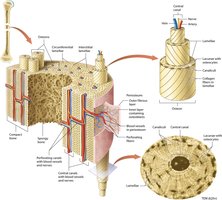
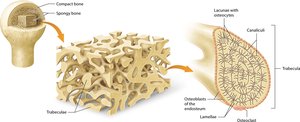
Bone Structure: Compact and Spongy Bone
Bones are composed of two main types of tissue: compact bone and spongy bone, each with unique structural features.
Compact Bone: Dense and strong, forms the outer layer of bones; organized into osteons (Haversian systems) with concentric lamellae, central canals, and canaliculi.
Spongy Bone: Less dense, found at the ends of long bones and inside flat bones; consists of trabeculae with spaces for marrow.
Bone vs Cartilage Comparison
Bones and cartilage are both connective tissues but differ in structure, function, and cellular composition.
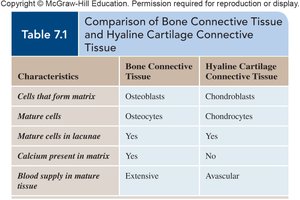
Characteristic | Bone Connective Tissue | Hyaline Cartilage Connective Tissue |
|---|---|---|
Cells that form matrix | Osteoblasts | Chondroblasts |
Mature cells | Osteocytes | Chondrocytes |
Mature cells in lacunae | Yes | Yes |
Calcium present in matrix | Yes | No |
Blood supply in mature tissue | Extensive | Avascular |
Cartilage Cells and Growth
Cartilage is formed and maintained by specialized cells and grows by two mechanisms.
Chondroblasts: Produce cartilage matrix; two cells per lacunae during growth.
Chondrocytes: Maintain cartilage; one cell per lacunae in mature cartilage.
Perichondrium: Dense irregular connective tissue surrounding cartilage, helping maintain its shape.
Interstitial Growth: Growth in length; chondrocytes divide and produce new matrix.
Appositional Growth: Growth in width; stem cells in perichondrium divide, some become chondroblasts and add new matrix to the surface.
Initial Bone Formation
Bone formation begins with the development of bone tissue from cartilage or fibrous tissue, a process known as ossification.
Bone Formation: Steps and Processes
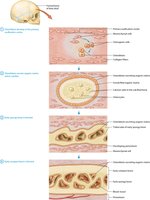
Bone formation occurs through two main processes: intramembranous ossification and endochondral ossification.
Intramembranous Ossification: Direct formation of bone from mesenchymal tissue, primarily in flat bones.
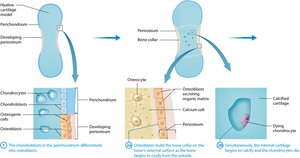
Endochondral Ossification: Bone forms by replacing hyaline cartilage, typical in long bones.
Growth of Bone
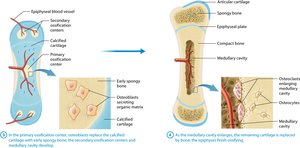
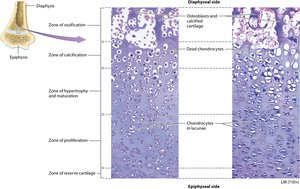
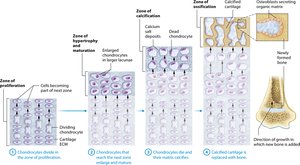
Bone growth occurs at the epiphyseal plate, where cartilage is replaced by bone tissue.
Epiphyseal Plate: Site of longitudinal bone growth; cartilage grows, becomes calcified, and is replaced by bone.
Osteoclasts: Dissolve calcified cartilage.
Osteoblasts: Replace dissolved cartilage with new bone.
Remodeling of Bone
Bone remodeling is a continuous process where old bone tissue is replaced by new tissue, maintaining bone strength and mineral homeostasis.
Osteoblasts: Build new bone; excessive activity can lead to overly thick bones.
Osteoclasts: Resorb bone; excessive activity can cause osteoporosis (weak bones) or osteomalacia (too flexible bones).
Bone Matrix Disorders
Disorders of the bone matrix affect bone strength and flexibility.
Osteoporosis: Characterized by decreased bone mass and increased fracture risk.
Osteomalacia: Bones become too flexible due to poor mineralization.
Factors Affecting Bone Calcium Density
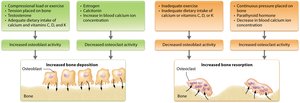
Bone calcium density is influenced by various factors, including diet, hormones, and physical activity.
Increased Bone Deposition: Stimulated by exercise, adequate calcium and vitamin D intake, and estrogen.
Increased Bone Resorption: Stimulated by continuous pressure, parathyroid hormone, and decreased calcium intake.
Repair of Fractures
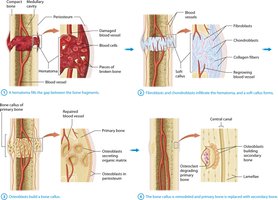
Bone repair after a fracture involves several stages:
Formation of Fracture Hematoma: Blood clot forms around the break.
Fibrocartilaginous Callus Formation: Fibroblasts produce collagen fibers, linking the bone ends.
Bony Callus Formation: Osteoblasts create spongy bone to unite the fracture.
Bone Remodeling: Compact bone replaces spongy bone, restoring original structure.
Types of Breaks in Bones
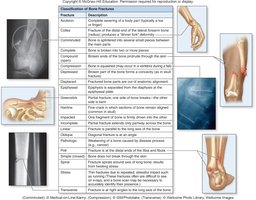
Bone fractures are classified based on their characteristics and severity.
Complete: Bone is broken all the way through.
Incomplete: Bone is only partially broken.
Closed (Simple): Bone does not pierce the skin.
Open (Compound): Bone pierces the skin.
Comminuted: Bone is broken into several pieces.
Greenstick: Bone bends and cracks, common in children.
Other types: Include spiral, transverse, oblique, and impacted fractures.
Review Questions: Bone Growth & Repair
Stages of Bone Growth: 1) Cartilage growth at epiphyseal plate, 2) Calcification, 3) Osteoclast dissolution, 4) Osteoblast bone formation.
Bone Repair Process: 1) Hematoma formation, 2) Fibrocartilaginous callus, 3) Bony callus, 4) Remodeling.
Causes of Osteoporosis: Excessive bone resorption, decreased bone deposition, hormonal changes, poor diet.
Calcium Resorption: Process by which osteoclasts release calcium from bone into the blood.
Cells Responsible for Calcium Resorption: Osteoclasts.
Additional info: Bone physiology is essential for understanding skeletal health, growth, and repair. Disorders such as osteoporosis and osteomalacia highlight the importance of balanced bone remodeling and mineral homeostasis.
