 뒤로
Cell Membranes and Transport: Structure and Function
스터디 가이드 - 스마트 노트
 자료에 맞춘 맞춤형 노트, 핵심 정의, 예시, 맥락을 확장해 제공합니다.
Cell Membranes and Transport
Plasma Membrane Structure
The plasma membrane is the cell's outermost boundary, crucial for maintaining cellular integrity and regulating the movement of substances. Its structure is primarily based on the phospholipid bilayer, which forms a flexible yet stable barrier between the cell's internal environment and the extracellular fluid (ECF).
Phospholipid Bilayer: Composed of amphiphilic phospholipids, with hydrophilic heads facing outward and inward, and hydrophobic tails sandwiched in between. This arrangement creates a selective barrier.
Fluid Mosaic Model: The membrane is dynamic, containing proteins, lipids, and carbohydrates that move and interact, allowing flexibility and adaptability.
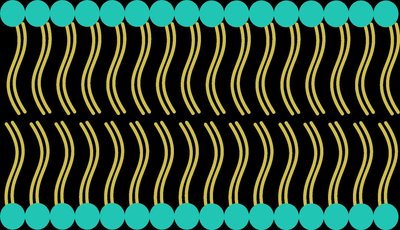
Additional info: The bilayer's polarity ensures that water-soluble substances are regulated, while lipid-soluble substances can pass more freely.
Membrane Proteins
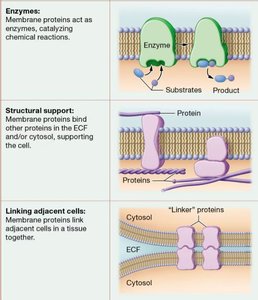
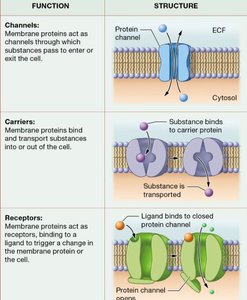
Membrane proteins are essential for the plasma membrane's function, providing structural support, facilitating transport, and enabling cell communication.
Integral Proteins: Span the entire membrane, often functioning as channels or carriers.
Peripheral Proteins: Attached to one side of the membrane, involved in signaling and structural support.
Functions:
Channels: Allow specific substances to pass through the membrane.
Carriers: Bind and transport substances across the membrane.
Receptors: Bind ligands (chemical messengers) to trigger cellular responses.
Enzymes: Catalyze reactions at the membrane surface.
Structural Support: Anchor the membrane to the cytoskeleton.
Linking Adjacent Cells: Connect cells in tissues.
Other Membrane Components
Besides phospholipids and proteins, the plasma membrane contains cholesterol, glycolipids, and glycoproteins, which contribute to membrane stability and cell recognition.
Cholesterol: Stabilizes membrane structure, especially during temperature changes.
Glycolipids & Glycoproteins: Involved in cell recognition and immune responses.
Example: Glycoproteins help the immune system distinguish self from non-self cells.
Transport Across the Plasma Membrane
Selective Permeability
The plasma membrane is selectively permeable, allowing certain substances to pass while restricting others. Transport mechanisms are classified as passive or active.
Passive Transport
Passive transport does not require cellular energy and relies on concentration gradients.
Diffusion: Movement of solute molecules from high to low concentration.
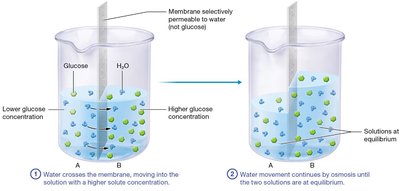
Osmosis: Movement of water (solvent) across a selectively permeable membrane from low to high solute concentration.
Factors Affecting Diffusion Rate:
Particle size
Phase (gas, liquid, solid)
Temperature
Concentration gradient
Medium and barriers
Types of Diffusion:
Simple Diffusion: Nonpolar solutes pass directly through the bilayer.
Facilitated Diffusion: Polar or charged solutes use channel or carrier proteins.
Osmosis
Osmosis is a passive process where water moves across the membrane to balance solute concentrations.
Water moves through aquaporins (water channels) or between phospholipids.
Volume changes occur as water moves between compartments.
Osmotic Pressure: The pressure required to prevent water movement by osmosis.
Hydrostatic Pressure: The force exerted by water on container walls.
Example: Reverse osmosis is used in water filtration systems.
Tonicity
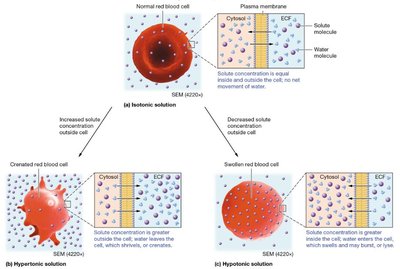
Tonicity compares the solute concentrations of two solutions, affecting cell volume and function.
Isotonic: Equal solute concentration; no net water movement.
Hypertonic: Higher solute concentration outside; cell loses water and shrivels (crenation).
Hypotonic: Lower solute concentration outside; cell gains water and may burst (lysis).
Summary Table: Diffusion and Osmosis
Process | Direction | Energy Required | Example |
|---|---|---|---|
Diffusion | High to low solute concentration | No | Oxygen entering cells |
Osmosis | Low to high solute concentration (water moves) | No | Water balance in red blood cells |
Active Transport | Low to high solute concentration | Yes (ATP) | Na⁺/K⁺ pump |
Active Transport via Membrane Proteins
Active transport requires energy (ATP) to move substances against their concentration gradient, using specialized protein pumps.
Pumps: Uniporters, antiporters, symporters
Primary Active Transport: Direct use of ATP; e.g., sodium-potassium pump (Na⁺/K⁺ pump)
Secondary Active Transport: Indirect use of ATP; one substance is actively transported, creating a gradient that drives passive transport of another substance.
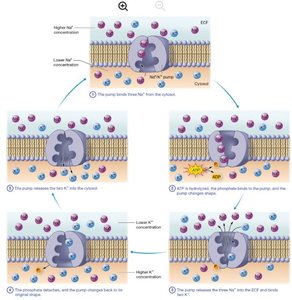
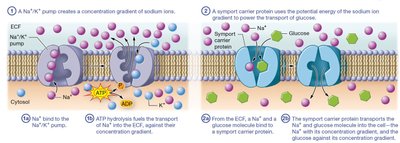
Example: Glucose absorption in intestinal cells uses secondary active transport.
Equation for ATP hydrolysis:
Electrophysiology and Membrane Potential
Electrical Potential and Membrane Potential
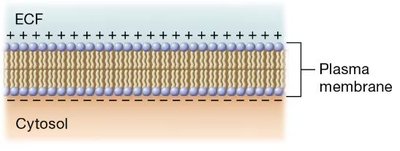
Cells maintain a separation of charges across the plasma membrane, creating an electrical potential (membrane potential) that is essential for nerve and muscle function.
Resting Membrane Potential: Typically -80 mV; cytosol is more negative than ECF.
Electrophysiology: Study of electrical properties in cells.
Vesicular Transport
Transport via Vesicles
Large particles are transported across the membrane in vesicles, requiring energy (ATP).
Endocytosis: Uptake of substances into the cell.
Phagocytosis: Ingestion of large particles (e.g., bacteria) by immune cells.
Pinocytosis: Uptake of extracellular fluid.
Receptor-mediated Endocytosis: Specific uptake of substances via receptors.
Exocytosis: Release of substances from the cell.
Transcytosis: Transport of substances across the cell, combining endocytosis and exocytosis.
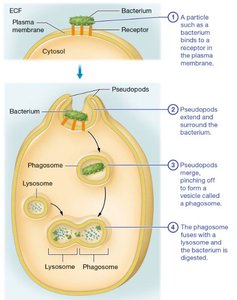
Example: Secretion of hormones and neurotransmitters occurs via exocytosis.
Applications in Anatomy & Physiology
Drugs and Membrane Receptors
Many drugs act as agonists or antagonists at membrane receptors, mimicking or inhibiting natural ligands.
Agonists: Mimic ligand actions (e.g., narcotic painkillers mimic endorphins).
Antagonists: Block ligand actions (e.g., antihistamines block histamine effects).
Dehydration and Cellular Water Balance
Dehydration affects cellular water content, with sports drinks providing electrolytes and water to restore balance. Severe dehydration may require medical intervention.
Sports drinks: Useful for mild dehydration.
Water poisoning: Excess water without electrolytes can cause cellular swelling.
Additional info: Understanding membrane transport is critical for clinical applications such as IV therapy and drug delivery.
