 뒤로
Fundamentals of the Nervous System and Nervous Tissue: Synapses and Signal Transmission
스터디 가이드 - 스마트 노트
 자료에 맞춘 맞춤형 노트, 핵심 정의, 예시, 맥락을 확장해 제공합니다.
Synapses and Neural Communication
Definition and Classification of Synapses
Synapses are specialized junctions where neurons communicate with other cells, such as neurons, muscle cells, or glands. This communication is essential for the transmission of signals throughout the nervous system.
Synapse: The site of communication between a neuron and its target cell.
Classification: Synapses are classified based on their location:
Axosomatic: Between an axon and a soma (cell body).
Axodendritic: Between an axon and a dendrite.
Axoaxonal: Between two axons.
Types of Synapses:
Electrical synapses: Involve direct ion flow through gap junctions; rapid and less common.
Chemical synapses: Use neurotransmitters to transmit signals; more common in the nervous system.
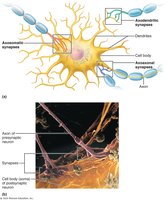
Structure of a Chemical Synapse
Chemical synapses consist of three main components that facilitate signal transmission:
Presynaptic terminal: Contains synaptic vesicles filled with neurotransmitters; releases the signal.
Synaptic cleft: A narrow space (30–50 nm) between the presynaptic and postsynaptic cells.
Postsynaptic membrane: Contains receptors for neurotransmitters; receives the signal.
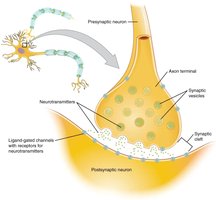
Steps of Synaptic Transmission
Sequence of Events in Chemical Synaptic Transmission
The transmission of a signal across a chemical synapse involves several coordinated steps:
Action potential arrives at the presynaptic axon terminal: The terminal membrane depolarizes.
Voltage-gated Ca2+ channels open: Calcium ions enter the presynaptic terminal.
Neurotransmitter release: Ca2+ triggers synaptic vesicle fusion and exocytosis, releasing neurotransmitter into the synaptic cleft.
Neurotransmitter diffusion: Neurotransmitter molecules diffuse across the synaptic cleft and bind to receptors on the postsynaptic membrane.
Postsynaptic response: Neurotransmitter binding causes receptor conformational changes, altering ion flow and generating graded potentials (EPSPs or IPSPs).
Termination of neurotransmitter effects: The signal ends by reuptake, enzymatic degradation, or diffusion away from the synaptic cleft.
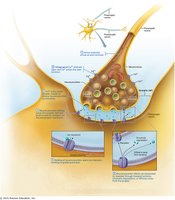
Mechanisms for Termination of Neurotransmitter Activity
Neurotransmitter activity at the synapse is terminated by several mechanisms:
Reuptake: Neurotransmitters are taken back into the presynaptic terminal or by neuroglia (e.g., astrocytes).
Degradation: Enzymes break down neurotransmitters in the synaptic cleft (e.g., acetylcholinesterase for acetylcholine).
Diffusion: Neurotransmitters diffuse away from the synaptic cleft.
Postsynaptic Potentials: EPSPs and IPSPs
Excitatory and Inhibitory Postsynaptic Potentials
Neurotransmitter binding to postsynaptic receptors produces graded potentials:
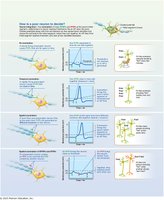
Excitatory Postsynaptic Potentials (EPSPs): Depolarize the postsynaptic membrane, increasing the likelihood of action potential generation.
Inhibitory Postsynaptic Potentials (IPSPs): Hyperpolarize the postsynaptic membrane, decreasing the likelihood of action potential generation.
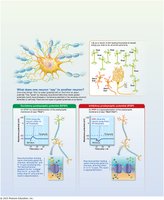
Effects of Excitatory and Inhibitory Neurotransmitters
Excitatory neurotransmitters: Promote depolarization and action potential generation (e.g., glutamate).
Inhibitory neurotransmitters: Promote hyperpolarization and inhibit action potential generation (e.g., GABA).
Summation of Graded Potentials
Temporal and Spatial Summation
Graded potentials can be summed to influence the strength of the postsynaptic signal and the cell's excitability:
Temporal summation: Multiple signals from a single presynaptic neuron occur in rapid succession.
Spatial summation: Signals from multiple presynaptic neurons occur simultaneously.
Neurotransmitters and Their Effects
Major Neurotransmitters in the Nervous System
Neurotransmitters are chemical messengers that transmit signals across synapses. Their effects depend on the type of receptor and the location in the nervous system.
Acetylcholine (Ach): Found in CNS and PNS; can be excitatory or inhibitory; involved in skeletal muscle contraction and autonomic function.
Norepinephrine (NE): Found in CNS and PNS; can be excitatory or inhibitory; involved in sympathetic nervous system responses (fight or flight).
Dopamine (DA): Found in CNS and PNS; can be excitatory or inhibitory; involved in movement control, reward, and motivation. Deficiency is linked to Parkinson’s disease.
Serotonin: Mainly inhibitory in CNS; involved in mood, sleep, and appetite. Drugs like SSRIs block its reuptake to relieve anxiety and depression.
GABA: Primarily inhibitory in CNS; major inhibitory neurotransmitter in the brain, reduces neuronal excitability.
Glutamate: Primarily excitatory in CNS; major excitatory neurotransmitter, involved in learning and memory. Excess can cause excitotoxicity.
Ligand-Gated Ion Channels
Mechanism of Ion Channel Activation
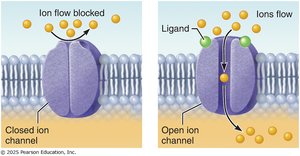
Ligand-gated ion channels are membrane proteins that open in response to neurotransmitter binding, allowing ions to flow across the membrane and change the cell's membrane potential.
Closed state: Ion flow is blocked.
Open state: Ligand (neurotransmitter) binds, channel opens, ions flow through.
Summary Table: Neurotransmitter Effects
Neurotransmitter | Location | Effect | Clinical Relevance |
|---|---|---|---|
Acetylcholine (Ach) | CNS & PNS | Excitatory or inhibitory | Skeletal muscle contraction, autonomic function |
Norepinephrine (NE) | CNS & PNS | Excitatory or inhibitory | Fight or flight response |
Dopamine (DA) | CNS & PNS | Excitatory or inhibitory | Movement, reward, Parkinson’s disease |
Serotonin | CNS | Mainly inhibitory | Mood, sleep, appetite, SSRIs |
GABA | CNS | Primarily inhibitory | Major inhibitory neurotransmitter |
Glutamate | CNS | Primarily excitatory | Learning, memory, excitotoxicity |
Additional info:
Parkinson’s disease is associated with dopamine deficiency in the basal ganglia.
SSRIs (Selective Serotonin Reuptake Inhibitors) are used to treat depression and anxiety by increasing serotonin levels.
Excitotoxicity refers to neuronal damage caused by excessive glutamate activity.
