 뒤로
뒤로Introduction to the Endocrine System: Hormones and Their Regulation
스터디 가이드 - 스마트 노트
 자료에 맞춘 맞춤형 노트, 핵심 정의, 예시, 맥락을 확장해 제공합니다.
Introduction to the Endocrine System
Overview of Endocrinology
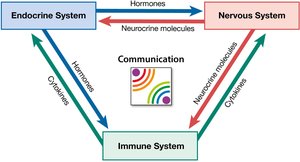
Endocrinology is the scientific study of hormones, which are chemical messengers responsible for regulating long-term, ongoing functions in the body. These include metabolism, regulation of the internal environment, reproduction, growth, and development. Hormones act by influencing enzymatic reactions, the transport of ions or molecules across cell membranes, and gene expression and protein synthesis.
Metabolism: Hormones regulate metabolic pathways and energy balance.
Homeostasis: Maintenance of a stable internal environment.
Growth and Development: Control of cell division, differentiation, and maturation.
Reproduction: Regulation of reproductive cycles and sexual development.
8.1 Hormones
Definition and Characteristics of Hormones
A hormone is a chemical signal secreted by a cell or group of cells into the blood, which is then transported to distant target tissues where it exerts its effects at very low concentrations. Hormones are distinct from pheromones, which are specialized ectohormones released into the external environment to affect other individuals.
Secretion: Hormones are secreted into the blood for systemic distribution.
Target Specificity: Only cells with specific receptors for a hormone will respond to its signal.
Low Concentration: Hormones are effective at very low concentrations.
Termination: Hormone action must be terminated, often by enzymatic breakdown or removal from the blood. The half-life of a hormone indicates its duration of activity.
Historical Perspective
Diseases of the endocrine system have been recognized since ancient times. The classic experimental steps to identify an endocrine gland and its hormone include removal of the suspected gland, replacement of the hormone, and creation of hormone excess to observe physiological effects.
8.2 The Classification of Hormones
Types of Hormones
Hormones are classified based on their chemical structure into three main groups: peptide/protein hormones, steroid hormones, and amino acid–derived (amine) hormones.
Peptide/Protein Hormones
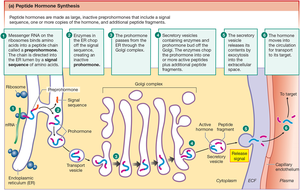
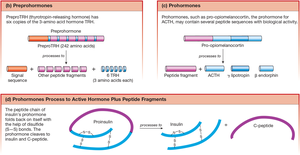
Synthesis: Synthesized as large, inactive precursors called preprohormones, which are processed to prohormones and then to active hormones.
Storage: Stored in secretory vesicles and released upon stimulation.
Transport: Water-soluble; travel freely in the blood.
Half-life: Short (minutes).
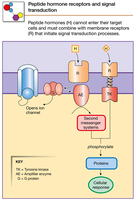
Mechanism of Action: Bind to cell surface receptors and initiate signal transduction pathways.
Steroid Hormones
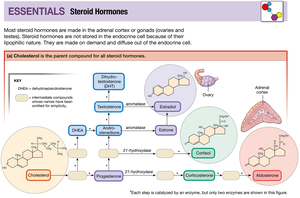
Origin: Derived from cholesterol; produced mainly in the adrenal cortex and gonads.
Synthesis: Synthesized on demand; not stored.
Transport: Lipid-soluble; require carrier proteins in the blood.
Half-life: Longer (hours).
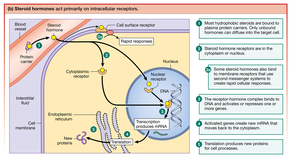
Mechanism of Action: Bind to intracellular (cytoplasmic or nuclear) receptors to alter gene expression; some act on membrane receptors for rapid effects.
Amino Acid–Derived (Amine) Hormones
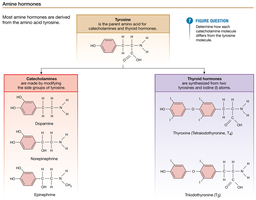
Derived from: Single amino acids, mainly tyrosine or tryptophan.
Catecholamines: (e.g., epinephrine, norepinephrine, dopamine) derived from tyrosine; act like peptide hormones.
Thyroid Hormones: Derived from two tyrosine molecules; act like steroid hormones.
Melatonin: Derived from tryptophan; secreted by the pineal gland.
Comparison Table: Peptide, Steroid, and Amine Hormones
Type | Synthesis & Storage | Transport | Half-life | Receptor Location | Examples |
|---|---|---|---|---|---|
Peptide/Protein | Preprohormone → Prohormone → Active hormone; stored in vesicles | Dissolved in plasma | Short (minutes) | Cell membrane | Insulin, glucagon, growth hormone |
Steroid | From cholesterol; synthesized on demand | Bound to carrier proteins | Long (hours) | Cytoplasm or nucleus (some membrane) | Cortisol, estrogen, testosterone |
Amine | From tyrosine or tryptophan | Catecholamines: dissolved; Thyroid: bound | Catecholamines: short; Thyroid: long | Catecholamines: membrane; Thyroid: nucleus | Epinephrine, thyroxine, melatonin |
8.3 Control of Hormone Release
Reflex Pathways and Regulation
Hormone release is controlled by reflex pathways that include a stimulus, sensor, input signal, integration center, output signal, target(s), and response. In simple endocrine reflexes, the endocrine cell itself acts as the sensor and integration center. Many endocrine reflexes are integrated with the nervous system, and neurohormones are hormones secreted by neurons into the blood.
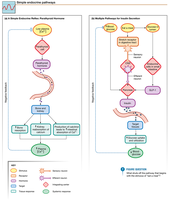
The Pituitary Gland
Posterior Pituitary: Composed of neural tissue; stores and releases two neurohormones (vasopressin/ADH and oxytocin) produced in the hypothalamus.
Anterior Pituitary: True endocrine gland; secretes six hormones (prolactin, growth hormone, FSH, LH, TSH, ACTH) regulated by hypothalamic hormones via the hypothalamic-hypophyseal portal system.
Trophic Hormones: Stimulate secretion of other hormones.
Feedback Regulation
Long-loop negative feedback: Peripheral gland hormone inhibits both pituitary and hypothalamic hormones.
Short-loop negative feedback: Pituitary hormone inhibits hypothalamic hormone.
Ultra-short-loop negative feedback: Autocrine/paracrine regulation within hypothalamus or pituitary.
8.4 Hormone Interactions
Types of Hormone Interactions
Synergism: Combined effect of hormones is greater than additive.
Permissiveness: One hormone allows another to exert its full effect.
Antagonism: One hormone opposes the action of another (e.g., insulin vs. glucagon).
8.5 Endocrine Pathologies
Types of Endocrine Disorders
Hypersecretion: Excess hormone, often due to tumors or medical treatment; may cause gland atrophy due to negative feedback.
Hyposecretion: Deficient hormone, due to gland atrophy or lack of synthesis materials; leads to overproduction of trophic hormones due to loss of negative feedback.
Abnormal Tissue Responsiveness: Due to receptor down-regulation, nonfunctional receptors, or signal transduction defects.
Diagnosis of Endocrine Pathologies
Primary pathology: Problem in the last endocrine gland in the pathway.
Secondary pathology: Problem in the pituitary gland.
Tertiary pathology: Problem in the hypothalamus.
8.6 Hormone Evolution
Evolutionary Aspects of Hormones
Hormone function is evolutionarily conserved across species. Comparative endocrinology studies hormone function in nonhuman species to understand their roles in humans. Some structures, such as the intermediate lobe of the pituitary, are vestigial in humans.
Proteomics: Used to determine physiological roles of hormones.
Examples: Calcitonin, pineal gland, and melatonin.
