 뒤로
Organic Compounds: Lipids, Proteins, and Nucleic Acids in Anatomy & Physiology
스터디 가이드 - 스마트 노트
 자료에 맞춘 맞춤형 노트, 핵심 정의, 예시, 맥락을 확장해 제공합니다.
Organic Compounds in Anatomy & Physiology
Lipids
Lipids are a diverse group of organic compounds that include fats, oils, phospholipids, and steroids. They are essential for energy storage, cellular structure, and signaling. Lipids contain carbon, hydrogen, and oxygen, but are nonpolar and hydrophobic due to their low oxygen content.
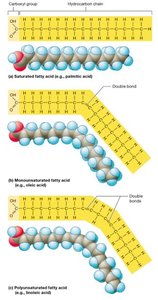
Fatty Acids: The basic monomer of lipids, consisting of a hydrocarbon chain (4–20 carbons) with a carboxylic acid group (-COOH).
Saturated Fatty Acids: No double bonds between carbons; saturated with hydrogen; solid at room temperature; found in animal fats.
Monounsaturated Fatty Acids: One double bond; chain bends; lower melting point; liquid at room temperature; found in olive and peanut oils.
Polyunsaturated Fatty Acids: Two or more double bonds; liquid at room temperature; lower melting point.
Example: Fatty acids are classified based on the number of double bonds in their hydrocarbon chain.
Triglycerides
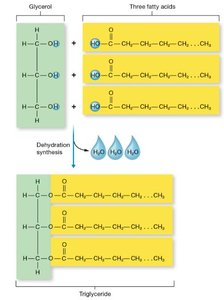
Triglycerides are the main form of stored fat in the body. They are formed by linking three fatty acids to a glycerol molecule through dehydration synthesis, resulting in a neutral fat.
Glycerol: A three-carbon alcohol that serves as the backbone for triglycerides.
Dehydration Synthesis: The process by which three fatty acids are joined to glycerol, releasing water molecules.
Function: Energy storage and insulation.
Phospholipids
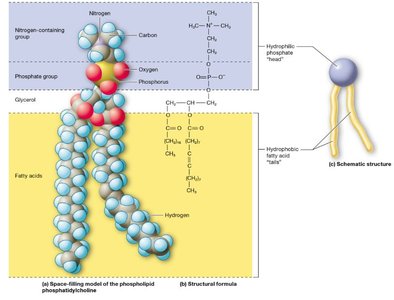
Phospholipids are major components of cell membranes. They consist of a glycerol backbone, two fatty acid tails (nonpolar), and a phosphate group (polar). Their amphiphilic nature allows them to form bilayers, controlling what enters and leaves cells.
Hydrophilic Head: The phosphate group is polar and interacts with water.
Hydrophobic Tails: The fatty acid chains are nonpolar and repel water.
Amphiphilic: Having both polar and nonpolar regions.
Steroids
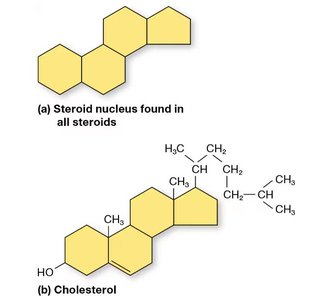
Steroids are lipids with a four-ring hydrocarbon structure known as the steroid nucleus. Cholesterol is a key steroid, serving as the precursor for bile acids, estrogen, and testosterone.
Cholesterol: Essential for cell membrane structure and hormone synthesis.
Nonpolar: Most steroids are nonpolar and insoluble in water.
Proteins
Amino Acids and Peptide Bonds
Proteins are macromolecules composed of amino acids linked by peptide bonds. They serve structural, enzymatic, defensive, communicative, and contractile functions in the body.
Amino Acids: 21 types, each with a central carbon bonded to a hydrogen, amino group, carboxylic acid group, and a variable R group.
Peptide Bond: A polar covalent bond formed by dehydration synthesis between amino acids.
Peptides: Chains of amino acids; dipeptides (2), tripeptides (3), polypeptides (10+).
Protein Structure
Protein structure is hierarchical and determines function:
Primary Structure: Sequence of amino acids in a polypeptide.
Secondary Structure: Folding into alpha helices (spring-like) or beta-pleated sheets (blinds-like).
Tertiary Structure: Further folding into a three-dimensional shape, stabilized by interactions between R groups.
Quaternary Structure: Assembly of multiple polypeptide chains.
Fibrous Proteins: Long, mostly nonpolar strands; provide structural support.
Globular Proteins: Spherical, mostly polar; function as enzymes, hormones, and messengers.
Protein Denaturation
Denaturation is the loss of protein structure and function due to heat, pH changes, or chemicals disrupting bonds.
Causes: Heat, pH, chemicals.
Effect: Loss of biological activity.
Sickle Cell Anemia
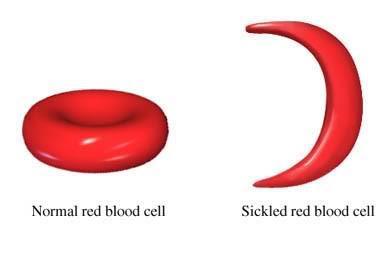
Sickle cell anemia is caused by a single amino acid change in hemoglobin, resulting in abnormal red blood cell shape and impaired oxygen transport.
Normal vs. Sickled Cells: Normal cells are disc-shaped; sickled cells are crescent-shaped.
Impact: Reduced oxygen delivery and health complications.
Nucleotides and Nucleic Acids
Nucleotides
Nucleotides are the monomers of nucleic acids, consisting of a nitrogenous base, a five-carbon sugar (ribose or deoxyribose), and a phosphate group.
Nitrogenous Bases: Purines (adenine, guanine) and pyrimidines (cytosine, thymine, uracil).
Function: Form DNA and RNA; play a role in ATP production.
Nucleic Acids: DNA and RNA
DNA and RNA are polymers of nucleotides that store and transmit genetic information.
DNA: Double-stranded, contains deoxyribose, bases are adenine, guanine, cytosine, and thymine; forms a double helix; exhibits complementary base pairing.
RNA: Single-stranded, contains ribose, bases are adenine, guanine, cytosine, and uracil; found throughout the cell.
Gene: A segment of DNA coding for a specific protein.
Adenosine Triphosphate (ATP)
ATP is the primary energy carrier in cells. It is hydrolyzed to ADP, releasing energy for cellular processes. ATP must be replenished frequently due to its rapid turnover.
Structure: Adenine base, ribose sugar, three phosphate groups.
Function: Provides energy for cellular activities.
Comparison of Organic Compound Types
Compound Type | Monomer | Structure | Function | Examples |
|---|---|---|---|---|
Lipids | Fatty acids | Hydrocarbon chains, glycerol backbone | Energy storage, cell membranes, hormones | Triglycerides, phospholipids, steroids |
Proteins | Amino acids | Polypeptide chains, folded structures | Enzymes, structure, defense, communication | Collagen, hemoglobin, enzymes |
Nucleic Acids | Nucleotides | Long chains of nucleotides | Genetic information, protein synthesis | DNA, RNA |
Key Terms and Concepts
Fatty Acid
Saturated/Monounsaturated/Polyunsaturated Fatty Acids
Glycerol
Triglyceride
Phospholipid
Steroid
Protein
Amino Acid
Peptide Bond
Primary/Secondary/Tertiary/Quaternary Structure
Denaturation
Nucleotide
DNA/RNA
ATP
Practice Application
Which types of nitrogenous bases are found in DNA? Adenine, Guanine, Cytosine, Thymine
Which types of nitrogenous bases are found in RNA? Adenine, Guanine, Cytosine, Uracil
A&P in the Real World
Omega-3 Fats: Essential, found in flaxseed and fish oil; beneficial for cardiovascular health.
Saturated Fats: Found in animal fats; overconsumption linked to heart disease.
Trans Fats: Artificially hydrogenated oils; increase risk of heart disease.
Equations and Formulas
General formula for glucose:
General formula for a fatty acid:
Dehydration synthesis (formation of peptide bond):
ATP hydrolysis:
Additional info: Expanded explanations and context were added to ensure completeness and academic quality for exam preparation.
