 뒤로
Respiratory Physiology: Ventilation and Pulmonary Mechanics
스터디 가이드 - 스마트 노트
 자료에 맞춘 맞춤형 노트, 핵심 정의, 예시, 맥락을 확장해 제공합니다.
Respiratory Physiology: Ventilation
Overview of Breathing
Breathing, or pulmonary ventilation, is a fundamental process in human physiology that involves the movement of air into and out of the lungs. It consists of two main components:
Ventilation: The physical movement of air in and out of the lungs.
Respiration: The exchange of gases (oxygen and carbon dioxide) between the lungs and the blood.
Mechanics of Ventilation
Ventilation is divided into two phases:
Inspiration (Inhalation): The process of drawing air into the lungs. It is an active process requiring muscular contraction.
Expiration (Exhalation): The process of expelling air from the lungs. It can be passive (during quiet breathing) or active (during forced breathing).
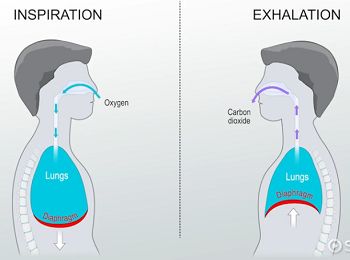
Types of Ventilation
Quiet Breathing (Eupnea): Normal, relaxed breathing. Inspiration is active (diaphragm and external intercostals contract), expiration is passive (muscles relax, lungs recoil).
Forced Breathing (Hyperpnea): Deep, vigorous breathing. Both inspiration and expiration are active, involving accessory muscles.
Muscles of Ventilation
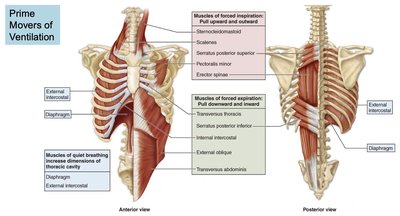
Prime Movers in Breathing
The muscles involved in ventilation change the volume of the thoracic cavity, which drives air movement.
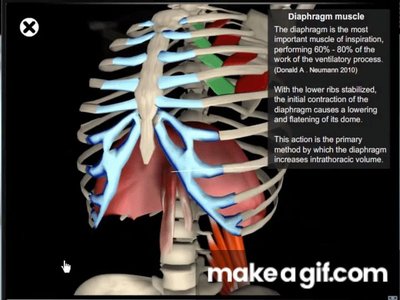
Diaphragm: The primary muscle for inspiration, responsible for most of the work during quiet breathing.
External Intercostals: Assist in elevating the ribs during inspiration.
Accessory Muscles: Used during forced breathing, including sternocleidomastoid, scalenes, and abdominal muscles.
Ventilation & Volume Changes
Thoracic Cavity Volume and Air Movement
Ventilation is achieved by altering the volume of the thoracic cavity:
Inspiration: Thoracic volume increases, pressure decreases, air enters the lungs.
Expiration: Thoracic volume decreases, pressure increases, air exits the lungs.
Boyle’s Law
Boyle’s Law describes the inverse relationship between gas pressure and volume:
As volume increases, pressure decreases.
As volume decreases, pressure increases.
Equation: (where P = pressure, V = volume, k = constant) 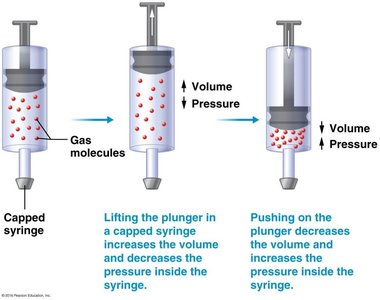
Pressure Gradients and Air Flow
Movement of Gases
Gases move from areas of high pressure to areas of low pressure. This principle drives air into and out of the lungs during ventilation. 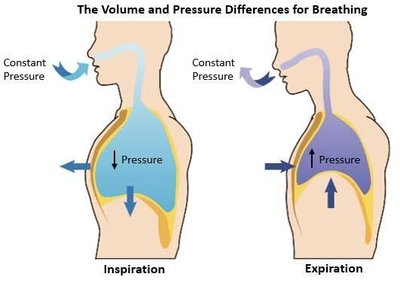
Ventilation Pressures
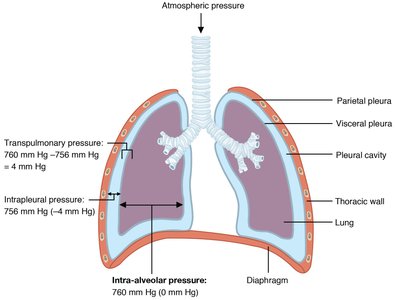
Atmospheric Pressure (Patm): Pressure exerted by air around the body, typically 760 mm Hg at sea level.
Intrapulmonary Pressure (Ppul): Pressure within the alveoli, varies with breathing.
Intrapleural Pressure (Pip): Pressure within the pleural cavity, usually negative relative to Patm.
Forces That Shape the Lungs
Inward and Outward Forces
Inward Forces: Elasticity and surface tension tend to collapse the lungs.
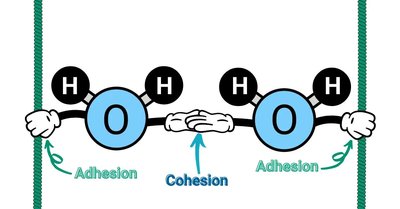
Outward Forces: Negative intrapleural pressure and pleural fluid cohesion keep the lungs open.
Transpulmonary Pressure
The difference between intrapulmonary and intrapleural pressure keeps the lungs inflated: Equation:
As long as Ppul > Pip, lungs remain open.
Pneumothorax
Pneumothorax occurs when air enters the pleural cavity, equalizing Pip and Ppul, causing lung collapse. 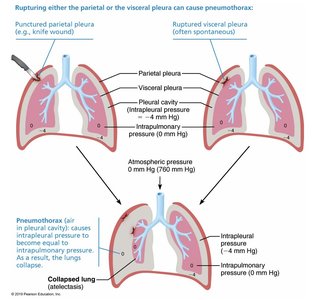
Air Flow and Resistance
Air Flow Equation
Air flow in the lungs is determined by the pressure gradient and airway resistance: Equation:
F = Air flow
ΔP = Pressure gradient
R = Resistance
Factors Affecting Pulmonary Ventilation
Airway Resistance: Greatest in medium-sized bronchi; regulated by smooth muscle contraction.
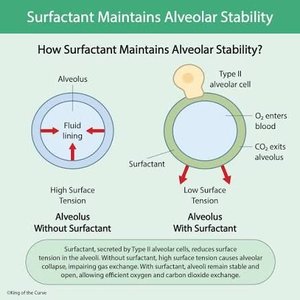
Alveolar Surface Tension: Reduced by surfactant, preventing alveolar collapse.
Lung Compliance: The ease with which lungs can be inflated; high compliance means easy inflation.
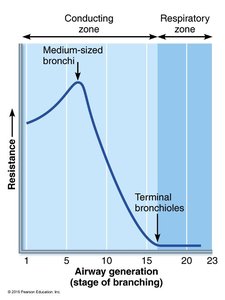
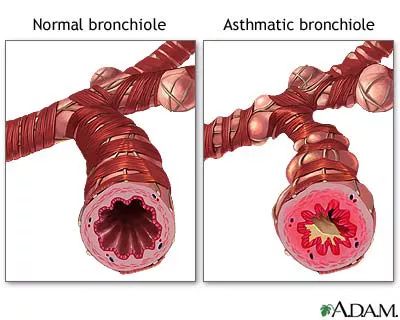
Airway Diameter and Asthma
Parasympathetic stimulation causes bronchoconstriction (decreases diameter, increases resistance).
Sympathetic stimulation causes bronchodilation (increases diameter, decreases resistance).
Asthma causes extreme bronchoconstriction, reducing airflow; β2 agonists are used for treatment.
Alveolar Surface Tension and Surfactant
Role of Surfactant
Surfactant, produced by type II alveolar cells, reduces surface tension in alveoli.
Prevents alveolar collapse and ensures efficient gas exchange.
Lung Compliance
Definition and Importance
Compliance: The measure of how easily the lungs can be inflated.
Healthy lungs have high compliance, making breathing efficient.
Poor compliance results in stiff lungs, making breathing difficult.
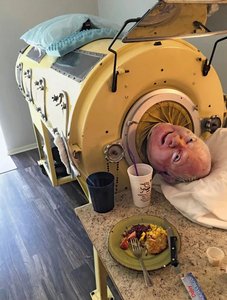
Clinical Application: The Iron Lung
Mechanical Ventilation
The iron lung was used for patients with paralyzed diaphragms, such as those affected by polio. It changes chamber volume and pressure to simulate breathing.
Decreasing chamber volume increases pressure, forcing exhalation.
Increasing chamber volume decreases pressure, causing inhalation.
Summary Table: Factors Affecting Pulmonary Ventilation
Factor | Effect | Clinical Relevance |
|---|---|---|
Airway Resistance | Decreases airflow as resistance increases | Asthma, bronchoconstriction |
Alveolar Surface Tension | Surfactant reduces tension, prevents collapse | Respiratory distress syndrome |
Lung Compliance | High compliance = easy inflation | Fibrosis, emphysema |
Additional info: Academic context was added to clarify the mechanics of ventilation, the role of pressures, and clinical implications such as pneumothorax and asthma.
