 뒤로
Study Guide: Nervous Tissue and Nervous System
스터디 가이드 - 스마트 노트
 자료에 맞춘 맞춤형 노트, 핵심 정의, 예시, 맥락을 확장해 제공합니다.
Nervous System Overview
Intracranial Regulation
Intracranial regulation (ICR) refers to the mechanisms and conditions that maintain a balance within the skull, promoting optimal brain function. This includes regulation of the brain, circulatory system, and dura mater. Proper ICR is essential for maintaining homeostasis and supporting cognitive and motor functions.
Functions of the Nervous System
The nervous system is the master controlling and communicating system of the body. It uses electrical and chemical signals to communicate rapidly and specifically, usually causing immediate responses.
Sensory Input: Information gathered by sensory receptors about internal and external changes.
Integration: Processing and interpretation of sensory input.
Motor Output: Activation of effector organs (muscles and glands) to produce a response.
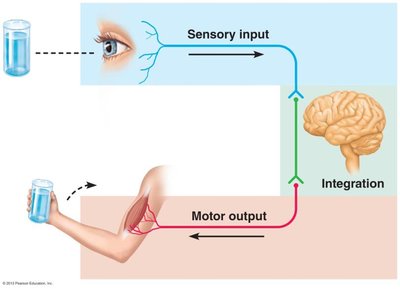
Divisions of the Nervous System
Central and Peripheral Nervous Systems
Central Nervous System (CNS): Consists of the brain and spinal cord; serves as the integration and control center.
Peripheral Nervous System (PNS): Composed of nerves outside the CNS; connects the CNS to the rest of the body.
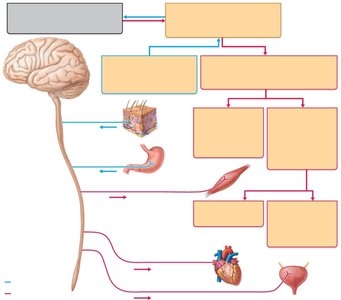
Functional Divisions of the PNS
Sensory (Afferent) Division: Transmits sensory information to the CNS.
Motor (Efferent) Division: Transmits impulses from the CNS to effector organs.
Somatic Nervous System: Voluntary control of skeletal muscles.
Autonomic Nervous System (ANS): Involuntary control of cardiac muscle, smooth muscle, and glands.
Sympathetic Division: Mobilizes body systems during activity.
Parasympathetic Division: Conserves energy and promotes housekeeping functions during rest.
Histology of Nervous Tissue
Cell Types
Nervous tissue is highly cellular with little extracellular space. It consists of two principal cell types:
Neurons: Excitable cells that transmit electrical signals.
Neuroglia (Glial Cells): Support and protect neurons.
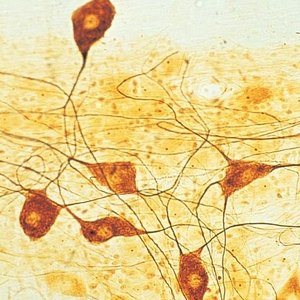
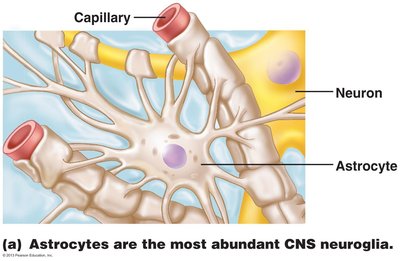
Neuroglia of the CNS
Astrocytes: Most abundant, versatile; provide structural support, maintain homeostasis, form blood-brain barrier, clear synapses, and form glial scars.
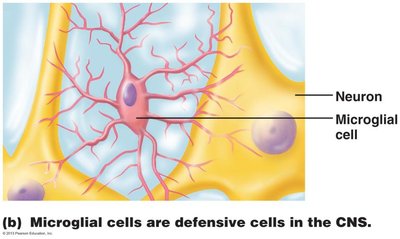
Microglial Cells: Small, defensive cells; act as macrophages, secrete cytotoxins, and present antigens.
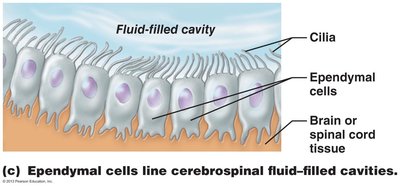
Ependymal Cells: Line cerebrospinal fluid-filled cavities; form a permeable barrier and secrete CSF.
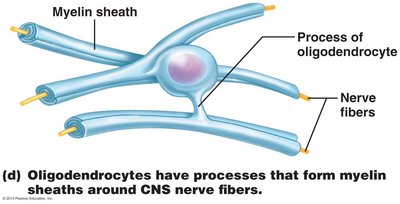
Oligodendrocytes: Branched cells that form myelin sheaths around CNS nerve fibers.
Neuroglia of the PNS
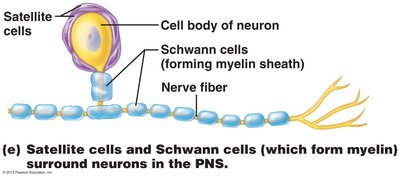
Satellite Cells: Surround neuron cell bodies in the PNS.
Schwann Cells: Surround all peripheral nerve fibers and form myelin sheaths; aid in regeneration of damaged fibers.
Myelin Sheath
Structure and Function
Myelin: Whitish, protein-lipoid substance forming segmented sheaths around axons.
Function: Protects and electrically insulates axons, increases speed of impulse transmission.
Nodes of Ranvier: Gaps between adjacent Schwann cells where axon collaterals can emerge.
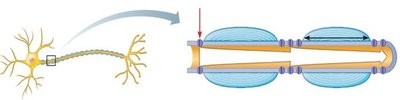
White Matter: Regions with dense collections of myelinated fibers.
Gray Matter: Mostly neuron cell bodies and nonmyelinated fibers.
Neurons
General Properties
Extreme Longevity: Can live over 100 years.
Amitotic: Do not divide after maturity.
High Metabolic Rate: Require continuous supply of oxygen and glucose.
Neuron Structure
Cell Body: Biosynthetic center; synthesizes proteins, membranes, and chemicals.
Dendrites: Short, branched processes; receptive region; convey messages toward cell body.
Axon: Single, long process; conducting region; transmits impulses away from cell body.
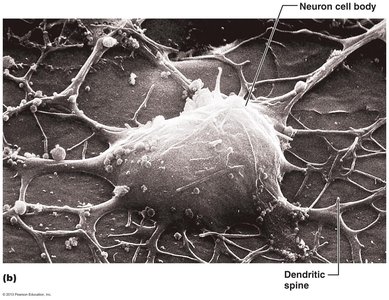
Neuron Processes
Dendrites: Input region; receive signals.
Axons: Output region; transmit signals to other neurons or effectors.
Classification of Neurons
Structural Classification
Multipolar: Three or more processes; most common.
Bipolar: Two processes; rare, found in special senses.
Unipolar: One short process; found mainly in PNS.
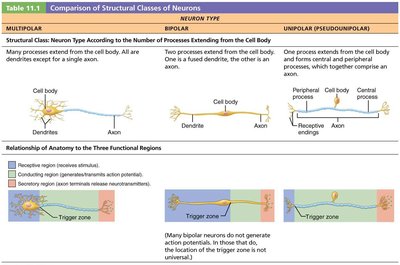
Functional Classification
Sensory (Afferent): Transmit impulses toward CNS; mostly unipolar.
Motor (Efferent): Carry impulses from CNS to effectors; mostly multipolar.
Interneurons: Shuttle signals between sensory and motor neurons; mostly multipolar, confined to CNS.
Neuronal Signaling
Membrane Potentials
Resting Membrane Potential: Potential difference across membrane of resting cell; typically –70 mV in neurons.
Depolarization: Decrease in membrane potential; inside becomes less negative.
Hyperpolarization: Increase in membrane potential; inside becomes more negative.
Types of Channels
Chemically Gated Channels: Open in response to binding of neurotransmitter.
Voltage Gated Channels: Open in response to changes in membrane potential.
Mechanically Gated Channels: Open in response to physical deformation.
Action Potential
All-or-None Principle: Action potentials are always the same regardless of stimulus intensity.
Threshold: Minimum depolarization required to trigger an action potential.
Refractory Period: Time during which neuron cannot respond to another stimulus.
Graded vs Action Potentials
Feature | Graded Potential | Action Potential |
|---|---|---|
Type | Depolarization or hyperpolarization | Depolarization |
Duration | Short, short-distance | Short, long-distance |
Summation | Can be summed | No summation |
Refractory Period | None | Absolute and relative |
Amplitude | Diminishes | Does not diminish |
Trigger | External stimuli or neurotransmitters | Graded potential |
Location | Dendrites and cell body | Axon |
Sodium-Potassium Pump
Function: Restores ionic conditions after repolarization.
Equation:
Conduction Velocity
Axon Diameter: Larger diameter fibers conduct impulses faster.
Degree of Myelination: Myelinated axons conduct impulses faster via saltatory conduction (jumping from node to node).
Synapses
Types of Synapses
Electrical Synapses: Neurons are electrically coupled via gap junctions; more common in embryonic tissue.
Chemical Synapses: Specialized for release and reception of neurotransmitters; involve synaptic cleft, presynaptic and postsynaptic neurons.
Neurotransmitters
Biogenic Amines: Dopamine, norepinephrine, epinephrine.
Amino Acids: Glutamate, aspartate.
Purines: ATP, adenosine.
Peptides: Endorphins.
Endocannabinoids: Act at same receptors as THC.
Gases and Lipids: Nitric oxide, carbon monoxide, hydrogen sulfide.
Acetylcholine (ACh): Released at neuromuscular junctions, some CNS and ANS neurons; degraded by acetylcholinesterase.
Neurotransmitter Receptors
Channel-Linked Receptors: Mediate fast synaptic transmission.
G Protein-Linked Receptors: Mediate slow, prolonged responses.
Neural Integration and Processing
Patterns of Neural Processing
Serial Processing: Input travels along one pathway; produces specific, anticipated response (e.g., spinal reflexes).
Parallel Processing: Input travels along several pathways; promotes numerous responses; important for higher-level mental functioning.
Reflex Arc
Components: Stimulus, receptor, sensory neuron, integration center, motor neuron, effector, response.
Key Terms and Concepts
Amitotic: Cells that do not undergo mitosis after maturity.
Processes: Extensions from the neuron cell body (dendrites and axons).
Multipolar Neuron: Most common structural type.
Motor Neuron: Most common functional type.
Summary Table: Structural Classes of Neurons
Neuron Type | Processes | Location |
|---|---|---|
Multipolar | 3 or more (dendrites + axon) | Most common in CNS |
Bipolar | 1 dendrite, 1 axon | Special senses (retina, olfactory) |
Unipolar | Single short process | Mainly in PNS |
