 뒤로
Study Guide: The Respiratory System (Anatomy & Physiology)
스터디 가이드 - 스마트 노트
 자료에 맞춘 맞춤형 노트, 핵심 정의, 예시, 맥락을 확장해 제공합니다.
The Respiratory System
Functions of the Respiratory System
The respiratory system is essential for gas exchange, sound production, and olfaction. It also plays a role in regulating blood pH.
Supply O2 and eliminate CO2: Oxygen is brought into the body and carbon dioxide is expelled.
Regulation of blood pH: By controlling CO2 levels, the respiratory system helps maintain acid-base balance.
Sound production: Air movement through the larynx produces sounds for vocalization.
Olfaction: The sense of smell is facilitated by olfactory receptors in the nasal cavity.
Basic Processes of Respiration
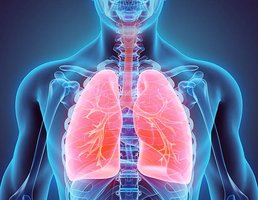
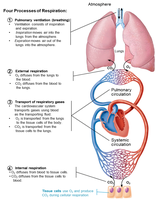
Respiration involves several distinct processes that together ensure efficient gas exchange and transport.
Ventilation: The movement of air into (inspiration) and out of (expiration) the lungs.
External respiration: Diffusion of gases between alveolar air and pulmonary blood.
Blood gas transport: Mechanisms for transporting O2 and CO2 in the bloodstream.
Internal respiration: Diffusion of gases between tissue capillaries and interstitial fluid.
Organization of the Respiratory System
Organs of the Respiratory Tract
The respiratory tract consists of several organs that conduct air and facilitate gas exchange.
Nose
Pharynx
Larynx
Trachea
Bronchial tree: Includes bronchi, bronchioles, terminal bronchioles, and respiratory bronchioles
Lungs: Contain alveoli, the primary site of gas exchange
Functional Divisions
The respiratory system is divided into conducting and respiratory passages based on their function.
Conducting passages: Carry air but do not participate in gas exchange. Includes nose, pharynx, trachea, larynx, bronchi, bronchioles, and terminal bronchioles.
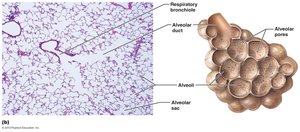
Respiratory passages: Sites of gas exchange. Includes respiratory bronchioles, alveolar ducts, and alveoli.
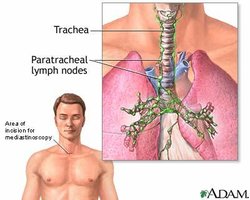
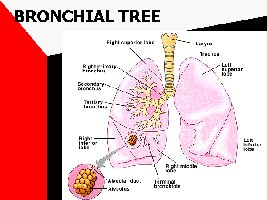
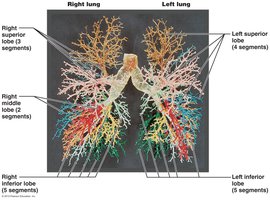
Organs of the Respiratory System
The Nose
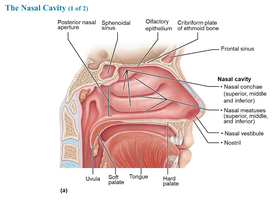
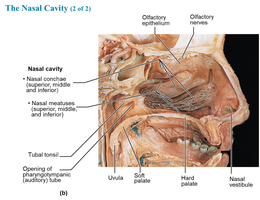
The nose is the primary entryway for air and serves several important functions.
Airway for ventilation: Allows air to enter and exit the respiratory system.
Moistens, warms, and filters air: Prepares air for entry into the lungs.
Resonating chamber for speech: Contributes to vocal quality.
Olfactory receptors: Located in the nasal cavity for the sense of smell.
Trachea
The trachea is a tube that connects the larynx to the bronchi and is located anterior to the esophagus.
Location: Extends from the inferior larynx (C6) and divides at T5 to form the primary bronchi.
Position: Lies in the midline of the thorax; lower portion is in the mediastinum.
Bronchial Tree
The bronchial tree is a branching system of airways within the lungs, ending in alveoli where gas exchange occurs.
Primary bronchi: Branch from the trachea into each lung.
Secondary and tertiary bronchi: Further subdivisions within the lungs.
Bronchioles: Smallest airways leading to alveolar ducts and alveoli.
Histology of the Respiratory System
Alveoli and the Respiratory Membrane
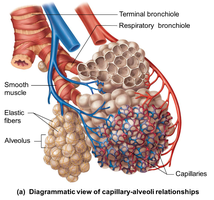
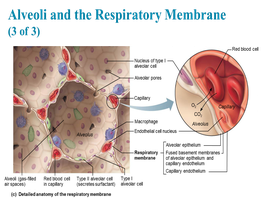
Alveoli are the primary sites of gas exchange and are composed of specialized cells.
Type I cells: Simple squamous epithelium forming the alveolar wall.
Type II cells: Cuboidal cells that secrete surfactant, reducing surface tension.
Macrophages (dust cells): Remove debris and pathogens.
Alveolar sacs: Clusters of alveoli.
Alveolar pores: Connect adjacent alveoli, equalizing air pressure.
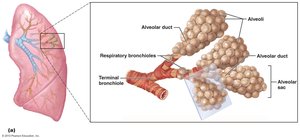
Lung Tissue
Lung tissue is primarily elastic connective tissue, allowing expansion and recoil during breathing. The bronchial tree and alveoli are embedded within this tissue.
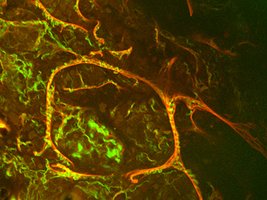
Elastic fibers: Provide stretch and recoil.
Collagen fibers: Provide structural support.
Blood supply: Pulmonary circulation oxygenates blood; bronchial pathway nourishes lung tissue.
Pulmonary Circulation | Bronchial Pathway |
|---|---|
Right ventricle → pulmonary arteries → pulmonary capillary networks → pulmonary veins → left atrium | Aorta → bronchial arteries → pulmonary capillaries → bronchial veins → superior vena cava/right atrium |
Pleura and Nerve Supply
Pleura
The pleura are serous membranes surrounding each lung, consisting of the parietal pleura, visceral pleura, and pleural cavity.
Pleural fluid: Reduces friction and facilitates lung movement.
Surface tension: Draws the surface of the lungs to the thoracic wall.
Nerve Supply to the Lungs
The lungs receive autonomic innervation that regulates airway diameter and mucus secretion.
Sympathetic Nervous System (SNS): Dilates bronchioles and inhibits mucus secretion.
Parasympathetic Nervous System (PNS): Constricts bronchioles and stimulates mucus secretion.
The Respiratory Membrane
Structure and Function
The respiratory membrane is the diffusion barrier for O2 and CO2 between alveolar air and blood during external respiration.
Alveolar endothelium: Simple squamous alveolar epithelium.
Basal lamina: Fused basement membranes of alveolar epithelium and capillary endothelium.
Capillary endothelium: Simple squamous capillary epithelium.
Rate of diffusion: Depends on the solubility of the gas in plasma and characteristics of the respiratory membrane.
Fick's Law of Diffusion: The rate of gas diffusion across a membrane is proportional to the surface area and concentration gradient, and inversely proportional to membrane thickness.
Summary Table: Key Structures and Functions
Structure | Function |
|---|---|
Nose | Airway, filters, moistens, warms air, olfaction |
Trachea | Conducts air to bronchi |
Bronchial Tree | Branches airways, leads to alveoli |
Alveoli | Site of gas exchange |
Pleura | Reduces friction, creates surface tension |
Respiratory Membrane | Diffusion barrier for O2 and CO2 |
