뒤로
Ventilation and Gas Exchange in the Respiratory System
스터디 가이드 - 스마트 노트
 자료에 맞춘 맞춤형 노트, 핵심 정의, 예시, 맥락을 확장해 제공합니다.
Ventilation: The Mechanics of Breathing
Inspiration and Expiration
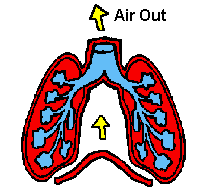
Ventilation, or breathing, is the process by which air moves in and out of the lungs. It consists of two phases: inspiration (inhalation), where air enters the alveoli from the atmosphere, and expiration (exhalation), where air leaves the alveoli for the atmosphere.
Inspiration: Air moves from the atmosphere (higher pressure) into the lungs (lower pressure).
Expiration: Air moves from the lungs (higher pressure) into the atmosphere (lower pressure).
Air Movement and Pressure Gradients
Air moves between the atmosphere and terminal bronchioles due to pressure gradients, always flowing from areas of high to low pressure. Resistance to airflow occurs as air passes through the respiratory passageways.
Air Flow Equation:
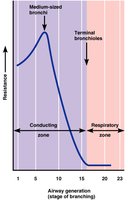
Resistance is greatest in medium-sized bronchi; at terminal bronchioles, diffusion predominates.
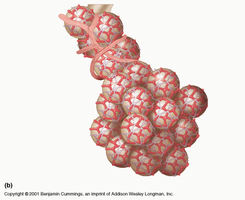
Diffusion Between Terminal Bronchioles and Alveoli
Gas exchange between terminal bronchioles and alveoli is primarily powered by diffusion, moving from high to low concentration.
Pressure Relationships in the Thoracic Cavity
Relevant Pressures
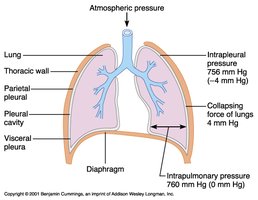
Three main pressures are involved in ventilation:
Intrapleural Pressure: Pressure within the pleural cavity, always less than lung pressure by about 4 mmHg.
Intrapulmonary (Intraalveolar) Pressure: Pressure within the alveoli, fluctuates between 759 and 761 mmHg.
Atmospheric Pressure: Pressure exerted by atmospheric gases, averages 760 mmHg at sea level.
Pressure Changes During Breathing
During inspiration, intraalveolar pressure falls below atmospheric pressure; during expiration, it rises above atmospheric pressure.
Inspiration: Atmospheric pressure = 760 mmHg, Intraalveolar pressure = 759 mmHg
Expiration: Atmospheric pressure = 760 mmHg, Intraalveolar pressure = 761 mmHg
Boyle’s Law and Lung Volume
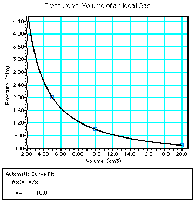
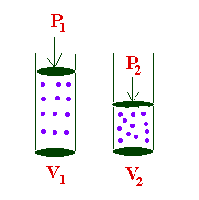
Boyle’s Law states that gas pressure is inversely related to the volume it occupies. As lung volume increases, pressure decreases, and vice versa.
Boyle’s Law Equation:
Factors Affecting Alveolar Expansion and Compression
Expansion of alveoli decreases gas pressure and promotes inspiration, while compression increases gas pressure and promotes expiration.
Expansion Factors: Pleural fluid surface tension, negative intrapleural pressure
Compression Factors: Alveolar fluid surface tension, elastic recoil of the lungs
Compliance and Elasticity
Compliance is the ability of the lungs to expand, crucial for inspiration. Elasticity is the ability of the lungs to recoil, important for expiration. Intrapleural pressure changes adjust lung volume by enlarging or reducing thorax volume.
Transpulmonary Pressure
Transpulmonary pressure is the difference between intrapulmonary and intrapleural pressure. It keeps the lungs from collapsing.
Transpulmonary Pressure Equation:
Diaphragmatic Breathing
Diaphragmatic breathing accounts for about 75% of the pressure change during quiet breathing, primarily by moving the diaphragm.
Forced Expiration
Forced expiration is achieved by actively recruiting additional muscles, including abdominal and thoracic muscles.
Abdominal Muscles: External oblique, internal oblique, transverse abdominus
Thoracic Muscles: Internal intercostals, latissimus dorsi, quadratus lumborum
Air Flow Resistance
Resistance in the Airways
The pressure gradient between alveoli and atmosphere drives ventilation, opposed by resistance. Resistance is greatest in medium-sized bronchi.
Resistance Equation:
Factors Affecting Resistance
Factors Increasing Resistance | Factors Decreasing Resistance |
|---|---|
Bronchoconstriction (PNS-acetylcholine, histamine, decreased pCO2, solid tumors, mucus, inflammation) | Bronchodilation (SNS-epinephrine, increased pCO2) |
Lung Capacities and Volumes
Overview
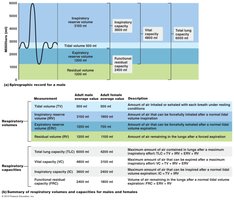
Lung capacities and volumes are essential for understanding respiratory function. Refer to your textbook for detailed values and definitions.
Gas Exchange: External and Internal Respiration
Dalton’s Law of Partial Pressures
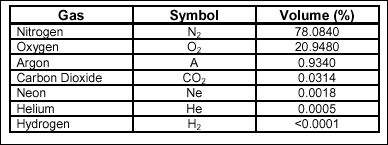
Dalton’s Law states that the total pressure exerted by a mixture of gases is the sum of the pressures exerted individually by each gas. The partial pressure of a gas is proportional to its percentage in the mixture.
Equation:
Example:
Henry’s Law
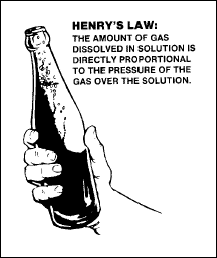
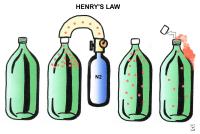
Henry’s Law states that when a mixture of gas contacts a liquid, a gas will dissolve into the liquid in proportion to its partial pressure and will diffuse until equilibrium is achieved.
Equation:
Other factors affecting gas movement: diffusion barrier properties, gas solubility, liquid temperature
External and Internal Respiration
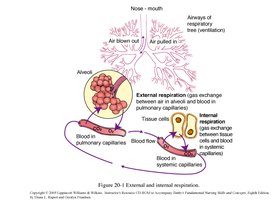
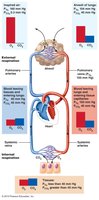
External respiration is the diffusion of gases between alveolar air and blood in pulmonary capillaries across the respiratory membrane. Internal respiration is the diffusion of gases between capillary blood, interstitium, and cells.
O2 diffuses into blood during external respiration; CO2 diffuses out.
O2 diffuses out of blood during internal respiration; CO2 diffuses in.
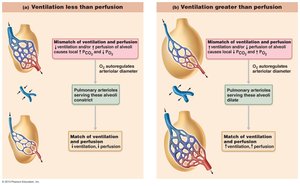
Ventilation-Perfusion Coupling
Matching Air Flow and Blood Flow
Ventilation (air flow) and perfusion (blood flow) are matched locally in the lung by adjusting bronchiole and arteriole diameters. Autoregulatory control ensures efficient gas exchange: PCO2 affects bronchiole diameter, PO2 affects arteriole diameter.