 뒤로
뒤로An Introduction to Carbohydrates – Structure, Types, and Functions
스터디 가이드 - 스마트 노트
 자료에 맞춘 맞춤형 노트, 핵심 정의, 예시, 맥락을 확장해 제공합니다.
Chapter 5: An Introduction to Carbohydrates
Overview of Carbohydrates
Carbohydrates are essential biomolecules that play critical roles in cell structure, cell identity, and energy storage. They are classified based on the number of sugar units present, ranging from simple monosaccharides to complex polysaccharides.
Monosaccharides: Single sugar units (e.g., glucose, fructose)
Oligosaccharides: Short chains of monosaccharides (2–10 units)
Polysaccharides: Long chains of monosaccharides (hundreds to thousands of units)
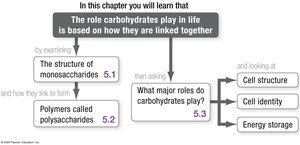
Chapter 4 Recap: Nucleic Acids and the RNA World
This section reviews the structure of nucleotides and nucleic acids, which are important for understanding the role of carbohydrates as precursors in biosynthetic pathways.
Nucleotides consist of a phosphate group, a five-carbon sugar, and a nitrogenous base.
Ribonucleotides contain ribose; deoxyribonucleotides contain deoxyribose.
Pyrimidines (C, T, U) and purines (A, G) are the two types of nitrogenous bases.
DNA is double-stranded, anti-parallel, and stabilized by hydrogen bonds and van der Waals interactions.
RNA is single-stranded, contains uracil, and forms complex secondary and tertiary structures.
5.1 Sugars as Monomers
Monosaccharides: Structure and Diversity
Monosaccharides are the simplest carbohydrates and serve as the building blocks for more complex carbohydrates. They vary in several structural features:
Location of the carbonyl group:
Aldose: Carbonyl group at the end of the molecule
Ketose: Carbonyl group in the middle of the molecule
Number of carbon atoms:
Triose: 3 carbons
Pentose: 5 carbons
Hexose: 6 carbons
Spatial arrangement of atoms: Different arrangements of hydroxyl groups lead to different sugars.
Linear and ring forms: In aqueous solutions, monosaccharides often form ring structures.
Each monosaccharide has a unique structure and function due to these variations.
5.2 The Structure of Polysaccharides
Formation of Polysaccharides
Polysaccharides are polymers formed by linking monosaccharide monomers through condensation reactions, resulting in covalent glycosidic linkages. These linkages can be broken by hydrolysis reactions.
Disaccharide: Two monosaccharides linked together
Glycosidic linkage: Covalent bond formed between two monosaccharides
Glycosidic linkages can form between any two hydroxyl groups, leading to structural diversity. The most common linkages are between the C-1 and C-4 carbons, but their geometry can differ (e.g., α-1,4 vs. β-1,4 linkages).
Types of Polysaccharides
Starch (plants): Storage polysaccharide composed of α-glucose monomers. Exists as amylose (unbranched, α-1,4 linkages) and amylopectin (branched, α-1,6 linkages).
Glycogen (animals): Highly branched storage polysaccharide stored in liver and muscle cells. Similar to starch but with more frequent branching (about 1 in 10 monomers).
Cellulose (plants): Structural polysaccharide made of β-glucose monomers joined by β-1,4 linkages. Every other glucose is flipped, allowing hydrogen bonds between parallel strands, forming strong fibers.
Chitin (fungi, insects, crustaceans): Structural polysaccharide with N-acetylglucosamine (NAG) monomers joined by β-1,4 linkages. Similar to cellulose, with linear strands and hydrogen bonding.
Peptidoglycan (bacteria): Structural polysaccharide with alternating monosaccharides joined by β-1,4 linkages and cross-linked by short peptide chains.
Polysaccharide | Main Monomer | Linkage Type | Function | Organism |
|---|---|---|---|---|
Starch | α-glucose | α-1,4 and α-1,6 | Energy storage | Plants |
Glycogen | α-glucose | α-1,4 and α-1,6 | Energy storage | Animals |
Cellulose | β-glucose | β-1,4 | Structural | Plants |
Chitin | N-acetylglucosamine | β-1,4 | Structural | Fungi, animals |
Peptidoglycan | Alternating monosaccharides | β-1,4 + peptide cross-links | Structural | Bacteria |
5.3 What Do Carbohydrates Do?
Functions of Carbohydrates in Cells
Carbohydrates serve a variety of essential functions in living organisms:
Precursors to other molecules: Used to synthesize nucleotides and amino acids.
Structural materials: Form fibrous structures in cell walls and exoskeletons.
Cell identity: Glycoproteins and glycolipids on cell surfaces are involved in cell–cell recognition and signaling.
Energy storage: Starch and glycogen are hydrolyzed to release glucose for cellular respiration.
The Role of Carbohydrates in Cell Identity
Carbohydrates attached to proteins (glycoproteins) and lipids (glycolipids) on the cell surface act as identification badges, allowing cells to recognize each other and communicate. This is crucial for immune response and tissue formation.
Enzymatic Hydrolysis of Polysaccharides
Energy-storage polysaccharides like starch and glycogen are easily hydrolyzed by specific enzymes to release glucose:
Phosphorylase: Hydrolyzes glycogen in animal cells.
Amylase: Hydrolyzes starch in plants and animals.
Hydrolysis is the process of breaking a bond using water, the reverse of condensation reactions.
Carbohydrates and Cellular Respiration
Glucose released from polysaccharides enters cellular respiration pathways, such as the Krebs cycle, to produce ATP, the energy currency of the cell.
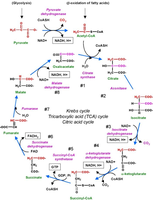
Summary Table: Major Polysaccharides and Their Functions
Name | Monomer | Linkage | Function | Location |
|---|---|---|---|---|
Starch | α-glucose | α-1,4 and α-1,6 | Energy storage | Plants |
Glycogen | α-glucose | α-1,4 and α-1,6 | Energy storage | Animals |
Cellulose | β-glucose | β-1,4 | Structural | Plant cell walls |
Chitin | N-acetylglucosamine | β-1,4 | Structural | Fungi, exoskeletons |
Peptidoglycan | Alternating monosaccharides | β-1,4 + peptide cross-links | Structural | Bacterial cell walls |
Additional info: The diagrams and tables above summarize the structural diversity and biological roles of carbohydrates, providing a foundation for understanding their importance in biology.
