 뒤로
Animal Diversity: Structure, Evolution, and Classification
스터디 가이드 - 스마트 노트
 자료에 맞춘 맞춤형 노트, 핵심 정의, 예시, 맥락을 확장해 제공합니다.
Animal Diversity and Evolution
Characteristics Distinguishing Animals
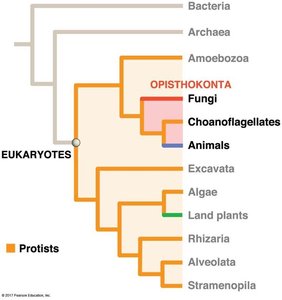
Animals are a monophyletic clade within eukaryotes, sharing several unique features that distinguish them from other organisms. These characteristics are foundational for understanding animal biology and evolution.
Lack of cell walls: Animals possess an extracellular matrix (ECM) instead of cell walls, providing structural support and facilitating cell communication.
Heterotrophic nutrition: Animals ingest food before digesting it, unlike plants and fungi.
Multicellularity: The common ancestor of all animals was multicellular.
Movement: Most animals move under their own power at some stage of their life cycle.
Homologous genes for contractile proteins: All animals share genes for actin and myosin, essential for muscle contraction.
Nerve and muscle cells: All animals except sponges have specialized nerve and muscle cells.
Animal Life Cycle: Diploid Dominance
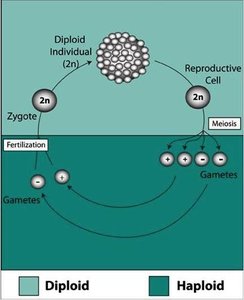
Animals exhibit a diploid-dominant life cycle, which is distinct from many other eukaryotes.
Zygote formation: Fertilization produces a diploid zygote.
Mitosis: The zygote undergoes mitosis to form a multicellular diploid organism.
Meiosis: Diploid cells undergo meiosis to produce haploid gametes.
Gamete fusion: Haploid gametes fuse to form a new diploid zygote.
Multicellularity: Only the diploid generation is multicellular in animals.
Major Themes in Animal Evolution
Animal Phylogeny and Diversification
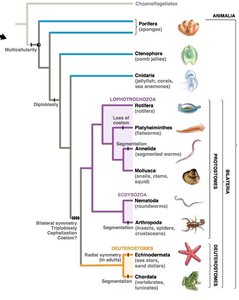
Animal evolution is marked by diversification within phyla, with key innovations arising gradually. Sponges are not ancestral to all animals but represent an early branch.
30-35 phyla: Animal diversity is organized into numerous phyla.
Key innovations: Features such as tissues, symmetry, and body cavities evolved at different times.
Ongoing evolution: Each lineage continues to evolve independently.
Non-Bilaterian Groups
Porifera (Sponges)
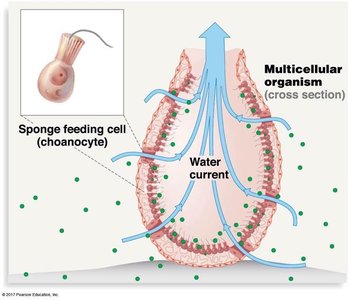
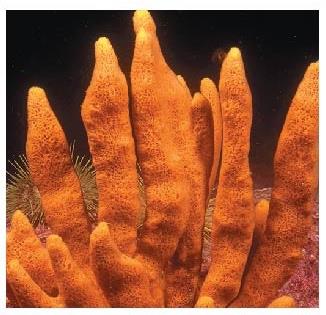
Sponges are sessile, benthic animals that lack true tissues, symmetry, muscles, and nerves. They are primarily marine, with some freshwater species.
Epithelium: Some sponges have a layer of tightly joined cells covering surfaces.
Suspension feeding: Sponges filter particles from water currents using specialized cells called choanocytes.
Larval movement: Sponge larvae move via cilia.
Fossil record: Sponges are the first animals to appear in the fossil record and can survive low oxygen conditions.
Developmental toolkit: Sponges possess genes necessary for basic animal processes.
Ctenophora (Comb Jellies)
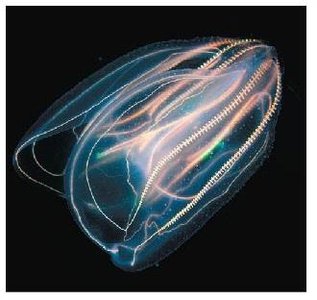
Comb jellies are planktonic, predatory marine animals lacking stinging cells but possessing sticky cells for prey capture.
Movement: Most are planktonic and use cilia for locomotion.
Feeding: Sticky cells on tentacles trap prey.
Cnidaria
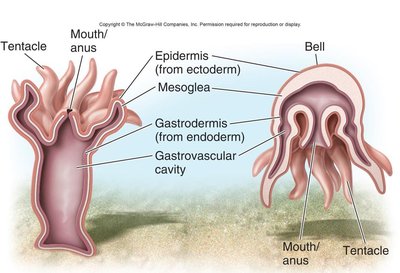
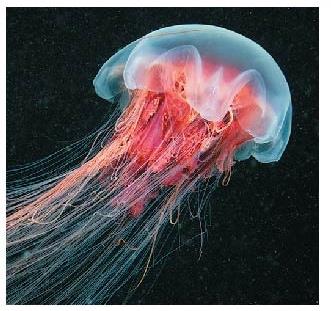
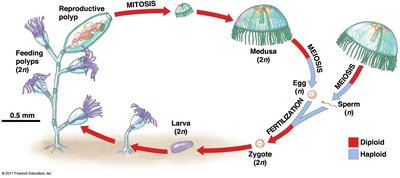
Cnidarians include jellyfish, corals, anemones, and hydroids. They possess specialized stinging cells called cnidocytes and exhibit both sessile polyp and free-floating medusa forms.
Cnidocyte: Ejects a barbed structure, sometimes with toxins.
Life cycle: Alternates between polyp and medusa forms.
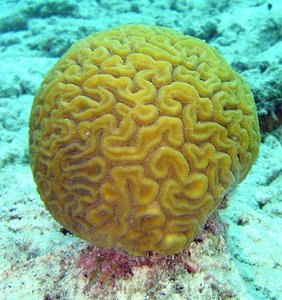
Corals: Exist only as polyps and secrete calcium-carbonate skeletons, forming reefs.
Mutualism: Corals form mutualistic relationships with photosynthetic dinoflagellates or green algae.
Coral bleaching: Loss of symbionts due to environmental stress leads to bleaching.
Embryonic Tissue Layers
Diploblasts vs. Triploblasts
Animals are classified based on the number of embryonic tissue layers (germ layers).
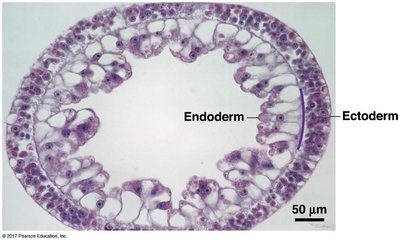
Diploblasts: Have two layers—ectoderm (outer) and endoderm (inner), connected by mesoglea.
Triploblasts: Have three layers—ectoderm, endoderm, and mesoderm.
Bilaterians
Bilateral Symmetry and Triploblasty
Bilaterians exhibit bilateral symmetry and possess three germ layers. This symmetry is controlled by Hox and dpp genes.
Anterior-posterior axis: Head-tail orientation controlled by Hox genes.
Dorsal-ventral axis: Back-belly orientation controlled by dpp genes.
Triploblasty: Ectoderm forms skin and nervous system, endoderm forms digestive tract, mesoderm forms muscles and internal structures.
Muscle and Nervous System Evolution
Bilaterians have true mesodermal muscles and a centralized nervous system, enabling complex movement and cephalization (development of a head).
Contractile proteins: Actin and myosin are universal in animals.
Cephalization: Concentration of sensory organs and cerebral ganglia (brain) in the head.
Origin of the Coelom
The coelom is a fluid-filled cavity between the gut and body wall, providing space for organ movement and circulation.
Coelomates: Body cavity completely lined with mesoderm.
Acoelomates: No coelom (e.g., flatworms).
Pseudocoelomates: Body cavity partially lined with mesoderm (e.g., rotifers, roundworms).
Protostomes vs. Deuterostomes
Developmental Differences
Bilaterians are divided into protostomes and deuterostomes based on embryonic development.
Protostomes: Mouth develops before anus during gastrulation.
Deuterostomes: Anus develops before mouth during gastrulation.
Protostome Diversity
Protostomes are the most abundant animals and are divided into Lophotrochozoa and Ecdysozoa.
Lophotrochozoa: Includes rotifers, flatworms, segmented worms, and mollusks. Characterized by lophophore and trochophore larva.
Ecdysozoa: Includes roundworms and arthropods. Characterized by molting (ecdysis) regulated by ecdysone hormone.
Arthropod Features
Segmented body: Tagmata (body segments).
Exoskeleton: Made of chitin.
Jointed appendages: Specialized for movement and feeding.
Wings: Insects were the first animals to evolve wings.
Metamorphosis: Complete and incomplete metamorphosis, with specialization in feeding and reproduction.
Deuterostome Diversity
Echinodermata
Echinoderms include sea stars, sea urchins, and sea cucumbers. They exhibit bilateral symmetry as juveniles and five-sided radial symmetry as adults.
Endoskeleton: Hard structure of calcium carbonate.
Water vascular system: Fluid-filled tubes and tube feet for movement and feeding.
Keystone species: Sea stars can dramatically affect community diversity.
Chordata
Chordates are defined by four key features: pharyngeal slits, dorsal hollow nerve cord, notochord, and post-anal tail. They include cephalochordates, urochordates, and vertebrates.
Vertebrates: Characterized by vertebrae and a cranium.
Cartilage and bone: Vertebrate skeletons are composed of cartilage or bone.
Summary Table: Major Animal Groups and Features
Group | Symmetry | Tissue Layers | Body Cavity | Key Features |
|---|---|---|---|---|
Porifera | None | None | None | Filter feeding, no true tissues |
Ctenophora/Cnidaria | Radial | Diploblast | None | Stinging cells (Cnidaria), sticky cells (Ctenophora) |
Lophotrochozoa | Bilateral | Triploblast | Varies | Lophophore, trochophore larva, segmentation |
Ecdysozoa | Bilateral | Triploblast | Varies | Molting, exoskeleton, jointed appendages |
Deuterostomes | Bilateral/5-radial | Triploblast | Coelomate | Endoskeleton, water vascular system, notochord |
Conclusion
Animal diversity is shaped by evolutionary innovations in structure, development, and function. Understanding these features is essential for studying animal biology and the relationships among major animal groups.
