 뒤로
Cell Cycle Checkpoints and the Genetic Code Table: Study Guidance
스터디 가이드 - 스마트 노트
 자료에 맞춘 맞춤형 노트, 핵심 정의, 예시, 맥락을 확장해 제공합니다.
Q1. Summarize what happens at each cell cycle checkpoint (G1, G2, M) and how it is controlled.
Background
Topic: Cell Cycle Regulation
This question tests your understanding of the cell cycle checkpoints, which are critical control mechanisms that ensure proper cell division and prevent errors such as DNA damage or chromosome missegregation.
Key Terms:
Checkpoint: A control point in the cell cycle where stop and go-ahead signals regulate the cycle.
G1 checkpoint: Occurs before DNA replication.
G2 checkpoint: Occurs after DNA replication, before mitosis.
M checkpoint: Occurs during mitosis, before chromosome separation.
Regulatory proteins: Cyclins and cyclin-dependent kinases (CDKs) are key regulators.
Step-by-Step Guidance
Start by identifying the three main checkpoints: G1, G2, and M.
For each checkpoint, consider what the cell is checking for. For example, at G1, the cell checks for DNA damage and whether conditions are favorable for division.
Think about the molecular signals involved. Cyclins and CDKs play a major role in controlling progression through each checkpoint.
At the G2 checkpoint, the cell verifies that DNA replication is complete and that there is no DNA damage.
At the M checkpoint, the cell ensures that all chromosomes are properly attached to the spindle before proceeding with chromosome separation.
Try solving on your own before revealing the answer!
Final Answer:
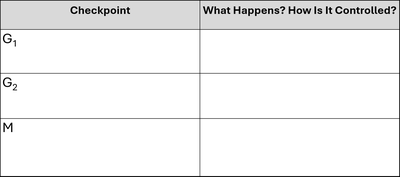
G1 checkpoint: The cell checks for DNA damage, cell size, and external signals. If conditions are not favorable, the cell may enter a resting state (G0). Controlled by cyclins and CDKs.
G2 checkpoint: The cell checks that DNA replication is complete and that there is no DNA damage. If errors are detected, the cell cycle is paused for repair. Controlled by cyclins and CDKs.
M checkpoint: The cell checks that all chromosomes are properly attached to the mitotic spindle before anaphase. If not, the cell cycle is paused to prevent chromosome missegregation. Controlled by spindle assembly checkpoint proteins.
These checkpoints help maintain genomic integrity and prevent the propagation of damaged cells.
Q2. Use the genetic code table to translate mRNA sequences and predict how changes in nucleotide sequences may affect the resulting polypeptide.
Background
Topic: Genetic Code and Translation
This question tests your ability to use the genetic code table to translate mRNA sequences into amino acids and to understand how mutations in the mRNA sequence can alter the polypeptide produced.
Key Terms and Formula:
Codon: A sequence of three mRNA nucleotides that codes for a specific amino acid.
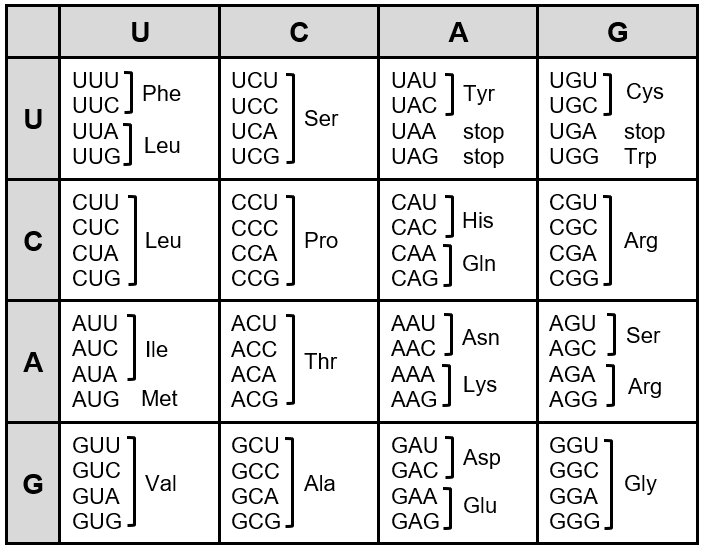
Start codon: AUG (codes for methionine, signals start of translation).
Stop codons: UAA, UAG, UGA (signal end of translation).
Redundancy: Multiple codons can code for the same amino acid.
Step-by-Step Guidance
Identify the mRNA sequence you need to translate. Break it into codons (groups of three nucleotides).
Use the genetic code table to match each codon to its corresponding amino acid.
Start translation at the AUG codon and continue until you reach a stop codon.
If a mutation changes a codon, check the table to see if the new codon codes for a different amino acid, the same amino acid, or a stop signal.
Consider how changes in the sequence (such as missense, nonsense, or silent mutations) might affect the polypeptide.
Try solving on your own before revealing the answer!
Final Answer:
To translate an mRNA sequence, break it into codons and use the genetic code table to determine the amino acid sequence. For example, the mRNA sequence AUG UGG GCU UGG codes for Met-Trp-Ala-Trp. If a codon changes, the effect depends on the new codon: it may code for a different amino acid (missense), the same amino acid (silent), or a stop codon (nonsense).
Understanding the genetic code table allows you to predict the effects of mutations on protein structure and function.
