 뒤로
Cell Cycle, Mitosis, Meiosis, and Cellular Differentiation: Study Notes for General Biology
스터디 가이드 - 스마트 노트
 자료에 맞춘 맞춤형 노트, 핵심 정의, 예시, 맥락을 확장해 제공합니다.
Cell Cycle
Overview of the Cell Cycle
The cell cycle is a series of phases that cells undergo to grow and divide, ensuring the continuity of life. It is essential for growth, repair, and reproduction in multicellular organisms. - Main Phases: G1 (Gap 1), S (Synthesis), G2 (Gap 2), and M (Mitosis) - Goal: To produce new, genetically identical cells called daughter cells - Regulation: Cells cannot duplicate indefinitely; regulatory mechanisms control division and cell size 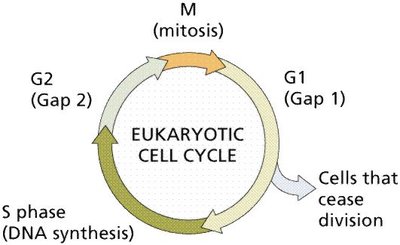
Cell Cycle Regulations
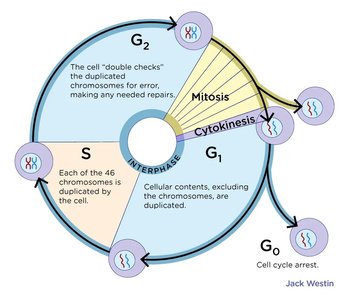
Regulation of the cell cycle is crucial to prevent uncontrolled growth and maintain proper cell function. - External Factors: Physical signals (contact inhibition), chemical signals (growth proteins) - Internal Factors: Activated by growth proteins, checkpoints ensure DNA integrity and proper cell size - Surface Area to Volume Ratio: Limits cell size; if a cell grows too large, its membrane cannot support its volume, leading to potential cell rupture
Interphase
Interphase is the longest phase of the cell cycle, during which the cell performs normal functions and prepares for division. - Stages: G1, S, G2 - Characteristics: Cell has a nucleus, DNA is in the form of chromatin, organelles and cytoplasm increase 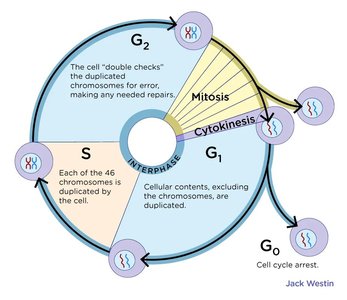
G1 Phase (Gap 1)
- Cell increases in size - Produces RNA and synthesizes proteins - Prepares for DNA synthesis
S Phase (Synthesis)
- DNA replication occurs - Each chromosome is duplicated
G2 Phase (Gap 2)
- Cell grows further, increases organelles and cytoplasm - Cell checkpoints for DNA errors, cell volume, and environmental conditions
M Phase (Mitosis)
- Cell divides to produce two identical daughter cells
G0 Phase (Cell Cycle Arrest)
- Cells exit the cycle and cease division, often to perform specialized functions 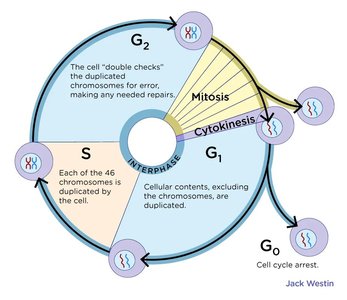
Mitosis
Purpose and Overview
Mitosis is the process of asexual reproduction in eukaryotic cells, resulting in two genetically identical daughter cells. It is essential for growth, repair, and asexual reproduction. - Occurs after interphase - Chromosomes are copied and become sister chromatids
Phases of Mitosis
Mitosis consists of four main phases, followed by cytokinesis.
Prophase: Chromosomes condense and become visible; centrioles move to opposite poles; spindle fibers form
Metaphase: Chromosomes align at the cell's equator; spindle fibers attach to chromatids
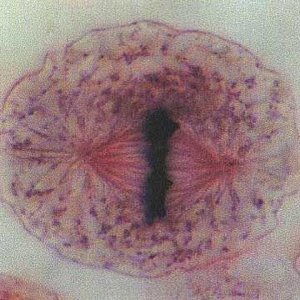
Anaphase: Chromatids separate and move to opposite poles
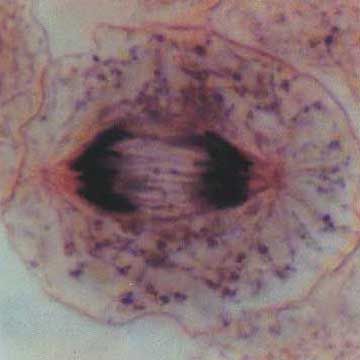
Telophase: Two new nuclei form; chromosomes return to chromatin form
Cytokinesis
- Cell membrane pinches inward, creating two daughter cells, each with identical chromosomes
Comparison: Animal vs. Plant Mitosis
- Both undergo the same phases, but plant cells lack centrioles and form a cell plate during cytokinesis
Cancer and Cell Cycle Regulation
Cancer: Uncontrolled Cell Division
Cancer is a group of diseases characterized by uncontrolled cell division due to damaged genes regulating the cell cycle. - Cancerous cells: Divide without growth proteins, form clumps (tumors) - Types of tumors: Benign (localized, removable), Malignant (can spread via bloodstream)  - Impact: Cancerous cells do not perform normal functions and consume space and nutrients
Apoptosis: Programmed Cell Death
Apoptosis is the process of programmed cell death, essential for development and removal of unnecessary cells. - Triggered when cells reach division limits or are not needed - Example: Removal of webbing between fingers and toes during embryonic development
Cell Specialization and Differentiation
Cell Specialization
Cell specialization refers to the process by which cells develop specific functions necessary for the survival of multicellular organisms. - Single-celled organisms perform all functions in one cell (e.g., Amoeba) - Multicellular organisms have specialized cells for nutrient supply, transport, waste removal, and defense 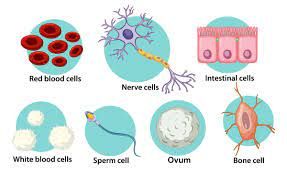
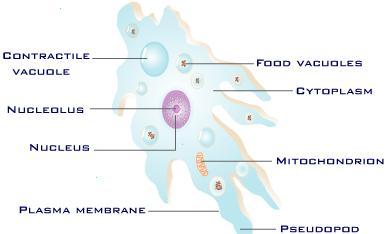
Levels of Organization
Cells are organized hierarchically: cells → tissues → organs → organ systems → organism.
Cellular Differentiation
Cellular differentiation is the process by which cells become specialized. - All cells originate from the zygote via mitosis - As embryos develop, cells change shape, contents, and function 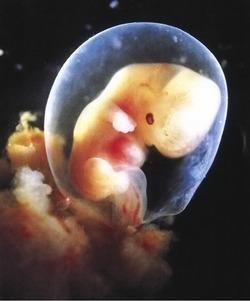
Stem Cells
Stem cells are undifferentiated cells capable of becoming various cell types. - Embryonic stem cells: Can differentiate into any cell type - Adult stem cells: Found in specific tissues, can form limited cell types (e.g., bone marrow stem cells produce blood cells)
Meiosis and Sexual Reproduction
Overview of Meiosis
Meiosis is a type of cell division that produces gametes (sex cells) with half the number of chromosomes (haploid, n). It is essential for sexual reproduction and genetic variation. - Requires two parents - Offspring are not identical
Key Terms
- Gametes: Sex cells (egg or sperm), haploid (n) - Zygote: Fertilized egg, diploid (2n) - Homologous chromosomes: Chromosome pairs from mother and father
Phases of Meiosis
Meiosis consists of two divisions: Meiosis I and Meiosis II.
Meiosis I
- Prophase I: Homologous chromosomes pair to form tetrads; crossing over occurs, increasing genetic variation - Metaphase I: Chromosomes align at the cell's equator
- Anaphase I: Homologous chromosomes are pulled apart (disjunction) - Telophase I: Nuclear membrane forms; cell splits into two haploid cells
Meiosis II
- Prophase II: Spindle fibers attach to chromosomes - Metaphase II: Chromosomes align at the equator - Anaphase II: Sister chromatids separate - Telophase II: Cells divide, resulting in four haploid gametes
Genetic Variation in Meiosis
- Independent Assortment: Produces distinct gametes, where n = number of unique chromosomes - Crossing Over: Further increases genetic diversity
Comparison: Mitosis vs. Meiosis
Feature | Mitosis | Meiosis |
|---|---|---|
Number of Divisions | 1 | 2 |
Daughter Cells | 2 (identical) | 4 (genetically unique) |
Chromosome Number | Diploid (2n) | Haploid (n) |
Function | Growth, repair, asexual reproduction | Sexual reproduction, genetic variation |
Meiosis Errors
Errors in meiosis can lead to abnormal chromosome numbers, such as trisomy 21 (Down syndrome).
Summary Table: Cell Cycle vs. Mitosis vs. Meiosis
Process | Purpose | Phases | Outcome |
|---|---|---|---|
Cell Cycle | Growth, division, regulation | G1, S, G2, M | Two identical cells |
Mitosis | Growth, repair, asexual reproduction | Prophase, Metaphase, Anaphase, Telophase, Cytokinesis | Two identical cells |
Meiosis | Sexual reproduction, genetic diversity | Meiosis I & II | Four unique gametes |
Key Points for Exam Preparation
- Understand the phases and regulation of the cell cycle - Know the steps and purpose of mitosis and meiosis - Recognize the importance of cell specialization and differentiation - Be able to compare and contrast mitosis and meiosis - Understand the consequences of errors in cell division Example: Down syndrome results from an extra chromosome 21 due to nondisjunction in meiosis. Additional info: The notes have been expanded with academic context, definitions, and comparisons to ensure completeness and clarity for exam preparation.
