 뒤로
Cell Membrane Structure and Transport Study Guide
스터디 가이드 - 스마트 노트
 자료에 맞춘 맞춤형 노트, 핵심 정의, 예시, 맥락을 확장해 제공합니다.
Q1. Describe the structure of a typical cell membrane.
Background
Topic: Cell Membrane Structure
This question tests your understanding of the basic architecture of biological membranes, which is fundamental to cell biology.
Key Terms:
Phospholipid bilayer: The main structural component of the membrane.
Proteins: Embedded or attached to the membrane, serving various functions.
Carbohydrate chains: Often attached to proteins or lipids, important for cell recognition.
Cholesterol: Interspersed within the bilayer, affecting fluidity.
Step-by-Step Guidance
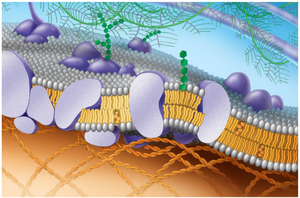
Start by identifying the phospholipid bilayer, which forms the basic structure of the cell membrane. Each phospholipid has a hydrophilic (water-loving) head and hydrophobic (water-fearing) tails.
Locate the proteins within the membrane. Some proteins span the entire membrane (integral proteins), while others are attached to the surface (peripheral proteins).
Observe the carbohydrate chains attached to proteins or lipids on the membrane's exterior. These are important for cell signaling and recognition.
Notice the cholesterol molecules interspersed within the bilayer, which help regulate membrane fluidity and stability.
Consider the overall arrangement and how these components interact to form a selectively permeable barrier.
Try solving on your own before revealing the answer!
Final Answer:
The typical cell membrane is composed of a phospholipid bilayer with embedded proteins, cholesterol, and carbohydrate chains. The phospholipid bilayer provides a flexible, semi-permeable barrier. Integral and peripheral proteins serve functions such as transport, signaling, and structural support. Cholesterol modulates membrane fluidity, and carbohydrate chains are involved in cell recognition and communication.
Q2. What is the purpose of each component of the membrane? Explain all of the features in the image below.
Background
Topic: Membrane Components and Their Functions
This question focuses on the roles of phospholipids, proteins, carbohydrates, and cholesterol in the cell membrane.
Key Terms:
Phospholipids: Form the bilayer and create a barrier to most molecules.
Proteins: Facilitate transport, act as receptors, and provide structural support.
Carbohydrates: Involved in cell recognition and signaling.
Cholesterol: Maintains membrane fluidity and stability.
Step-by-Step Guidance
Identify the phospholipids in the bilayer and describe their role in forming a selectively permeable membrane.
Examine the proteins (integral and peripheral) and discuss their functions, such as transport, enzymatic activity, and cell communication.
Look at the carbohydrate chains attached to proteins or lipids and explain their importance in cell recognition.
Find the cholesterol molecules and describe how they influence membrane fluidity.
Relate each component to its specific function in maintaining cell integrity and communication.
Try solving on your own before revealing the answer!
Final Answer:
Phospholipids: Create the bilayer, providing a barrier and selective permeability.
Proteins: Transport substances, act as receptors, and support cell structure.
Carbohydrates: Enable cell recognition and signaling.
Cholesterol: Regulates membrane fluidity and stability.
The image shows all these components working together to form a functional cell membrane.
Q3. What is the role of cholesterol in cell membranes?
Background
Topic: Membrane Fluidity and Stability
This question tests your understanding of how cholesterol affects the physical properties of the cell membrane.
Key Terms:
Cholesterol: A lipid molecule interspersed within the phospholipid bilayer.
Fluidity: The ability of the membrane to move and flex.
Stability: The membrane's resistance to changes in temperature and structure.
Step-by-Step Guidance
Recall that cholesterol is found between the phospholipid tails in the bilayer.
Consider how cholesterol prevents the fatty acid tails from packing too closely together, which increases fluidity at low temperatures.
Think about how cholesterol also restricts movement at high temperatures, preventing the membrane from becoming too fluid.
Relate these effects to the overall stability and function of the cell membrane.
Try solving on your own before revealing the answer!
Final Answer:
Cholesterol maintains membrane fluidity by preventing phospholipids from packing too tightly at low temperatures and restraining excessive movement at high temperatures. This ensures the membrane remains stable and functional across a range of conditions.
Q4. Name the 2 major types of membrane proteins.
Background
Topic: Membrane Protein Classification
This question tests your knowledge of the structural and functional categories of proteins found in cell membranes.
Key Terms:
Integral proteins: Embedded within the membrane, often spanning it.
Peripheral proteins: Attached to the membrane surface.
Step-by-Step Guidance
Recall that integral proteins are embedded in the membrane and may span the entire bilayer.
Peripheral proteins are attached to the exterior or interior surface of the membrane, not embedded within the bilayer.
Think about how these two types differ in their location and function.
Try solving on your own before revealing the answer!
Final Answer:
The two major types of membrane proteins are integral (transmembrane) proteins and peripheral proteins. Integral proteins span the membrane, while peripheral proteins are attached to its surface.
Q5. Know some of the functions of membrane proteins.
Background
Topic: Membrane Protein Functions
This question tests your understanding of the diverse roles that proteins play in the cell membrane.
Key Terms:
Transport: Moving substances across the membrane.
Enzymatic activity: Catalyzing reactions.
Signal transduction: Relaying signals from outside to inside the cell.
Cell recognition: Identifying other cells.
Intercellular joining: Connecting cells together.
Attachment: Linking to the cytoskeleton or extracellular matrix.
Step-by-Step Guidance
List the main functions of membrane proteins, such as transport, enzymatic activity, and signal transduction.
Consider how proteins facilitate cell recognition and intercellular joining.
Think about how proteins anchor the membrane to internal and external structures.
Try solving on your own before revealing the answer!
Final Answer:
Transport of molecules
Enzymatic activity
Signal transduction
Cell recognition
Intercellular joining
Attachment to cytoskeleton and extracellular matrix
Q6. What builds the cell membrane?
Background
Topic: Membrane Assembly
This question tests your understanding of the biosynthesis and assembly of cell membrane components.
Key Terms:
Phospholipids: Synthesized in the smooth endoplasmic reticulum.
Proteins: Synthesized by ribosomes, often inserted into the membrane via the rough ER.
Carbohydrates: Added in the Golgi apparatus.
Cholesterol: Synthesized in the liver and transported to membranes.
Step-by-Step Guidance
Recall where phospholipids are synthesized and how they are transported to the membrane.
Think about how membrane proteins are produced and inserted into the membrane.
Consider how carbohydrates are attached to proteins and lipids.
Review the role of cholesterol in membrane assembly.
Try solving on your own before revealing the answer!
Final Answer:
The cell membrane is built from phospholipids, proteins, carbohydrates, and cholesterol. Phospholipids and proteins are synthesized in the endoplasmic reticulum, carbohydrates are added in the Golgi apparatus, and cholesterol is incorporated from the liver.
Q7. What establishes the direction of movement of ions, substances, etc. across a cell membrane? Define selectively permeable.
Background
Topic: Membrane Permeability and Transport
This question tests your understanding of how the cell membrane controls the movement of substances and what selective permeability means.
Key Terms:
Concentration gradient: Difference in concentration across the membrane.
Electrochemical gradient: Combined effect of concentration and charge.
Selectively permeable: Allows some substances to pass while blocking others.
Step-by-Step Guidance
Recall that movement is driven by concentration and electrochemical gradients.
Consider how membrane proteins facilitate or restrict movement.
Define selectively permeable and relate it to the membrane's structure.
Try solving on your own before revealing the answer!
Final Answer:
The direction of movement is established by concentration and electrochemical gradients. A selectively permeable membrane allows certain substances to pass while blocking others, based on size, charge, and solubility.
Q8. Name the types of passive transport in living systems.
Background
Topic: Passive Transport Mechanisms
This question tests your knowledge of how substances move across membranes without energy input.
Key Terms:
Diffusion: Movement of molecules from high to low concentration.
Facilitated diffusion: Movement via membrane proteins.
Osmosis: Diffusion of water across a membrane.
Step-by-Step Guidance
List the main types of passive transport: diffusion, facilitated diffusion, and osmosis.
Describe how each type works and what distinguishes them.
Try solving on your own before revealing the answer!
Final Answer:
Diffusion
Facilitated diffusion
Osmosis
Q9. Explain tonicity and know what happens to cells placed in the various solutions.
Background
Topic: Tonicity and Osmosis
This question tests your understanding of how different solutions affect cell volume and water movement.
Key Terms:
Tonicity: The ability of a solution to cause a cell to gain or lose water.
Isotonic: No net water movement.
Hypertonic: Cell loses water.
Hypotonic: Cell gains water.
Step-by-Step Guidance
Define tonicity and relate it to osmosis.
Describe what happens to cells in isotonic, hypertonic, and hypotonic solutions.
Consider the effects on cell volume and function.
Try solving on your own before revealing the answer!
Final Answer:
Isotonic: Cell remains the same size.
Hypertonic: Cell shrinks as water leaves.
Hypotonic: Cell swells as water enters.
Tonicity describes how a solution affects cell water balance.
Q10. Give an example of active transport in an animal cell.
Background
Topic: Active Transport Mechanisms
This question tests your knowledge of processes that require energy to move substances against their gradient.
Key Terms:
Active transport: Movement against a concentration gradient using energy.
ATP: Energy source for active transport.
Sodium-potassium pump: Classic example in animal cells.
Step-by-Step Guidance
Recall that active transport requires energy, usually from ATP.
Think of examples, such as the sodium-potassium pump.
Describe how the pump moves sodium and potassium ions against their gradients.
Try solving on your own before revealing the answer!
Final Answer:
The sodium-potassium pump is an example of active transport in animal cells. It uses ATP to move sodium ions out and potassium ions into the cell against their concentration gradients.
Q11. What is cotransport?
Background
Topic: Coupled Transport Mechanisms
This question tests your understanding of how two substances can be transported together across a membrane.
Key Terms:
Cotransport: Simultaneous transport of two substances.
Symport: Both substances move in the same direction.
Antiport: Substances move in opposite directions.
Step-by-Step Guidance
Define cotransport and distinguish between symport and antiport.
Consider examples of cotransport in cells.
Try solving on your own before revealing the answer!
Final Answer:
Cotransport is the simultaneous movement of two substances across a membrane, either in the same direction (symport) or opposite directions (antiport).
Q12. Describe the various processes considered to be “bulk transport.”
Background
Topic: Bulk Transport Mechanisms
This question tests your knowledge of how cells move large quantities of substances across membranes.
Key Terms:
Endocytosis: Uptake of substances into the cell.
Exocytosis: Release of substances from the cell.
Phagocytosis: "Cell eating" of large particles.
Pinocytosis: "Cell drinking" of fluids.
Receptor-mediated endocytosis: Specific uptake using receptors.
Step-by-Step Guidance
List the main types of bulk transport: endocytosis and exocytosis.
Describe the subtypes of endocytosis: phagocytosis, pinocytosis, and receptor-mediated endocytosis.
Explain how these processes allow cells to move large quantities of material.
Try solving on your own before revealing the answer!
Final Answer:
Endocytosis (phagocytosis, pinocytosis, receptor-mediated)
Exocytosis
Bulk transport processes move large amounts of substances into or out of cells.
