 뒤로
Cellular Energy: Guided Study for General Biology
스터디 가이드 - 스마트 노트
 자료에 맞춘 맞춤형 노트, 핵심 정의, 예시, 맥락을 확장해 제공합니다.
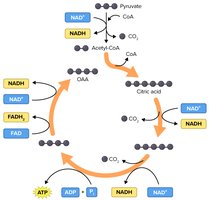
Q1. Be able to keep track of the carbon in the Krebs cycle. How many does it start with? How many does it end with? Where does the carbon go?
Background
Topic: Krebs Cycle (Citric Acid Cycle)
This question tests your understanding of carbon flow during the Krebs cycle, a key metabolic pathway in cellular respiration.
Key Terms and Formulas:
Krebs Cycle: A series of reactions that generate energy through the oxidation of acetyl-CoA.
Acetyl-CoA: The molecule that enters the cycle, containing 2 carbons.
CO2: Carbon dioxide, released as a waste product.
OAA (Oxaloacetate): A 4-carbon molecule that combines with acetyl-CoA.
Step-by-Step Guidance
Start by identifying the number of carbons in acetyl-CoA (2 carbons) and oxaloacetate (4 carbons).
When acetyl-CoA enters the cycle, it combines with oxaloacetate to form citrate (6 carbons).
Follow the steps of the cycle: Citrate is converted through several intermediates, and during these steps, carbon atoms are released as CO2.
Track how many CO2 molecules are released per cycle and which steps they are released in.
Consider what happens to the remaining carbon atoms at the end of the cycle and how oxaloacetate is regenerated.
Try solving on your own before revealing the answer!
Final Answer:
The Krebs cycle starts with 2 carbons from acetyl-CoA and 4 carbons from oxaloacetate, forming a 6-carbon citrate. During the cycle, 2 carbons are released as CO2 per turn. The cycle ends with the regeneration of the 4-carbon oxaloacetate. The released carbons exit as CO2, which is a waste product expelled from the cell.
This carbon tracking is essential for understanding how cells extract energy and dispose of waste during respiration.
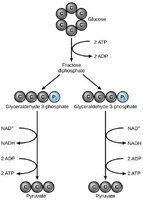
Q2. Be able to explain what is going on in a diagram of glycolysis. Where is this reaction exergonic and where is the reaction endergonic?
Background
Topic: Glycolysis
This question tests your ability to interpret the steps of glycolysis and distinguish between energy-releasing (exergonic) and energy-consuming (endergonic) phases.
Key Terms and Formulas:
Glycolysis: The metabolic pathway that breaks down glucose into pyruvate.
Exergonic: A reaction that releases energy.
Endergonic: A reaction that requires energy input.
ATP and NADH: Molecules involved in energy transfer.
Step-by-Step Guidance
Identify the initial steps of glycolysis where ATP is consumed (energy investment phase).
Locate the steps where glucose is split into two 3-carbon molecules (G3P).
Find the steps where ATP and NADH are produced (energy payoff phase).
Determine which steps are exergonic (energy released) and which are endergonic (energy required).
Review the overall energy balance of glycolysis and how it relates to cellular energy needs.
Try solving on your own before revealing the answer!
Final Answer:
In glycolysis, the initial steps (energy investment phase) are endergonic, requiring ATP input. The later steps (energy payoff phase) are exergonic, producing ATP and NADH. Overall, glycolysis results in a net gain of energy for the cell.
Understanding these phases helps explain how cells manage energy during glucose metabolism.
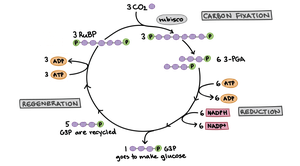
Q3. Tell the story of the Calvin cycle based on the diagram.
Background
Topic: Calvin Cycle (Photosynthesis)
This question asks you to describe the steps of the Calvin cycle, which is the process plants use to fix carbon and produce sugars.
Key Terms and Formulas:
Calvin Cycle: The set of chemical reactions that take place in chloroplasts during photosynthesis.
RuBP: Ribulose bisphosphate, the molecule that starts the cycle.
G3P: Glyceraldehyde-3-phosphate, a product of the cycle.
ATP and NADPH: Energy carriers used in the cycle.
Step-by-Step Guidance
Begin with carbon fixation: CO2 is added to RuBP by the enzyme rubisco.
Follow the reduction phase: ATP and NADPH are used to convert 3-PGA into G3P.
Identify the regeneration phase: Some G3P is used to regenerate RuBP, allowing the cycle to continue.
Track the use of ATP and NADPH in each phase and how many molecules are required.
Consider what happens to the G3P produced and how it contributes to glucose synthesis.
Try solving on your own before revealing the answer!
Final Answer:
The Calvin cycle starts with CO2 fixation to RuBP, followed by reduction using ATP and NADPH to produce G3P. Some G3P is used to make glucose, while the rest regenerates RuBP. The cycle is essential for converting inorganic carbon into organic molecules in plants.
This process is central to photosynthesis and the energy flow in ecosystems.
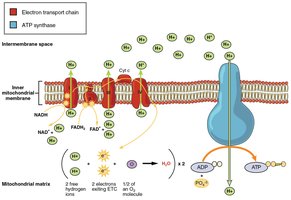
Q4. Describe how ATP synthase works within the mitochondria to produce ATP molecules.
Background
Topic: ATP Synthase and Cellular Respiration
This question tests your understanding of the mechanism by which ATP synthase generates ATP during oxidative phosphorylation.
Key Terms and Formulas:
ATP Synthase: An enzyme that synthesizes ATP from ADP and inorganic phosphate (Pi).
Proton Gradient: The difference in proton concentration across the mitochondrial membrane.
Oxidative Phosphorylation: The process of ATP production using energy from electron transport.
Step-by-Step Guidance
Identify the location of ATP synthase in the inner mitochondrial membrane.
Describe how the electron transport chain creates a proton gradient across the membrane.
Explain how protons flow through ATP synthase, causing it to rotate and catalyze ATP formation.
Discuss the role of ADP and Pi in the synthesis of ATP.
Consider how the energy from the proton gradient is converted into chemical energy in ATP.
Try solving on your own before revealing the answer!
Final Answer:
ATP synthase uses the energy from protons moving down their gradient to convert ADP and Pi into ATP. This process is essential for cellular energy production and is driven by the electron transport chain.
The enzyme's function is a key step in oxidative phosphorylation, linking electron transport to ATP generation.
