 뒤로
Cellular Respiration and Fermentation: Catabolic Pathways and ATP Production
스터디 가이드 - 스마트 노트
 자료에 맞춘 맞춤형 노트, 핵심 정의, 예시, 맥락을 확장해 제공합니다.
Cellular Respiration and Fermentation
Catabolic Pathways and ATP Production
Cellular respiration and fermentation are essential metabolic pathways that allow cells to extract energy from organic molecules. These processes are central to the production of ATP, the cell's energy currency, and involve both aerobic and anaerobic mechanisms.
Fermentation: Partial degradation of sugars without oxygen, yielding limited ATP.
Cellular Respiration: Complete breakdown of organic molecules, typically using oxygen as the terminal electron acceptor, and producing ATP via an electron transport chain (ETC).
Aerobic Respiration: Oxygen is the terminal electron acceptor at the ETC.
Anaerobic Respiration: Terminal electron acceptors other than oxygen (e.g., sulfate, nitrate) are used at the ETC.
ATP Formation Mechanisms
ATP can be synthesized through two primary mechanisms: substrate-level phosphorylation and oxidative phosphorylation.
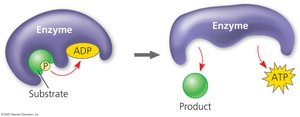
Substrate-Level Phosphorylation: An enzyme transfers a phosphate group directly from a substrate molecule to ADP, forming ATP. This occurs in glycolysis, the citric acid cycle, and fermentation.
Oxidative Phosphorylation: Accounts for nearly 90% of ATP generated by cellular respiration. Occurs at the ETC, where energy from electron transfer is used to drive ATP synthesis.
Catabolic Pathways: Fuel Sources
Cellular respiration can utilize carbohydrates, fats, and proteins as fuel. Glucose is often used as a model substrate, but alternate fuels are funneled into common metabolic pathways for efficiency. Modifications such as beta-oxidation (for fatty acids) and deamination (for amino acids) are required.
The Principle of Redox Reactions
Oxidation-Reduction (Redox) Reactions
Redox reactions involve the transfer of electrons between reactants. These reactions are fundamental to cellular respiration.
Oxidation: Loss of electrons; the electron donor is the reducing agent.
Reduction: Gain of electrons; the electron acceptor is the oxidizing agent.
During cellular respiration, fuel (e.g., glucose) is oxidized, and oxygen is reduced.

NAD+ acts as an oxidizing agent during respiration, accepting electrons and becoming reduced to NADH. An electron acceptor is a molecule that receives electrons during a redox reaction.
Stages of Cellular Respiration: Overview
Three Main Stages
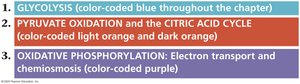
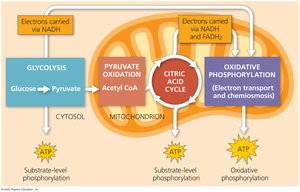
Energy extraction from glucose occurs in three sequential stages:
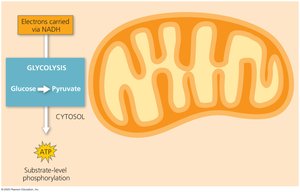
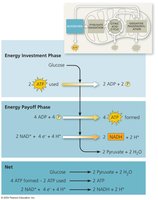
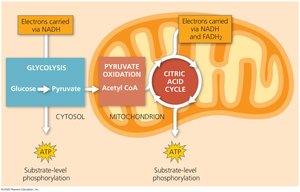
Glycolysis: Breaks down glucose into two pyruvate molecules in the cytosol.
Pyruvate Oxidation and Citric Acid Cycle: Completes glucose breakdown in the mitochondrial matrix.
Oxidative Phosphorylation: Accounts for most ATP synthesis, occurring in the inner mitochondrial membrane.
Glycolysis
Glycolysis is a universal metabolic pathway, present in most organisms, and does not require oxygen or specialized organelles.
Occurs in the cytosol.
Produces a net gain of 2 ATP and 2 NADH per glucose molecule.
Considered one of the earliest metabolic pathways to evolve.
Pyruvate Oxidation and Citric Acid Cycle
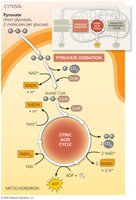
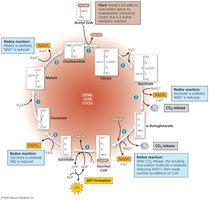
After glycolysis, pyruvate is transported into the mitochondrion (in eukaryotes) and converted to acetyl CoA, which enters the citric acid cycle.
Pyruvate oxidation yields 1 NADH per pyruvate (2 NADH per glucose).
The citric acid cycle (Krebs cycle) completes the oxidation of pyruvate, generating 2 ATP, 6 NADH, and 2 FADH2 per glucose.
ATP Production and Pathways
Substrate-Level vs. Oxidative Phosphorylation
ATP is produced by substrate-level phosphorylation in glycolysis and the citric acid cycle, and by oxidative phosphorylation in the electron transport chain.
Substrate-Level Phosphorylation: Direct transfer of phosphate to ADP.
Oxidative Phosphorylation: ATP synthesis driven by electron transport and chemiosmosis.
Summary Table: ATP Production in Cellular Respiration
Stage | Location | ATP Yield (per glucose) | Phosphorylation Type |
|---|---|---|---|
Glycolysis | Cytosol | 2 | Substrate-level |
Citric Acid Cycle | Mitochondrial Matrix | 2 | Substrate-level |
Oxidative Phosphorylation | Inner Mitochondrial Membrane | ~26-28 | Oxidative |
Order of Metabolic Reactions in Aerobic Respiration
The correct sequence for the complete oxidation of glucose is:
Glucose
Glycolysis
Pyruvate Oxidation
Citric Acid Cycle
Electron Transport Chain

Electron Transport Chain Location
In eukaryotes, the ETC is located in the inner mitochondrial membrane.
In prokaryotes, the ETC is found in the plasma membrane.
This supports the endosymbiotic theory, which proposes that mitochondria originated from ancestral prokaryotes.
Key Terms and Concepts
Reducing Agent: Donates electrons in a redox reaction.
Oxidizing Agent: Accepts electrons in a redox reaction.
Electron Acceptor: Molecule that receives electrons during electron transport.
NAD+: Main electron carrier, acts as an oxidizing agent.
Beta-Oxidation: Modification of fatty acids for entry into metabolic pathways.
Deamination: Removal of amino groups from proteins for entry into metabolic pathways.
Summary Equation for Cellular Respiration
The overall equation for aerobic cellular respiration is:
Glucose is oxidized to carbon dioxide, and oxygen is reduced to water, releasing energy for ATP synthesis.
Additional Info
Alternate fuels (fats, proteins) are modified and funneled into common pathways to maximize efficiency and minimize the need for distinct metabolic routes.
Glycolysis is considered ancient due to its universality and independence from organelles and oxygen.
