 뒤로
Cellular Respiration: Chapter 9 Study Guide and Lecture Outline
스터디 가이드 - 스마트 노트
 자료에 맞춘 맞춤형 노트, 핵심 정의, 예시, 맥락을 확장해 제공합니다.
Cellular Respiration
Introduction to Cellular Respiration
Cellular respiration is a fundamental metabolic pathway that allows cells to harvest energy from organic molecules, primarily glucose, to produce ATP. This process is essential for all aerobic organisms and connects energy and carbon cycling within ecosystems.
Ultimate Source of Energy: The sun provides energy to ecosystems. Plants convert sunlight into chemical energy via photosynthesis, producing glucose. Animals obtain energy by consuming plants or other animals.
Energy and Carbon Cycling: Energy flows into ecosystems as sunlight and leaves as heat. Carbon cycles as CO2 is fixed by photosynthesizers and released by consumers during cellular respiration.
Catabolic Pathway: Cellular respiration is a catabolic pathway, breaking down glucose and other molecules to release energy.
Aerobic Process: Requires oxygen (O2) as the final electron acceptor.
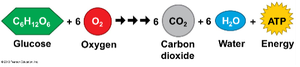
Overall Equation: Glucose + Oxygen → Carbon dioxide + Water + Energy (ATP)
Redox Reactions: Glucose is oxidized (loses electrons), oxygen is reduced (gains electrons).
Coenzymes: NAD+ and FAD act as electron carriers, becoming NADH and FADH2 when reduced.
ATP Synthesis: Occurs via substrate-level phosphorylation (direct transfer of phosphate) and oxidative phosphorylation (electron transport chain and chemiosmosis).
Major Stages: Glycolysis, Citric Acid Cycle, Oxidative Phosphorylation.
Redox Reactions in Cellular Respiration
Redox reactions are central to cellular respiration, involving the transfer of electrons and energy release.
Oxidation: Loss of electrons (and hydrogen) from a molecule.
Reduction: Gain of electrons (and hydrogen) by a molecule.
Electron Carriers: NAD+ and FAD accept electrons during oxidation of glucose, forming NADH and FADH2.
Role of Oxygen: Oxygen's high electronegativity makes it an efficient final electron acceptor, releasing energy as electrons "fall" to oxygen.
Stages of Cellular Respiration
Cellular respiration consists of three main stages, each contributing to ATP production.
Glycolysis: Occurs in the cytoplasm; breaks down glucose into two pyruvate molecules. Net gain: 2 ATP, 2 NADH.
Citric Acid Cycle (Krebs Cycle): Occurs in the mitochondrial matrix; completes oxidation of pyruvate. Net gain per glucose: 2 ATP, 6 NADH, 2 FADH2, 4 CO2.
Oxidative Phosphorylation: Occurs in the inner mitochondrial membrane; includes electron transport chain and chemiosmosis. Produces most ATP (~28-32 per glucose).
Glycolysis
Overview and Phases
Glycolysis is the first stage of cellular respiration, occurring in the cytoplasm and does not require oxygen.
Inputs: Glucose, 2 ATP, 2 NAD+
Outputs: 2 Pyruvate, 4 ATP (net gain 2), 2 NADH
Energy Investment Phase: 2 ATP are used to activate glucose, which splits into two G3P molecules.
Energy Payoff Phase: G3P is oxidized, producing NADH and ATP via substrate-level phosphorylation.
Oxygen Requirement: Glycolysis can occur without oxygen.
Pyruvate Oxidation and Citric Acid Cycle
Pyruvate Oxidation
Pyruvate produced in glycolysis is transported into the mitochondria and converted to acetyl-CoA.
Inputs: Pyruvate, NAD+, Coenzyme A
Outputs: Acetyl-CoA, NADH, CO2
Location: Mitochondrial matrix
ATP Production: None directly
Oxygen Requirement: Requires oxygen
Citric Acid Cycle (Krebs Cycle)
The citric acid cycle completes the breakdown of glucose, generating electron carriers and ATP.
Inputs: Acetyl-CoA, oxaloacetate, NAD+, FAD
Outputs: CO2, NADH, FADH2, ATP
Cycle: Oxaloacetate is regenerated, making the process cyclical.
Turns per Glucose: Two turns (one per pyruvate)
Net Production: 2 ATP, 6 NADH, 2 FADH2, 4 CO2 per glucose
Oxidative Phosphorylation
Electron Transport Chain and Chemiosmosis
Oxidative phosphorylation is the final stage, producing most of the cell's ATP.
Electron Transport Chain: Series of protein complexes (including cytochromes) in the inner mitochondrial membrane; electrons from NADH and FADH2 are passed down the chain to oxygen.
Final Electron Acceptor: Oxygen, forming water.
ATP Production: Energy released is used to pump H+ ions, creating a gradient.
Chemiosmosis: H+ flows back through ATP synthase, driving ATP synthesis.
Efficiency: About 34% of glucose energy is transferred to ATP; remainder lost as heat.
Fermentation and Anaerobic Respiration
Fermentation
Fermentation allows cells to produce ATP without oxygen, using glycolysis and reactions that regenerate NAD+.
ATP Production: Only 2 ATP per glucose (from glycolysis)
Types: Alcohol fermentation (produces ethanol and CO2), lactic acid fermentation (produces lactate)
Obligate Anaerobes: Cannot survive in presence of O2
Facultative Anaerobes: Can use fermentation or respiration
Human Muscle Cells: Use lactic acid fermentation during strenuous exercise
Evolutionary Significance of Glycolysis
Glycolysis is considered an ancient metabolic pathway, used by early prokaryotes before oxygen was abundant.
Location: Cytosol, does not require membrane-bound organelles
Significance: Universal pathway for energy production
Connecting Metabolic Pathways
Catabolic and Anabolic Pathways
Cellular respiration is interconnected with other metabolic pathways, allowing cells to utilize various nutrients and regulate energy production.
Catabolic Pathways: Proteins, fats, and carbohydrates can enter cellular respiration at different points.
Beta Oxidation: Fatty acids are broken down to acetyl-CoA, NADH, and FADH2; fats yield more ATP than carbohydrates.
Anabolic Pathways: Small molecules from glycolysis and citric acid cycle are used to build other compounds.
Feedback Inhibition: ATP and citrate inhibit glycolysis when abundant, regulating energy production.
Key Terms and Concepts
Aerobic/Anaerobic: Aerobic requires oxygen; anaerobic does not.
Cellular Respiration: Process of converting glucose and oxygen to ATP, CO2, and H2O.
Redox Reactions: Oxidation (loss of electrons), reduction (gain of electrons).
NAD+ & NADH: Electron carriers; NAD+ is reduced to NADH.
FAD & FADH2: Electron carriers; FAD is reduced to FADH2.
Glycolysis: First stage of cellular respiration; occurs in cytoplasm.
Citric Acid Cycle: Second stage; occurs in mitochondrial matrix.
Substrate-level Phosphorylation: Direct transfer of phosphate to ADP.
Oxidative Phosphorylation: ATP synthesis via electron transport chain and chemiosmosis.
Electron Transport Chain: Series of proteins transferring electrons to oxygen.
Chemiosmosis: ATP synthesis driven by H+ gradient.
Cytochromes: Proteins in electron transport chain with heme groups.
Fermentation: Anaerobic ATP production.
Obligate Anaerobes: Require anaerobic conditions.
Facultative Anaerobes: Can switch between aerobic and anaerobic metabolism.
Beta Oxidation: Breakdown of fatty acids for energy.
Summary Table: Stages of Cellular Respiration
Stage | Location | Inputs | Outputs | ATP Produced |
|---|---|---|---|---|
Glycolysis | Cytoplasm | Glucose, 2 ATP, 2 NAD+ | 2 Pyruvate, 2 NADH, 4 ATP (net 2) | 2 |
Pyruvate Oxidation | Mitochondrial Matrix | 2 Pyruvate, 2 NAD+, 2 CoA | 2 Acetyl-CoA, 2 NADH, 2 CO2 | 0 |
Citric Acid Cycle | Mitochondrial Matrix | 2 Acetyl-CoA, 6 NAD+, 2 FAD | 4 CO2, 6 NADH, 2 FADH2, 2 ATP | 2 |
Oxidative Phosphorylation | Inner Mitochondrial Membrane | NADH, FADH2, O2 | H2O, ATP | ~28-32 |
Key Equations
Overall Cellular Respiration:
NAD+ Reduction:
FAD Reduction:
