 뒤로
Cellular Respiration: Citric Acid Cycle, Electron Transport Chain, and Anaerobic Processes
스터디 가이드 - 스마트 노트
 자료에 맞춘 맞춤형 노트, 핵심 정의, 예시, 맥락을 확장해 제공합니다.
Cellular Respiration: Overview
Main Pathways of Cellular Respiration
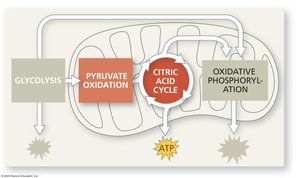
Cellular respiration is a multi-step process by which cells extract energy from glucose and other organic molecules. The process consists of glycolysis, pyruvate oxidation, the citric acid cycle, and oxidative phosphorylation. Each stage occurs in specific cellular locations and contributes to the overall production of ATP, the cell’s energy currency.
Glycolysis: Occurs in the cytosol; breaks down glucose into pyruvate.
Pyruvate Oxidation: Converts pyruvate to acetyl CoA in the mitochondrion.
Citric Acid Cycle (Krebs Cycle): Completes the oxidation of acetyl CoA, generating electron carriers.
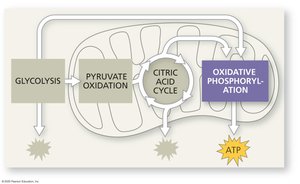
Oxidative Phosphorylation: Uses electron transport and chemiosmosis to produce most ATP.
Pyruvate Oxidation and the Citric Acid Cycle
Pyruvate Oxidation
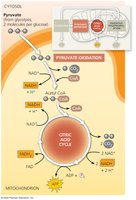
After glycolysis, pyruvate is transported into the mitochondrion if oxygen is present. Here, it is oxidized to acetyl CoA, releasing CO2 and producing NADH.
Location: Mitochondrial matrix (eukaryotes).
Products per glucose: 2 NADH, 2 CO2, 2 acetyl CoA.
Key enzyme: Pyruvate dehydrogenase complex.
Citric Acid Cycle (Krebs Cycle)
The citric acid cycle is a series of eight enzyme-catalyzed reactions that further oxidize acetyl CoA. Each turn of the cycle generates high-energy electron carriers and ATP.
Each cycle turn: 1 acetyl CoA enters, producing 1 ATP (or GTP), 3 NADH, 1 FADH2, and 2 CO2.
Per glucose: 2 turns, yielding 2 ATP, 6 NADH, 2 FADH2, 4 CO2.
Cycle steps: Acetyl group combines with oxaloacetate to form citrate; citrate is decomposed back to oxaloacetate.
Electron Transport Chain (ETC) and Oxidative Phosphorylation
Electron Transport Chain (ETC)
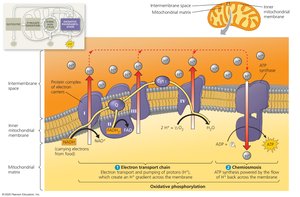
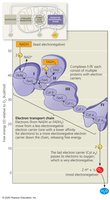
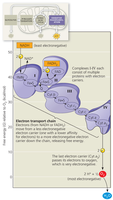
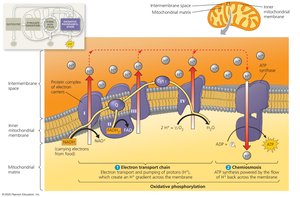
The ETC is a series of protein complexes (I-IV) embedded in the inner mitochondrial membrane. NADH and FADH2 donate electrons to the chain, which are transferred stepwise to oxygen, the final electron acceptor.
Location: Inner mitochondrial membrane.
Electron carriers: Cytochromes, ubiquinone, iron-sulfur proteins.
Energy release: Electrons lose free energy as they move down the chain, which is used to pump protons (H+) into the intermembrane space.
Role of oxygen: Oxygen accepts electrons at the end of the chain, forming water.
Free-Energy Change During Electron Transport
As electrons pass through the ETC, their free energy decreases. This energy is harnessed to pump protons across the membrane, creating a proton gradient (proton-motive force).
Electron donors: NADH donates electrons at the highest energy level; FADH2 donates at a lower level.
Energy drop: Stepwise transfer allows controlled energy release.
Chemiosmosis and ATP Synthesis
Mechanism of Chemiosmosis
Chemiosmosis is the process by which the energy stored in a proton gradient across the inner mitochondrial membrane is used to drive ATP synthesis. Protons flow back into the matrix through ATP synthase, a protein complex that catalyzes the formation of ATP from ADP and inorganic phosphate.
Proton-motive force: The gradient of H+ across the membrane.
ATP synthase: Uses the exergonic flow of protons to phosphorylate ADP.
Immediate energy source: The proton-motive force across the inner mitochondrial membrane.
Summary Table: Cellular Respiration Pathways
Pathway | Main Products | ATP Production | Electron Carriers | Location |
|---|---|---|---|---|
Glycolysis | Pyruvate, NADH | 2 ATP (substrate-level) | NADH | Cytosol |
Pyruvate Oxidation | Acetyl CoA, NADH, CO2 | 0 | NADH | Mitochondrial matrix |
Citric Acid Cycle | CO2, NADH, FADH2, ATP | 2 ATP (substrate-level) | NADH, FADH2 | Mitochondrial matrix |
Oxidative Phosphorylation | ATP, H2O | ~26-28 ATP (oxidative) | --- | Inner mitochondrial membrane |
Anaerobic Processes: Anaerobic Respiration and Fermentation
Anaerobic Respiration
In the absence of oxygen, some cells use anaerobic respiration, employing an electron transport chain with a terminal electron acceptor other than O2 (e.g., sulfate).
Electron transport chain: Present, but uses alternative acceptors.
ATP yield: Lower than aerobic respiration due to less electronegative acceptors.
Examples: Sulfate (SO42-), nitrate (NO3-).
Fermentation
Fermentation allows cells to produce ATP without an electron transport chain. It relies solely on glycolysis and substrate-level phosphorylation.
Electron transport chain: Not used.
ATP yield: Very low (2 ATP per glucose).
Types: Alcohol fermentation (produces ethanol), lactic acid fermentation (produces lactate).
Key Concepts and Definitions
Substrate-level phosphorylation: Direct transfer of a phosphate group to ADP to form ATP during glycolysis and the citric acid cycle.
Oxidative phosphorylation: ATP synthesis powered by the energy released from electron transport and chemiosmosis.
NADH and FADH2: Electron carriers that link the citric acid cycle to the electron transport chain.
Electron flow down the chain: Refers to the stepwise transfer of electrons from NADH/FADH2 to O2 via the ETC, releasing energy.
Summary Table: Anaerobic Respiration vs. Fermentation
Process | Electron Transport Chain | ATP Production | Final Electron Acceptor | Examples |
|---|---|---|---|---|
Anaerobic Respiration | Yes | Moderate | Sulfate, nitrate, etc. | Bacteria |
Fermentation | No | Low | Organic molecules (pyruvate, acetaldehyde) | Yeast, muscle cells |
Equations
Overall equation for aerobic cellular respiration:
ATP yield from complete oxidation of glucose:
Additional info:
ATP synthase is a rotary enzyme that uses the flow of protons to drive the synthesis of ATP.
Fermentation is essential for cells that lack mitochondria or are in environments without oxygen.
Electron carriers (NADH, FADH2) are crucial for linking metabolic pathways and facilitating energy transfer.
