 뒤로
Cellular Respiration, Photosynthesis, and Cell Structure: Study Notes for General Biology
스터디 가이드 - 스마트 노트
 자료에 맞춘 맞춤형 노트, 핵심 정의, 예시, 맥락을 확장해 제공합니다.
Biology: The Study of Life
Characteristics of Life
Biology is the study of living organisms, which are defined by several key characteristics. All living things are composed of cells, can replicate, store and use information (genes), require energy, and evolve over time.
Cell: The basic unit of life, surrounded by a membrane that regulates material passage.
Replication: The ability to reproduce and pass genetic information to offspring.
Information: Genetic material (DNA/RNA) directs cellular activities.
Energy: Organisms obtain energy by absorbing sunlight (plants) or ingesting food (animals).
Evolution: Populations of organisms change over time through natural selection.
Water and Carbon: The Chemical Basis of Life
Atomic Structure and Chemical Bonds
Atoms are the fundamental units of matter, consisting of protons, neutrons, and electrons. Chemical bonds form between atoms to create molecules, which are essential for biological processes.
Ions: Atoms or molecules with an electric charge due to loss or gain of electrons.
Isotopes: Variants of elements with the same number of protons but different numbers of neutrons.
Covalent Bonds: Strong bonds formed by sharing electrons.
Ionic Bonds: Bonds formed by transfer of electrons.
Hydrogen Bonds: Weak bonds important for water and biological molecules.
Van der Waals Forces: Weak interactions between molecules.
Hydrophobic Interactions: Nonpolar molecules aggregate to avoid water.
Properties of Water
Water is a polar molecule with unique properties that make it an efficient solvent for biological reactions.
Polarity: Water's bent shape and polar covalent bonds result in partial charges.
Solvent Ability: Water dissolves many substances due to its polarity.
Cellular Respiration
Overview of Cellular Metabolism
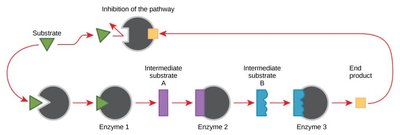
Cellular respiration is a series of metabolic pathways that convert glucose and other molecules into energy (ATP). It is regulated by feedback inhibition, where the end product inhibits the pathway to prevent overproduction.
Metabolic Pathway: Linked sequence of reactions converting starting molecules to final products.
Feedback Inhibition: End product inhibits an earlier enzyme in the pathway.
Glucose as a Metabolic Substrate
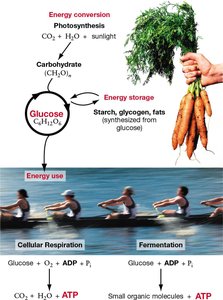
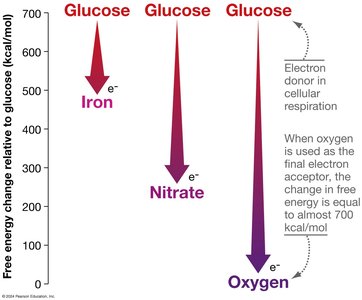
Glucose is the primary substrate for cellular respiration. It can be metabolized aerobically (with oxygen) or anaerobically (without oxygen).
Aerobic Respiration: Occurs in eukaryotes, requires oxygen, and produces more energy.
Anaerobic Respiration/Fermentation: Occurs in prokaryotes, does not require oxygen, produces less energy.
Aerobic Respiration in Eukaryotes
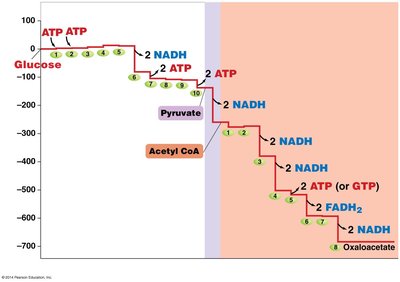
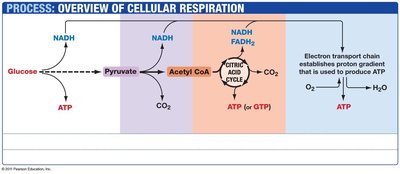
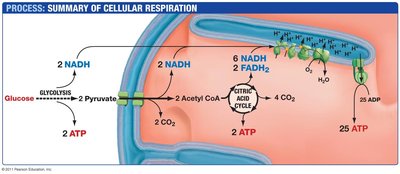
Aerobic respiration occurs in the mitochondria, involving glycolysis, pyruvate processing, the citric acid cycle, and the electron transport chain (ETC).
Glycolysis: Occurs in the cytosol, breaks glucose into pyruvate.
Pyruvate Processing: Converts pyruvate to Acetyl CoA.
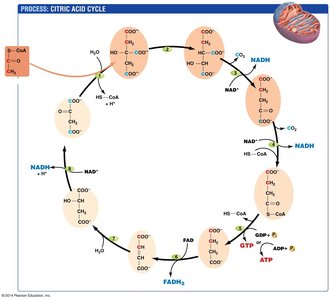
Citric Acid Cycle (Krebs Cycle): Oxidizes Acetyl CoA, produces NADH, FADH2, ATP, and CO2.
Electron Transport Chain: Uses NADH and FADH2 to produce ATP via oxidative phosphorylation.
Electron Transport Chain and ATP Synthesis
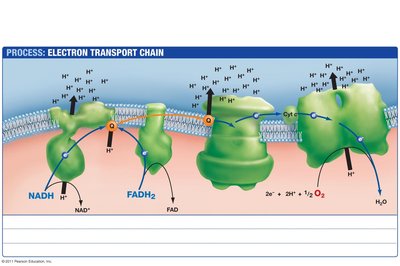
The ETC is a series of protein complexes in the inner mitochondrial membrane that transfer electrons and create a proton gradient, driving ATP synthesis.
NADH and FADH2: Electron carriers that donate electrons to the ETC.
ATP Synthase: Enzyme that uses the proton gradient to synthesize ATP.
Summary of Cellular Respiration
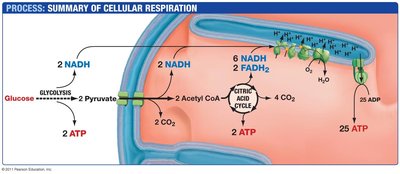
Cellular respiration produces ATP, CO2, and H2O from glucose and oxygen. The process is highly efficient when oxygen is the final electron acceptor.
Overall Reaction:
Energy Yield: Up to 30-32 ATP per glucose molecule.
Fermentation
When oxygen is absent, cells use fermentation to regenerate NAD+ and produce ATP. Common products are lactic acid (in animals) and alcohol (in yeast).
Lactic Acid Fermentation: Pyruvate is reduced to lactic acid.
Alcohol Fermentation: Pyruvate is converted to ethanol and CO2.
Photosynthesis
Overview of Photosynthesis
Photosynthesis is the process by which plants, algae, and some bacteria convert sunlight, water, and carbon dioxide into carbohydrates and oxygen.
Overall Reaction:
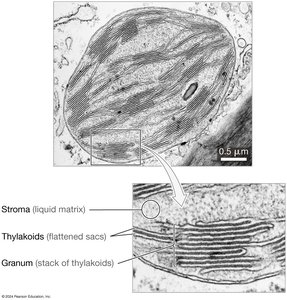
Occurs in Chloroplasts: Specialized organelles in plant cells.
Light-Capturing Reactions
Light reactions occur in the thylakoid membranes, where sunlight is absorbed by pigments (chlorophylls and carotenoids) and converted to chemical energy (ATP and NADPH).
Photosystem II: Produces ATP via photophosphorylation.
Photosystem I: Produces NADPH.
Z-Scheme: Describes the flow of electrons from water to NADP+.
Calvin Cycle
The Calvin cycle uses ATP and NADPH to fix carbon dioxide and produce sugars. It occurs in the stroma of the chloroplast.
Carbon Fixation: Addition of CO2 to organic molecules.
Rubisco: Key enzyme for carbon fixation, but can also bind O2 (competitive inhibition).
C4 and CAM Plants: Adaptations to reduce photorespiration and increase efficiency in hot, dry environments.
Inside the Cell: Cell Structure and Function
Prokaryotes vs. Eukaryotes
Cells are classified as prokaryotic or eukaryotic based on their internal structure.
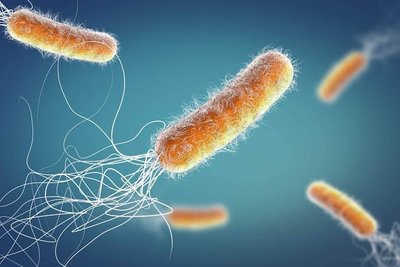
Prokaryotes: Lack a nucleus and membrane-bound organelles; include bacteria and archaea.
Eukaryotes: Have a nucleus and many organelles; include plants, animals, fungi, and protists.
Cell Organelles and Functions
Eukaryotic cells contain specialized organelles that perform distinct functions.
Nucleus: Stores genetic information.
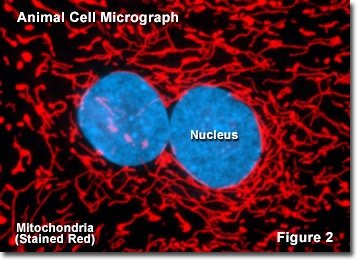
Mitochondria: Site of cellular respiration and ATP production.
Chloroplasts: Site of photosynthesis in plants.
Endoplasmic Reticulum (ER): Protein and lipid synthesis.
Golgi Apparatus: Protein modification and sorting.
Lysosomes/Vacuoles: Waste disposal and storage.
Cellular Metabolism and Regulation
Metabolic pathways are interconnected and regulated to maintain cellular homeostasis. Feedback inhibition is a common regulatory mechanism.
Catabolic Pathways: Break down molecules to release energy.
Anabolic Pathways: Build complex molecules from simpler ones.
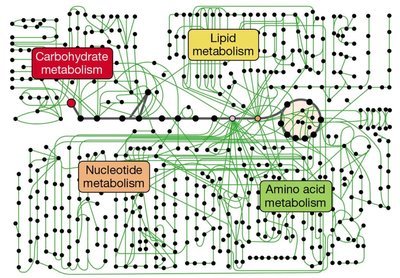
Energy and Enzymes: Metabolism
Enzyme Function and Regulation
Enzymes are biological catalysts that speed up chemical reactions. They are regulated by allosteric and feedback inhibition.
Active Site: Region where substrate binds and reaction occurs.
Allosteric Regulation: Molecule binds to a site other than the active site, changing enzyme activity.
Feedback Inhibition: End product inhibits an earlier step in the pathway.
Summary Table: Cellular Respiration Steps
Step | Main Location | Key Products |
|---|---|---|
Glycolysis | Cytosol | Pyruvate, ATP, NADH |
Pyruvate Processing | Mitochondrial Matrix | Acetyl CoA, CO2, NADH |
Citric Acid Cycle | Mitochondrial Matrix | CO2, ATP, NADH, FADH2 |
Electron Transport Chain | Inner Mitochondrial Membrane | ATP, H2O |
Additional info:
Some details about metabolic regulation, cell structure, and photosynthesis were inferred and expanded for completeness.
Images were included only when directly relevant to the explanation of the adjacent paragraph.
