 뒤로
Central Dogma, Replication, Transcription, and Translation Study Guide
스터디 가이드 - 스마트 노트
 자료에 맞춘 맞춤형 노트, 핵심 정의, 예시, 맥락을 확장해 제공합니다.
Q1. The Central Dogma: Fill in the blanks
Background
Topic: Central Dogma of Molecular Biology
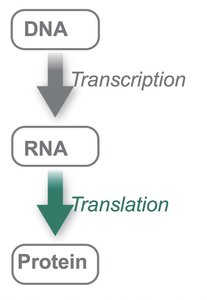
This question tests your understanding of how genetic information flows from DNA to RNA to protein, a fundamental concept in biology.
Key Terms:
DNA bases: The nucleotide sequence in DNA (A, T, C, G).
RNA bases: The nucleotide sequence in RNA (A, U, C, G).
Amino acids: Building blocks of proteins.
Transcription: The process of copying DNA into RNA.
Translation: The process of converting RNA into a protein sequence.
Step-by-Step Guidance
Recall that genetic information is stored in DNA as a sequence of nucleotide bases.
During transcription, this information is copied into RNA, which also consists of nucleotide bases.
During translation, the sequence of RNA bases is read in sets of three (codons) to specify amino acids, which are then linked to form a protein.
Review the answer choices and match each step of the central dogma to the correct sequence: DNA bases → RNA bases → amino acids.
Try solving on your own before revealing the answer!
Final Answer: D. DNA bases, RNA bases, amino acids
The central dogma describes the flow of genetic information: DNA is transcribed into RNA, which is then translated into protein (amino acids).
Q2. mRNA Codons and Translation
Background
Topic: Codons and the Genetic Code
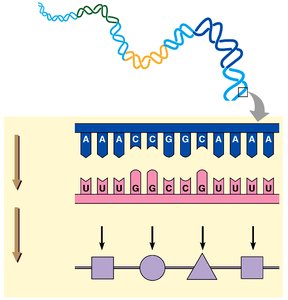
This question tests your understanding of how mRNA is read by ribosomes in three-nucleotide units (codons) and how each codon specifies an amino acid or a stop signal.
Key Terms:
Codon: A sequence of three RNA nucleotides that codes for an amino acid.
Ribosome: The molecular machine that reads mRNA and synthesizes proteins.
Polypeptide: A chain of amino acids.
Step-by-Step Guidance
Understand that mRNA is read in sets of three nucleotides (codons).
Each codon corresponds to a specific amino acid or a stop signal.
Use a codon table to determine which amino acid is specified by a given mRNA codon.
Remember that translation occurs in the ribosome, where tRNA brings the correct amino acid for each codon.
Try solving on your own before revealing the answer!
Final Answer: Each codon specifies an amino acid or stop signal
mRNA is read by the ribosome in three-nucleotide units (codons), and each codon codes for an amino acid or a stop signal.
Q3. Directionality of Nucleic Acid Synthesis
Background
Topic: DNA and RNA Synthesis
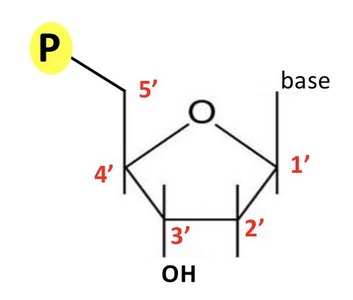
This question tests your understanding of the chemical directionality of nucleic acid synthesis, specifically which part of the sugar molecule new nucleotides are added to.
Key Terms:
3' OH: The hydroxyl group on the 3' carbon of the sugar in a nucleotide.
5' and 3' ends: Refers to the directionality of nucleic acid strands.
Step-by-Step Guidance
Recall that nucleic acids (DNA and RNA) have directionality, with a 5' end and a 3' end.
New nucleotides are always added to the 3' OH group of the sugar, extending the chain in the 5' to 3' direction.
Review the structure of a nucleotide and identify the 3' OH group.
Consider why this directionality is important for replication and transcription.
Try solving on your own before revealing the answer!
Final Answer: C. 3' OH of sugar
New nucleotides are added to the 3' OH group of the sugar, which is essential for the synthesis of DNA and RNA.
Q4. DNA Strand Polarity and Replication
Background
Topic: DNA Replication and Strand Polarity
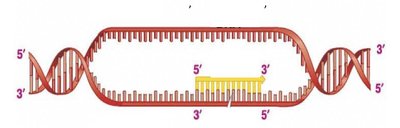
This question tests your understanding of the antiparallel nature of DNA strands and how new DNA is synthesized during replication.
Key Terms:
Leading strand: Synthesized continuously in the 5' to 3' direction.
Lagging strand: Synthesized discontinuously in fragments (Okazaki fragments).
Origin of replication: The site where DNA replication begins.
Step-by-Step Guidance
Identify the directionality of each DNA strand at the replication fork.
Recall that DNA polymerase synthesizes new DNA in the 5' to 3' direction.
Determine which strands are synthesized continuously (leading) and which are synthesized discontinuously (lagging).
Use the diagram to locate the origins and the direction of synthesis for each strand.
Try solving on your own before revealing the answer!
Final Answer: Areas with new DNA made as leading strands are those where synthesis proceeds toward the replication fork in the 5' to 3' direction.
Leading strands are synthesized continuously toward the replication fork, while lagging strands are synthesized away from the fork in fragments.
Q5. Template and Coding Strands in Transcription
Background
Topic: Transcription and DNA Strand Roles
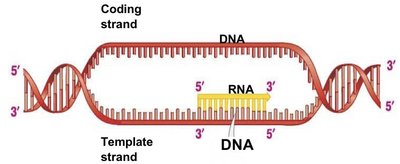
This question tests your understanding of which DNA strand serves as the template for mRNA synthesis and the relationship between the coding and template strands.
Key Terms:
Template strand: The DNA strand used by RNA polymerase to synthesize mRNA.
Coding strand: The DNA strand with the same sequence as the mRNA (except T instead of U).
Sense strand: Another name for the coding strand.
Step-by-Step Guidance
Identify the two DNA strands: one is the template, and one is the coding strand.
The template strand is read by RNA polymerase in the 3' to 5' direction to synthesize mRNA in the 5' to 3' direction.
The coding strand has the same sequence as the mRNA, except T is replaced by U.
Use the diagram to determine which strand is the template based on directionality and sequence.
Try solving on your own before revealing the answer!
Final Answer: B. Bottom strand is the template strand
The template strand is the one that RNA polymerase reads to synthesize mRNA; the coding strand matches the mRNA sequence.
