 뒤로
Chapter 10: Photosynthesis – The Process That Feeds the Biosphere
스터디 가이드 - 스마트 노트
 자료에 맞춘 맞춤형 노트, 핵심 정의, 예시, 맥락을 확장해 제공합니다.
Photosynthesis: The Process That Feeds the Biosphere
Autotrophs and Heterotrophs
Photosynthesis is the fundamental process by which autotrophs convert light energy into chemical energy, sustaining life on Earth. Autotrophs are organisms that produce their own food from inorganic substances, while heterotrophs rely on consuming other organisms for energy.
Autotrophs: "Self-feeders" that synthesize organic molecules from CO2 and water.
Photoautotrophs: Use sunlight to drive photosynthesis (e.g., plants, algae, cyanobacteria).
Heterotrophs: Obtain organic material by consuming other organisms or decomposing organic matter.
Dependency: Almost all heterotrophs depend on photoautotrophs for food and oxygen.
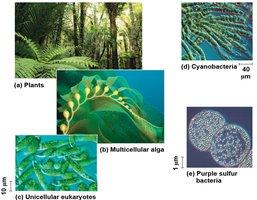
Major Sites of Photosynthesis in Plants
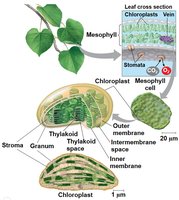
Photosynthesis primarily occurs in the leaves of plants, specifically within the mesophyll cells, which contain numerous chloroplasts. Gas exchange occurs through stomata, small pores on the leaf surface.
Mesophyll: Interior tissue of the leaf where most chloroplasts are found.
Chloroplasts: Organelles responsible for photosynthesis; each mesophyll cell contains 30–40 chloroplasts.
Stomata: Microscopic pores for gas exchange (CO2 in, O2 out).
Concept 10.1: Photosynthesis Converts Light Energy to Chemical Energy
Chloroplast Structure
Chloroplasts are double-membraned organelles containing a dense fluid called stroma and a third membrane system composed of thylakoids, which may be stacked into grana. Chlorophyll, the green pigment, is embedded in thylakoid membranes.
Stroma: Fluid inside the chloroplast where the Calvin cycle occurs.
Thylakoids: Flattened sacs forming the site of light reactions.
Grana: Stacks of thylakoids.
Chlorophyll: Pigment responsible for capturing light energy.
Photosynthesis Equation and Atom Tracking
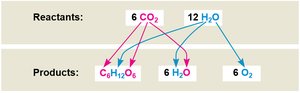
Photosynthesis is a complex series of reactions summarized by the following equation:
Overall Reaction:
Reverse of Cellular Respiration: The process is essentially the opposite of cellular respiration.
Redox Changes: CO2 is reduced to sugar, H2O is oxidized to O2.

Stages of Photosynthesis
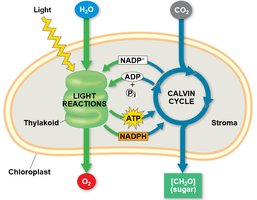
Photosynthesis consists of two main stages: the light reactions and the Calvin cycle.
Light Reactions: Occur in thylakoids; split water, release O2, reduce NADP+ to NADPH, and generate ATP by photophosphorylation.
Calvin Cycle: Occurs in stroma; begins with carbon fixation, uses ATP and NADPH to synthesize sugars.
Concept 10.2: The Light Reactions Convert Solar Energy to Chemical Energy
The Electromagnetic Spectrum and Visible Light
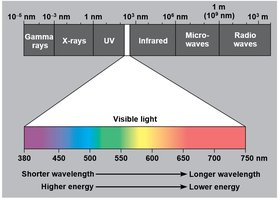
The electromagnetic spectrum encompasses all wavelengths of electromagnetic energy. Photosynthesis utilizes visible light (380–750 nm), which is perceived as color.
Photons: Discrete particles of light energy.
Visible Light: Drives photosynthesis; shorter wavelengths have higher energy.
Photosynthetic Pigments: Light Receptors
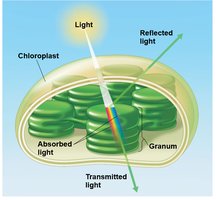
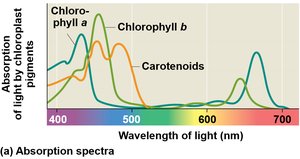
Pigments absorb specific wavelengths of light, with chlorophyll reflecting and transmitting green light. Different pigments broaden the spectrum of light used for photosynthesis.
Chlorophyll a: Primary pigment for light capture.
Chlorophyll b: Accessory pigment.
Carotenoids: Accessory pigments for photoprotection and broadening absorption.
Structure of Chlorophyll Molecules
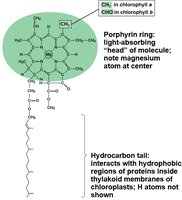
Chlorophyll molecules consist of a porphyrin ring with a magnesium atom at the center and a hydrophobic hydrocarbon tail that anchors the molecule in the thylakoid membrane.
Excitation of Chlorophyll by Light
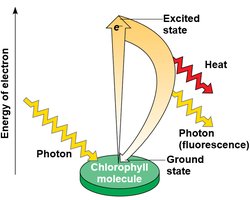
When chlorophyll absorbs light, electrons are excited to a higher energy state. As they return to the ground state, energy is released as heat or fluorescence.
Photosystems: Reaction-Center Complexes
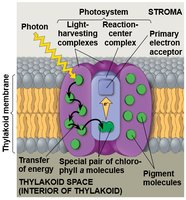
A photosystem is a complex of proteins and pigments that harvest light energy. It consists of a reaction-center complex and light-harvesting complexes.
Reaction-center complex: Contains special chlorophyll a molecules and a primary electron acceptor.
Light-harvesting complex: Transfers energy to the reaction center.
Types of Photosystems
There are two photosystems in the thylakoid membrane:
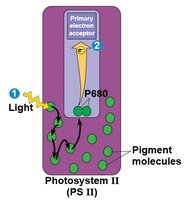
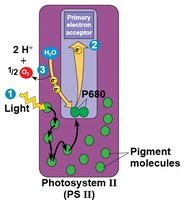
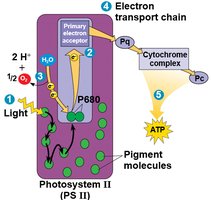
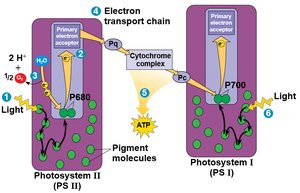
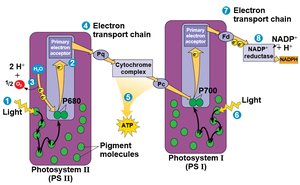
Photosystem II (PS II): Functions first; reaction-center chlorophyll is P680 (absorbs 680 nm).
Photosystem I (PS I): Functions second; reaction-center chlorophyll is P700 (absorbs 700 nm).
Linear Electron Flow in Light Reactions
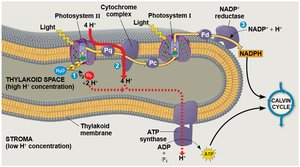
Linear electron flow involves the transfer of electrons from water to NADP+ via both photosystems, generating ATP and NADPH.
Light excites electrons in PS II (P680).
Water is split, releasing O2 and protons.
Electrons move through an electron transport chain, generating ATP.
Electrons reach PS I (P700), are re-excited, and reduce NADP+ to NADPH.
Comparison of Chemiosmosis in Mitochondria and Chloroplasts
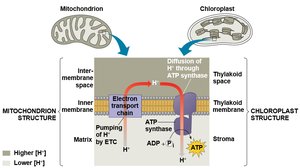
Both mitochondria and chloroplasts use chemiosmosis to generate ATP, but differ in their structures and sources of energy.
Mitochondria: Use energy from food molecules.
Chloroplasts: Use light energy to drive ATP synthesis.
Organization of the Thylakoid Membrane
The thylakoid membrane is organized to facilitate light reactions, electron transport, and ATP synthesis.
Concept 10.3: The Calvin Cycle Uses ATP and NADPH to Reduce CO2 to Sugar
The Calvin Cycle
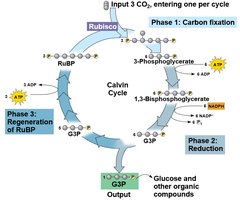
The Calvin cycle is the set of reactions that convert CO2 into organic molecules using ATP and NADPH. It consists of three phases:
Carbon Fixation: CO2 is attached to RuBP by the enzyme rubisco.
Reduction: ATP and NADPH are used to convert 3-phosphoglycerate into G3P.
Regeneration: RuBP is regenerated to continue the cycle.
Output: For every three turns, one G3P molecule is produced.
Example: The Calvin cycle is essential for the synthesis of glucose and other organic compounds in plants.
Additional info: The Calvin cycle is sometimes referred to as the "dark reactions" because it does not require light directly, but depends on the products of the light reactions.
