 뒤로
Chapter 33: An Introduction to Invertebrates – Study Notes
스터디 가이드 - 스마트 노트
 자료에 맞춘 맞춤형 노트, 핵심 정의, 예시, 맥락을 확장해 제공합니다.
An Introduction to Invertebrates
Overview: Life Without a Backbone
Invertebrates are animals without a backbone, accounting for 95% of known animal species and representing nearly all animal phyla. Their adaptation to diverse environments has resulted in a remarkable variety of forms and functions.
Habitat Diversity: Invertebrates inhabit nearly all environments, from deep-sea vents to polar regions.
Evolutionary Significance: Their evolutionary adaptations have produced extensive morphological diversity.
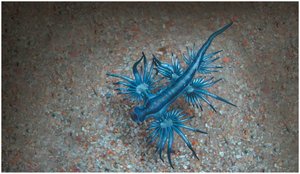
Example: The thin, blue "fingers" of the organism in the image are likely specialized appendages for feeding or defense, illustrating the diversity of invertebrate adaptations.
Concept 33.1: Sponges are Basal Animals that Lack True Tissues
Phylum Porifera: Structure and Function
Sponges are simple, sedentary animals that lack true tissues but possess several specialized cell types. They are considered basal animals, originating near the root of the animal phylogenetic tree.
Body Structure: The sponge body is a sac perforated with pores, allowing water to flow into a central cavity (spongocoel) and exit through the osculum.
Cell Types: Includes choanocytes (collar cells) for feeding, and amoebocytes for nutrient distribution and skeletal fiber production.
Skeletal Elements: Sponges may have sharp spicules (calcium carbonate or silica) or flexible spongin fibers.
Reproduction: Most are sequential hermaphrodites; sperm is released into water, fertilizing eggs in neighboring sponges.
Medical Relevance: Sponges produce antibiotics and compounds with potential anti-cancer properties.
Definition: Spongocoel – The central cavity of a sponge through which water flows.
Concept 33.2: Cnidarians – Ancient Eumetazoans
Phylum Cnidaria: Body Plan and Diversity
Cnidarians are among the oldest animal lineages with true tissues. They exhibit a simple, diploblastic, radial body plan and include jellyfish, corals, and hydras.
Body Plan: Sac-like structure with a central gastrovascular cavity and a single opening serving as both mouth and anus.
Forms: Two main variations: sessile polyp and motile medusa.
Feeding: Carnivorous, using tentacles with cnidocytes (stinging cells) to capture prey.
Defense: Specialized nematocysts inject toxins into prey.
Nervous System: Noncentralized nerve net with simple sensory receptors.
Major Clades: Medusozoans (Hydrozoa, Scyphozoa, Cubozoa) and Anthozoans (sea anemones, corals).
Example: Coral reefs, built by anthozoan polyps, provide habitat for diverse marine life but are threatened by pollution and climate change.
Concept 33.3: Lophotrochozoans – Diversity of Body Forms
Bilateria and Lophotrochozoa
Lophotrochozoans are a major clade of bilaterally symmetrical, triploblastic animals, identified by molecular data. They include flatworms, rotifers, ectoprocts, brachiopods, molluscs, and annelids.
Key Features: Bilateral symmetry, triploblastic development, coelom, and digestive tract with mouth and anus.
Lophophore: Crown of ciliated tentacles for feeding (in some groups).
Trochophore Larva: Distinctive larval stage (in some groups).
Phylum Platyhelminthes: Flatworms
Body Plan: Thin, dorsoventrally flattened, acoelomate.
Gas Exchange: Occurs by diffusion; no specialized organs.
Excretory System: Protonephridia with flame bulbs.
Reproduction: Both asexual (regeneration, budding) and sexual (hermaphroditic cross-fertilization).
Parasitic Groups: Trematodes (blood flukes), tapeworms.
Phylum Rotifera: Rotifers
Body Plan: Pseudocoelomate, complete digestive tract.
Feeding: Crown of cilia creates a vortex, jaws (trophi) grind food.
Reproduction: Parthenogenesis (asexual), sexual reproduction under certain conditions.
Lophophorates: Ectoprocts and Brachiopods
Lophophore: Feeding structure with ciliated tentacles.
Body Cavity: True coelom.
Digestive Tract: U-shaped, no distinct head.
Phylum Mollusca: Molluscs
Body Plan: Muscular foot, visceral mass, mantle.
Feeding: Radula for scraping food.
Clades: Polyplacophora (chitons), Gastropoda (snails, slugs), Bivalvia (clams, oysters), Cephalopoda (squids, octopuses).
Circulatory System: Cephalopods have a closed system; others open.
Threats: Habitat loss, pollution, invasive species.
Phylum Annelida: Segmented Worms
Body Plan: Segmented, coelomate.
Clades: Errantia (mobile, marine), Sedentaria (earthworms, leeches).
Reproduction: Hermaphroditic cross-fertilization, asexual fragmentation.
Medical Relevance: Leeches produce hirudin, an anticoagulant used clinically.
Concept 33.4: Ecdysozoans – The Most Species-Rich Animal Group
Ecdysozoa: Molting Animals
Ecdysozoans are defined by their ability to shed a tough external cuticle as they grow (ecdysis). This clade includes nematodes and arthropods, the most successful and abundant animal groups.
Phylum Nematoda: Roundworms
Body Plan: Cylindrical, unsegmented, covered by a cuticle.
Habitat: Aquatic, soil, plant tissues, animal bodies.
Reproduction: Sexual, internal fertilization.
Medical Relevance: Parasitic species cause diseases (e.g., trichinosis).
Phylum Arthropoda: Arthropods
Body Plan: Segmented, jointed appendages, exoskeleton of chitin.
Sense Organs: Eyes, antennae, olfactory receptors.
Circulatory System: Open, hemolymph fills body sinuses.
Gas Exchange: Gills (aquatic), tracheal systems (terrestrial).
Major Lineages: Chelicerates (spiders, scorpions), Myriapods (centipedes, millipedes), Pancrustaceans (insects, crustaceans).
Reproduction: Usually sexual, internal fertilization.
Metamorphosis: Incomplete (nymphs) and complete (larvae, pupae, adults).
Ecological Roles: Pollinators, decomposers, disease vectors, agricultural pests.
Crustaceans
Habitat: Mostly marine and freshwater, some terrestrial.
Body Plan: Specialized appendages, carapace, gills.
Reproduction: Separate sexes, copulation, swimming larval stages.
Ecological Importance: Planktonic crustaceans (copepods, krill) are major food sources in aquatic ecosystems.
Concept 33.5: Echinoderms and Chordates – Deuterostomes
Deuterostomia: Developmental and Genetic Features
Echinoderms and chordates are closely related, sharing deuterostome developmental features such as radial cleavage and formation of the anus from the blastopore. DNA evidence defines the clade Deuterostomia.
Phylum Echinodermata: Echinoderms
Body Plan: Endoskeleton of calcareous plates, water vascular system, secondary radial symmetry.
Locomotion: Tube feet powered by hydraulic canals.
Reproduction: Sexual, gametes released into seawater.
Clades: Asteroidea (sea stars, sea daisies), Ophiuroidea (brittle stars), Echinoidea (sea urchins, sand dollars), Crinoidea (sea lilies, feather stars), Holothuroidea (sea cucumbers).
Regeneration: Many echinoderms can regenerate lost arms or body parts.
Phylum Chordata: Chordates
Groups: Includes two invertebrate subphyla and all vertebrates.
Evolution: Echinoderms and chordates have existed as distinct phyla for over half a billion years.
