 뒤로
Chapter 5: The Working Cell – Membranes, Energy, and Enzymes (Study Notes)
스터디 가이드 - 스마트 노트
 자료에 맞춘 맞춤형 노트, 핵심 정의, 예시, 맥락을 확장해 제공합니다.
Chapter 5: The Working Cell – Membranes, Energy, and Enzymes
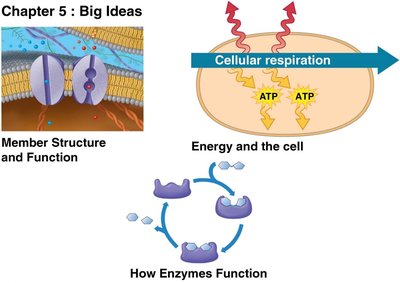
Membrane Structure and Function
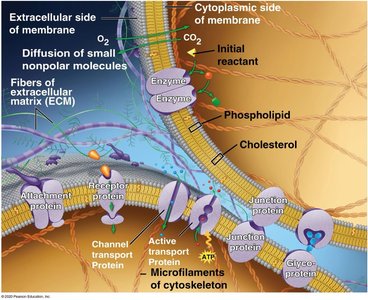
The plasma membrane is a dynamic structure that separates the cell from its environment and regulates the movement of substances in and out of the cell. It is composed primarily of a phospholipid bilayer with embedded proteins, cholesterol, and carbohydrates, forming a fluid mosaic model.
Fluid Mosaic Model: Describes the membrane as a flexible layer made of lipid molecules interspersed with large protein molecules that act as channels through which other molecules enter and leave the cell.
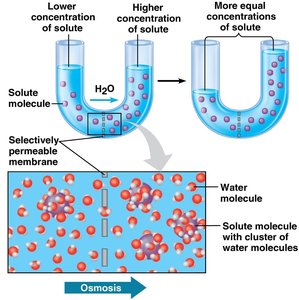
Selective Permeability: The membrane allows some substances to cross more easily than others, maintaining the internal environment of the cell.
Membrane Proteins: Serve various functions including transport, enzymatic activity, signal transduction, cell-cell recognition, intercellular joining, and attachment to the cytoskeleton and extracellular matrix.
Selective Permeability and Membrane Proteins
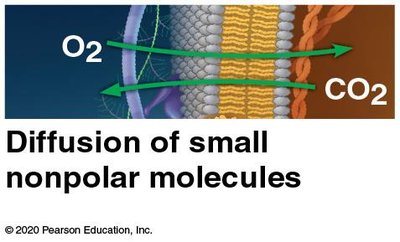
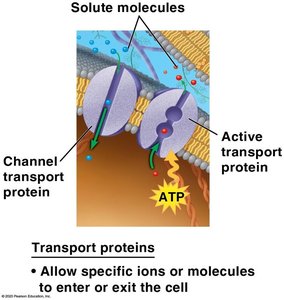
The hydrophobic core of the phospholipid bilayer allows small, nonpolar molecules (such as O2 and CO2) to diffuse directly through the membrane, while ions and polar molecules require specific transport proteins.
Channel Proteins: Provide hydrophilic pathways for specific ions or molecules to cross the membrane.
Active Transport Proteins: Use ATP to move solutes against their concentration gradient.
Enzymes and Receptor Proteins in Membranes
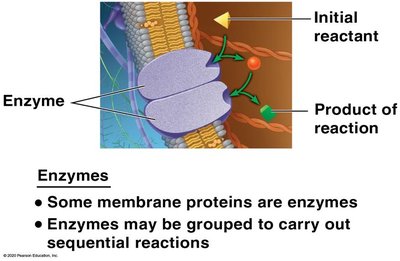
Enzymes: Some membrane proteins catalyze sequential reactions, passing products from one enzyme to the next.
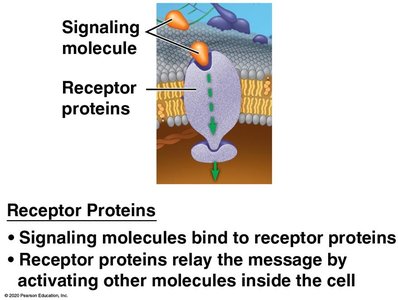
Receptor Proteins: Bind signaling molecules and relay messages into the cell by changing shape and activating internal pathways.
Passive Transport: Diffusion and Osmosis
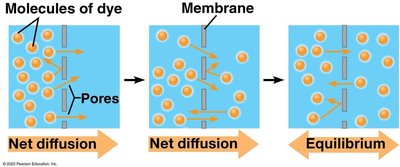
Diffusion is the movement of particles from an area of higher concentration to an area of lower concentration, driven by the concentration gradient. Passive transport does not require energy input from the cell.
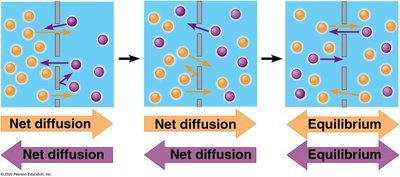
Each type of molecule diffuses independently until equilibrium is reached.
Facilitated diffusion uses membrane proteins to help polar or charged substances cross the membrane.
Osmosis: The Diffusion of Water
Osmosis is the diffusion of water across a selectively permeable membrane. Water moves from areas of higher free water concentration (lower solute concentration) to areas of lower free water concentration (higher solute concentration).
Solute molecules bind water, reducing the number of free water molecules on that side of the membrane.
Net water flow is toward the side with higher solute concentration.
Water Balance and Tonicity
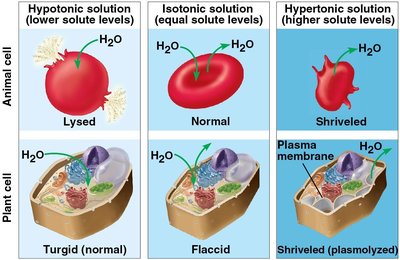
Tonicity describes the ability of a solution to cause a cell to gain or lose water. The effects differ between animal and plant cells due to the presence of a cell wall in plants.
Hypotonic Solution: Lower solute concentration outside; water enters the cell. Animal cells may lyse, plant cells become turgid (normal).
Isotonic Solution: Equal solute concentration; no net water movement. Animal cells are normal, plant cells are flaccid.
Hypertonic Solution: Higher solute concentration outside; water leaves the cell. Animal cells shrivel, plant cells undergo plasmolysis.
Bulk Transport: Exocytosis and Endocytosis
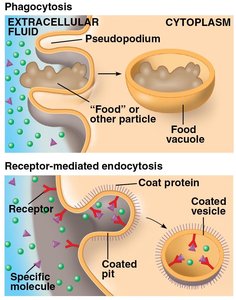
Large molecules or particles are transported across the membrane via vesicles in processes called exocytosis and endocytosis.
Exocytosis: Vesicles fuse with the plasma membrane to release contents outside the cell.
Phagocytosis: The cell engulfs large particles or cells by wrapping pseudopodia around them.
Receptor-mediated endocytosis: Specific molecules bind to receptors, triggering vesicle formation.
Passive vs. Active Transport
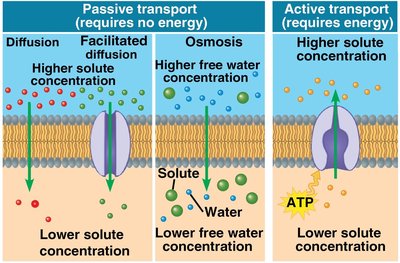
Passive transport moves substances down their concentration gradient without energy input. Active transport requires ATP to move substances against their gradient.
Diffusion, facilitated diffusion, and osmosis are passive processes.
Active transport uses membrane proteins and ATP to move solutes from low to high concentration.
ATP: The Energy Currency of the Cell
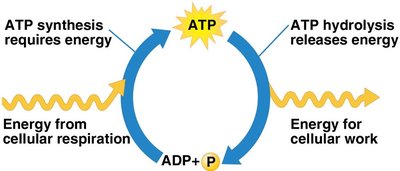
Adenosine triphosphate (ATP) stores and transfers energy within cells. The hydrolysis of ATP releases energy for cellular work.
ATP Structure: Adenosine molecule bonded to three phosphate groups.
Hydrolysis: Water breaks the terminal phosphate bond, forming ADP and inorganic phosphate, releasing energy.
ATP Cycle: Cellular respiration regenerates ATP from ADP and phosphate.

Enzymes: Biological Catalysts
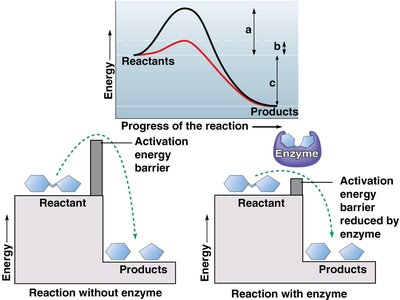
Enzymes are proteins that speed up chemical reactions by lowering the activation energy barrier. They are not consumed in the reaction and can be used repeatedly.
Activation Energy: The initial energy required to start a reaction.
Enzymes lower activation energy, allowing reactions to proceed rapidly at body temperature.
The net energy change of the reaction is not affected by the enzyme.
How Enzymes Function: The Catalytic Cycle
Each enzyme has a specific active site that binds only its substrate. The enzyme-substrate complex undergoes an induced fit, straining bonds and positioning reactants for the reaction. After the reaction, products are released and the enzyme is free to catalyze another reaction.
Active Site: The region on the enzyme where the substrate binds.
Induced Fit: The enzyme changes shape to better fit the substrate and facilitate the reaction.
Catalytic Cycle: Substrate binding, conversion to products, and product release.
Additional info: Enzyme specificity is due to the unique three-dimensional structure of the active site, which matches only certain substrates.
