 뒤로
Chapter 8: An Introduction to Metabolism – General Biology Study Notes
스터디 가이드 - 스마트 노트
 자료에 맞춘 맞춤형 노트, 핵심 정의, 예시, 맥락을 확장해 제공합니다.
Metabolism: Transforming Matter and Energy
Overview of Metabolism
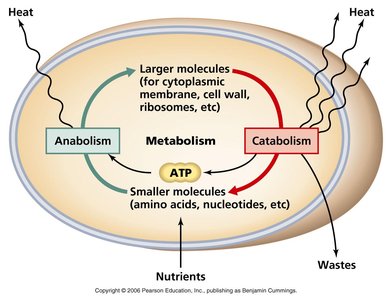
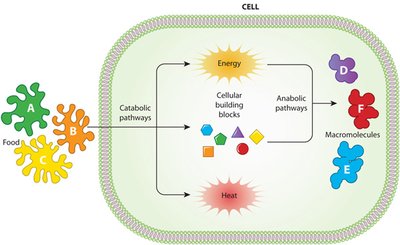
Metabolism encompasses all chemical reactions occurring within a cell, enabling the transformation of matter and energy. These reactions are organized into metabolic pathways, each catalyzed by specific enzymes. Metabolism is an emergent property of life, arising from the orderly interactions between molecules.
Catabolic pathways break down complex molecules into simpler ones, releasing energy (e.g., cellular respiration).
Anabolic pathways build complex molecules from simpler ones, consuming energy (e.g., protein synthesis).
ATP acts as the energy currency, linking catabolic and anabolic processes.
Metabolic Pathways
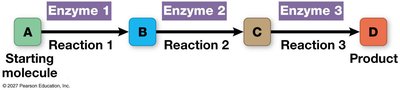
Metabolic pathways consist of a series of chemical reactions, each step catalyzed by a specific enzyme. The product of one reaction becomes the substrate for the next.
Pathways can be linear or cyclic.
Enzymes ensure specificity and efficiency.
Energy and Thermodynamics in Biology
Forms of Energy
Energy is the capacity to cause change and is essential for cellular work. It exists in several forms:
Kinetic energy: Energy of motion.
Potential energy: Energy stored due to position or structure.
Chemical energy: Potential energy available for release in chemical reactions.
The Laws of Thermodynamics
Biological processes obey the laws of thermodynamics:
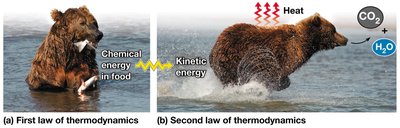
First Law: Energy can be transferred and transformed, but not created or destroyed.
Second Law: Every energy transfer increases the entropy (disorder) of the universe; some energy is lost as heat.

Free Energy and Spontaneity of Reactions
Gibbs Free Energy (ΔG)
Free energy (G) is the portion of a system’s energy that can perform work. The change in free energy (ΔG) determines whether a reaction is spontaneous.
Spontaneous reactions: (release free energy, energetically favorable).
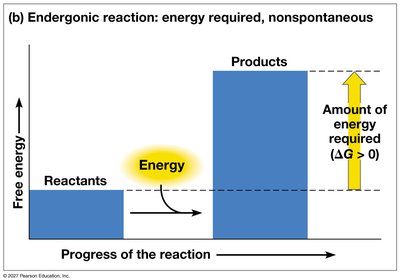
Nonspontaneous reactions: (require energy input).
Exergonic vs. Endergonic Reactions
Reactions are classified by their free energy changes:
Exergonic: Net release of free energy; spontaneous.
Endergonic: Absorbs free energy; nonspontaneous.



ATP: The Energy Currency of the Cell
Structure and Function of ATP
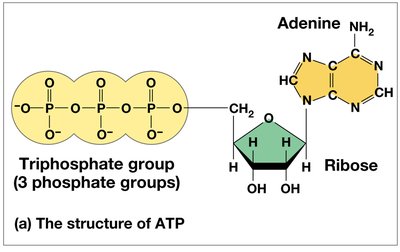
ATP (adenosine triphosphate) consists of ribose, adenine, and three phosphate groups. It belongs to the nucleic acid macromolecule class and is used to make RNA.
ATP Hydrolysis and Energy Release
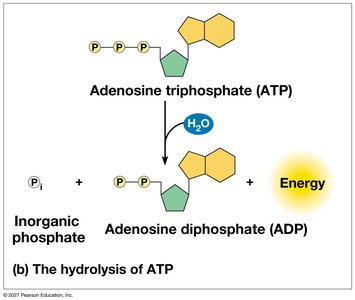
Energy is released when ATP’s terminal phosphate bond is broken by hydrolysis, converting ATP to ADP and inorganic phosphate.
The released energy powers cellular work (chemical, transport, mechanical).
Phosphorylation transfers a phosphate group to another molecule, driving endergonic reactions.
Enzymes and Metabolic Regulation
Enzyme Function and Specificity
Enzymes are biological catalysts that speed up reactions by lowering activation energy barriers. They are highly specific, binding to substrates at their active sites.
Induced-fit model: Enzyme changes shape to fit substrate, enhancing catalysis.
Enzyme activity is affected by substrate concentration, temperature, pH, cofactors, and inhibitors.
Enzyme Regulation
Cells regulate metabolism by controlling enzyme activity:
Allosteric regulation: Regulatory molecules bind to sites other than the active site, affecting enzyme function.
Feedback inhibition: End product of a pathway inhibits an earlier step, preventing waste.
Type of Regulation | Mechanism | Effect |
|---|---|---|
Allosteric Regulation | Regulatory molecule binds to enzyme at a site other than active site | Can activate or inhibit enzyme |
Feedback Inhibition | End product inhibits pathway | Prevents overproduction and waste |
Summary Table: Catabolic vs. Anabolic Pathways
Pathway | Function | Energy Flow | Example |
|---|---|---|---|
Catabolic | Breaks down molecules | Releases energy | Cellular respiration |
Anabolic | Builds molecules | Consumes energy | Protein synthesis |
