 뒤로
뒤로Chapter 8: Energy and Metabolism in Biological Systems
스터디 가이드 - 스마트 노트
 자료에 맞춘 맞춤형 노트, 핵심 정의, 예시, 맥락을 확장해 제공합니다.
An Introduction to Metabolism
Definition and Overview
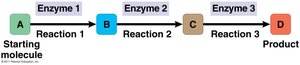
Metabolism refers to the totality of an organism’s chemical reactions, encompassing all processes that manage the materials and energy resources of a cell. These reactions are organized into metabolic pathways, where the product of one reaction serves as the substrate for the next.
Metabolic Pathways: Series of interconnected biochemical reactions catalyzed by enzymes.
Catabolic Pathways: Release energy by breaking down complex molecules into simpler compounds (e.g., digestion).
Anabolic Pathways: Consume energy to build complex molecules from simpler ones (e.g., protein synthesis).
Example: Digestive enzymes break down food to release energy, while amino acids link to form muscle protein.
Forms of Energy
Types and Conversion
Energy is the capacity to do work and exists in various forms within biological systems.
Kinetic Energy (KE): Energy associated with motion.
Heat (Thermal Energy): KE associated with random movement of atoms or molecules.
Potential Energy (PE): Stored energy due to position or structure.
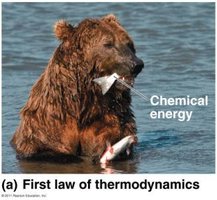
Chemical Energy: PE available for release in a chemical reaction.
Energy can be converted from one form to another, such as chemical to mechanical or electrical.
Thermodynamics in Biology
Open and Closed Systems
Biological organisms are open systems, exchanging energy and matter with their surroundings. Thermodynamics is the study of energy transformations in nature.
First Law of Thermodynamics
The energy of the universe is constant. Energy can be transferred and transformed, but cannot be created or destroyed. This is also known as the principle of conservation of energy.
Second Law of Thermodynamics
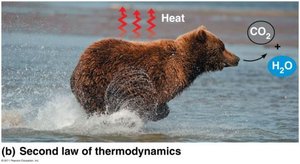
Every energy transfer or transformation increases the entropy (disorder) of the universe. Some energy is always lost as heat, making energy conversions less than 100% efficient.
Free Energy and Chemical Reactions
Exergonic and Endergonic Reactions
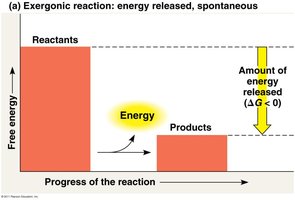
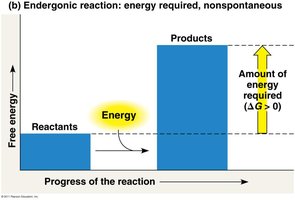
Free energy (ΔG) is the portion of a system’s energy available to perform work. Chemical reactions can be classified based on their energy changes:
Exergonic Reaction: Releases energy, is spontaneous, and has ΔG < 0.
Endergonic Reaction: Requires energy input, is nonspontaneous, and has ΔG > 0.
Examples: Breakdown of glucose in cellular respiration (exergonic); synthesis of proteins from amino acids (endergonic).
Equation:
ATP: The Energy Currency of the Cell
Structure and Function
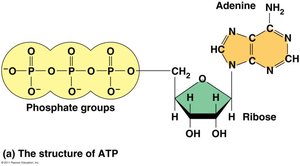
ATP (adenosine triphosphate) is the primary energy carrier in cells, enabling energy coupling between exergonic and endergonic reactions.
Composed of adenine, ribose, and three phosphate groups.
Energy is released when the terminal phosphate bond is broken by hydrolysis.
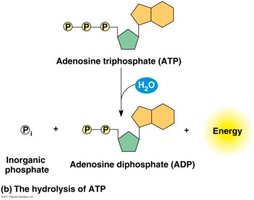
Equation for ATP hydrolysis:
ATP Cycle
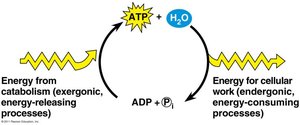
The ATP cycle links energy from catabolic (exergonic) processes to cellular work (endergonic processes).
Cellular Work Powered by ATP
Cells use ATP to perform mechanical, transport, and chemical work by transferring phosphate groups to target molecules (phosphorylation).
Mechanical Work: ATP phosphorylates motor proteins.
Transport Work: ATP phosphorylates membrane transport proteins.
Chemical Work: ATP phosphorylates reactants to drive endergonic reactions.
Enzymes and Catalysis
Definition and Function
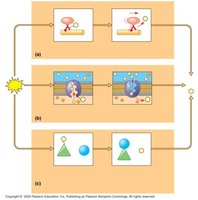
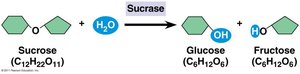
Enzymes are biological catalysts that speed up metabolic reactions by lowering the activation energy required to initiate a reaction, without being consumed in the process.
Activation Energy (EA): The energy needed to start a reaction.
Equation:
Enzyme-Substrate Specificity
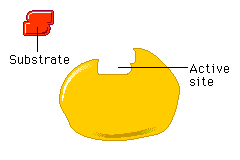
Each enzyme is specific to its substrate, binding at the active site to form an enzyme-substrate complex.
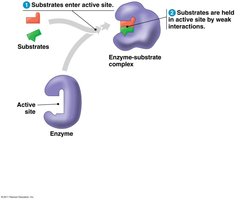
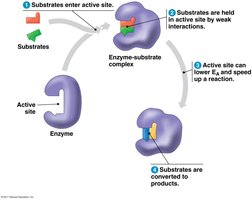
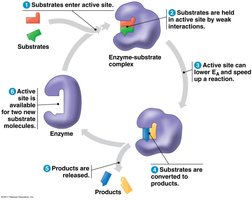
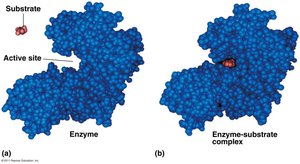
Induced Fit: The enzyme changes shape to fit snugly around the substrate, enhancing catalysis.
Factors Affecting Enzyme Activity
Enzyme function can be influenced by:
Temperature: Optimal range for activity; extremes can denature the enzyme.
pH: Each enzyme has an optimal pH.
Chemicals: Presence of inhibitors or activators.
Cofactors and Coenzymes
Cofactors are nonprotein helpers required for enzyme activity. They can be:
Inorganic: Minerals such as Zn, Fe, Cu.
Organic (Coenzymes): Vitamins.
Enzyme Inhibition
Enzyme activity can be regulated by inhibitors:
Competitive Inhibitors: Bind to the active site, competing with the substrate.
Noncompetitive Inhibitors: Bind elsewhere, causing the enzyme to change shape and rendering the active site nonfunctional.
Regulation of Metabolic Pathways
Allosteric Regulation
Allosteric regulation involves the binding of regulatory molecules to sites other than the active site, affecting enzyme activity.
Activator: Stabilizes the active form of the enzyme.
Inhibitor: Stabilizes the inactive form.
Cooperativity: Binding of one substrate increases activity at other active sites.
Feedback Inhibition
Feedback inhibition occurs when the end product of a metabolic pathway binds to an enzyme’s allosteric site, shutting down the pathway to prevent waste and increase efficiency.
Type of Regulation | Mechanism | Effect |
|---|---|---|
Allosteric Regulation | Regulatory molecule binds to allosteric site | Activates or inhibits enzyme |
Feedback Inhibition | End product binds to enzyme | Shuts down pathway |
Competitive Inhibition | Inhibitor binds to active site | Blocks substrate |
Noncompetitive Inhibition | Inhibitor binds elsewhere | Changes enzyme shape |
Summary: Metabolism is central to life, involving energy transformations governed by thermodynamic laws, and regulated by enzymes and feedback mechanisms to ensure cellular efficiency.
