 뒤로
DNA Structure, Replication, and the Central Dogma: Study Notes for General Biology
스터디 가이드 - 스마트 노트
 자료에 맞춘 맞춤형 노트, 핵심 정의, 예시, 맥락을 확장해 제공합니다.
DNA as Genetic Material
Historical Experiments Demonstrating DNA's Role
The identification of DNA as the genetic material was a pivotal moment in biology, established through a series of classic experiments.
Griffith's Experiment (1928): Demonstrated transformation in bacteria, showing that genetic information could be transferred from dead to living cells.
Avery, MacLeod, and McCarty (1944): Identified DNA as the transforming principle by isolating and testing bacterial extracts.
Hershey & Chase (1952): Used radioactive labeling to show that DNA, not protein, is injected by bacteriophages into bacteria, confirming DNA as genetic material.
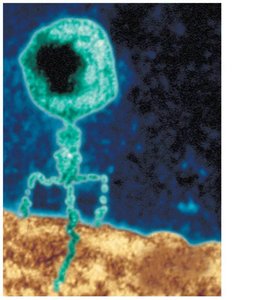
Example: Hershey & Chase's experiment used radioactive phosphorus (32P) to label DNA and radioactive sulfur (35S) to label protein, demonstrating that only DNA entered the bacterial cells.
Discovery of DNA Structure
X-ray Crystallography and the Double Helix
The structure of DNA was elucidated through X-ray crystallography and model building, leading to the discovery of its double helix form.
Photo 51: The first X-ray diffraction image of DNA, taken by Rosalind Franklin, provided critical evidence for the helical structure.
Watson and Crick: Built the double helix model based on Franklin's data and Chargaff's rules.
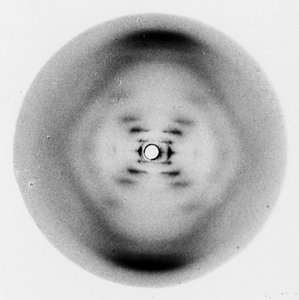
Example: The double helix model explained how DNA could replicate and store genetic information.
DNA Structure and Components
Basic Chemical Structure
DNA is a polymer composed of nucleotides, each containing a phosphate group, a deoxyribose sugar, and one of four nitrogenous bases: adenine (A), thymine (T), cytosine (C), and guanine (G).
Backbone: Alternating phosphate and deoxyribose units.
Bases: Attached as side chains; A pairs with T, C pairs with G via hydrogen bonds.
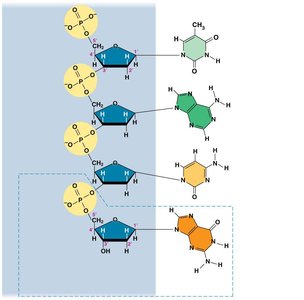
Example: The antiparallel strands of DNA are held together by complementary base pairing.
Base Pairing and Helical Structure
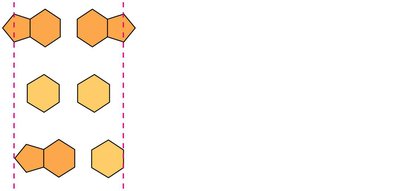
Base pairing ensures the width of the DNA molecule is consistent, as purines pair with pyrimidines.
Purine + Purine: Too wide
Pyrimidine + Pyrimidine: Too narrow
Purine + Pyrimidine: Correct width
DNA Replication
Mechanism of Replication
DNA replication is a semi-conservative process, where each new molecule contains one old and one new strand.
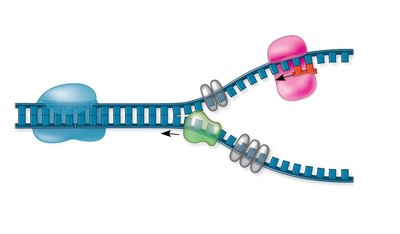
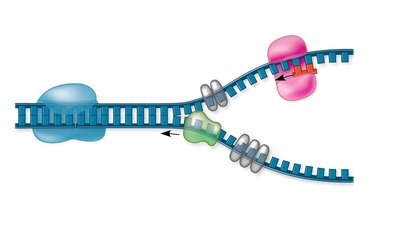
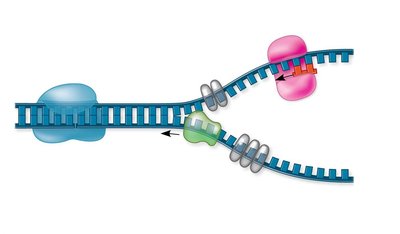
Step 1: Topoisomerase uncoils DNA.
Step 2: Helicase separates the strands.
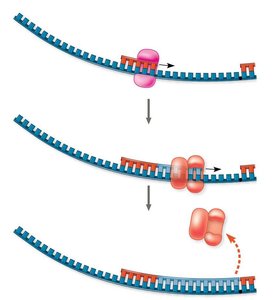
Step 3: Primase adds RNA primers.
Step 4A: Leading strand synthesized continuously by DNA polymerase.
Step 4B: Lagging strand synthesized in fragments (Okazaki fragments).
Step 5: Ligase joins fragments.
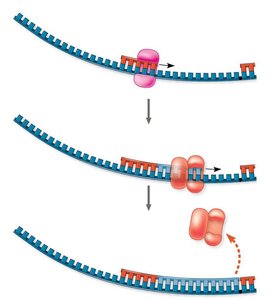
Equation: The basic reaction for DNA polymerization is:
Error Correction in DNA Replication
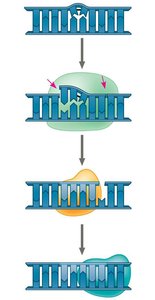
DNA polymerase and ligase also function in error correction, using nuclease to remove incorrect bases and restore the correct sequence.
Central Dogma of Molecular Biology
Transcription and Translation
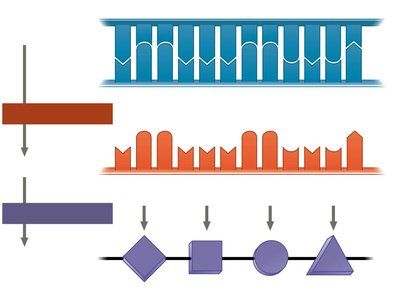
The central dogma describes the flow of genetic information: DNA is transcribed into RNA, which is then translated into protein.
Transcription: DNA → RNA
Translation: RNA → Protein
Transcription Process
Transcription involves three main steps: initiation, elongation, and termination.
Initiation: RNA polymerase binds to the promoter region.
Elongation: RNA polymerase synthesizes RNA at ~40 nucleotides per second.
Termination: RNA polymerase releases the completed RNA transcript.
Post-Transcriptional Modification
In eukaryotes, RNA undergoes modifications such as splicing, capping, and polyadenylation before translation.
Splicing: Removal of introns and joining of exons.
Capping: Addition of a 5' cap for ribosome recognition.
Polyadenylation: Addition of a poly-A tail for stability.
Translation Process
Translation converts mRNA into a polypeptide chain using ribosomes and tRNAs.
Initiation: Ribosome assembles at the start codon.
Elongation: tRNAs bring amino acids, matching codons with anticodons.
Termination: Ribosome reaches a stop codon and releases the polypeptide.
Genetic Code and Codons
The genetic code is nearly universal, with each codon (three RNA bases) specifying an amino acid.
Start Codon: AUG (methionine)
Stop Codons: UAA, UAG, UGA
Codon Chart: Used to translate mRNA sequences into amino acids.
Example: The universality of the genetic code supports the evolutionary relationship among all organisms.
Mutations and Their Effects
Types of Mutations
Mutations are changes in the DNA sequence that can affect gene function.
Point Mutation: Change of a single base.
Deletion: Removal of one or more bases.
Frameshift Mutation: Insertion or deletion that alters the reading frame.
Example: Mutating one base can be less disruptive than deleting one, as deletions may cause frameshifts.
Summary Table: DNA Replication Steps
Step | Enzyme | Function |
|---|---|---|
1 | Topoisomerase | Uncoils DNA |
2 | Helicase | Separates DNA strands |
3 | Primase | Adds RNA primer |
4A | DNA Polymerase | Synthesizes leading strand |
4B | DNA Polymerase | Synthesizes lagging strand (Okazaki fragments) |
5 | Ligase | Joins DNA fragments |
Additional info:
Some context and explanations were expanded for clarity and completeness.
Mutations and their effects are discussed in relation to DNA replication and gene expression.
