 뒤로
Energy, Entropy, and Active Transport in Cells
스터디 가이드 - 스마트 노트
 자료에 맞춘 맞춤형 노트, 핵심 정의, 예시, 맥락을 확장해 제공합니다.
Energy and the Living Cell
Active Transport and Concentration Gradients
Cells often move molecules against a concentration gradient, from areas of low concentration to high concentration. This process is fundamental to cellular function and requires energy input.
Concentration Gradient: A difference in the concentration of a substance across a space, such as a cell membrane.
Active Transport: The movement of molecules against their concentration gradient, requiring energy expenditure by the cell.
Entropy: Moving molecules up a concentration gradient reduces randomness and decreases entropy.
Energy Use: Cells spend energy (usually from ATP) to perform active transport, but this energy is not lost—it is converted into potential energy stored in the gradient.
Sodium-Potassium Pump: This pump acts like a battery, converting ATP energy into potential energy stored in sodium and potassium gradients across the membrane.
Example: The sodium-potassium pump moves Na+ out of the cell and K+ into the cell, maintaining essential gradients for cellular function.
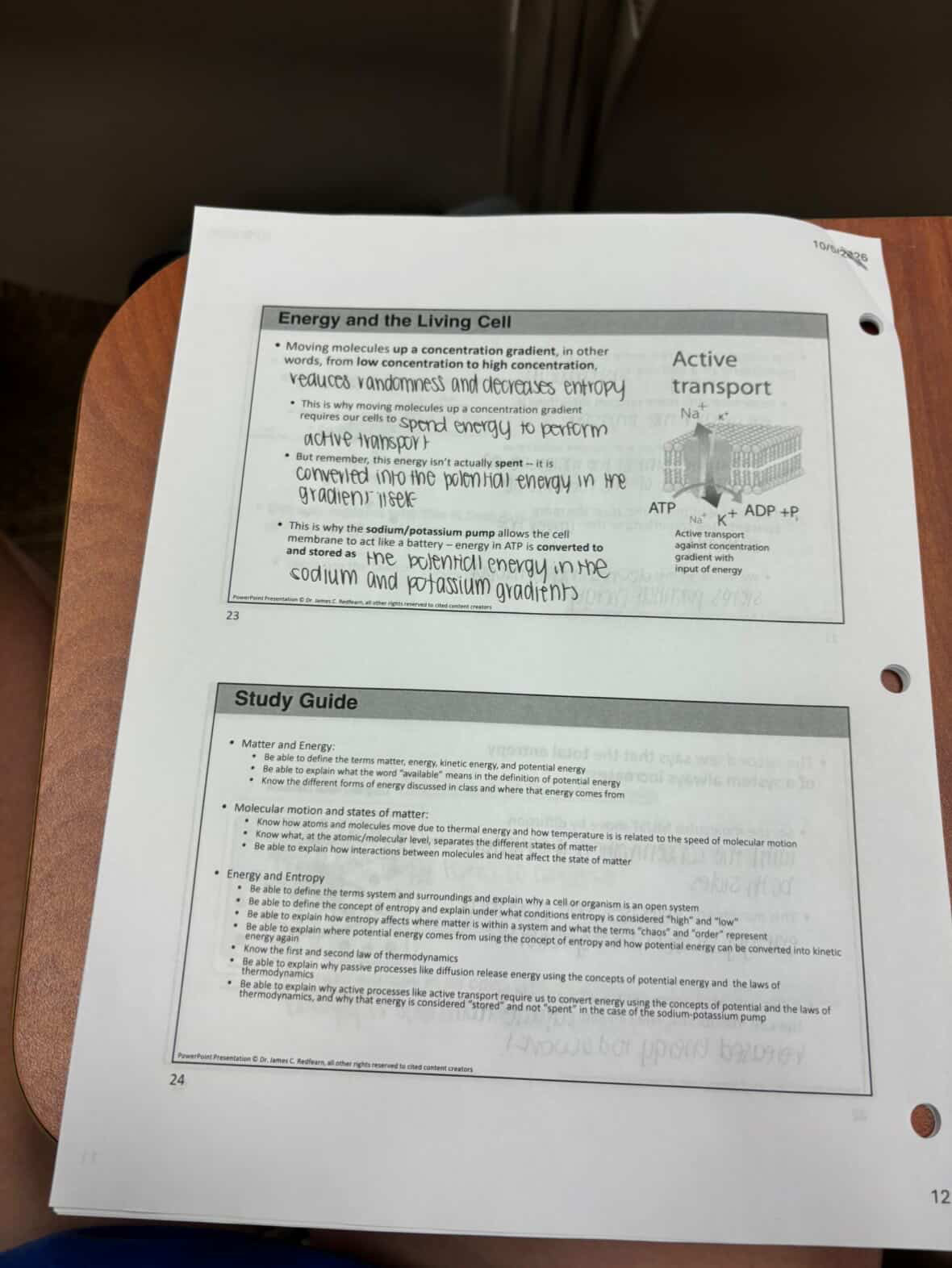
Study Guide: Energy and Entropy
Matter and Energy
Understanding the relationship between matter and energy is crucial for studying biological systems.
Key Terms: Energy, kinetic energy, potential energy.
Available Energy: The portion of energy that can be used to do work.
Forms of Energy: Know the different forms discussed in class and their sources.
Molecular Motion and States of Matter
Molecules move due to thermal energy, and temperature affects the speed of this motion.
Atomic/Molecular Level: The atomic/molecular view separates different states of matter.
Interactions: Interactions between molecules and heat affect the state of matter.
Energy and Entropy
Energy and entropy are central concepts in thermodynamics and biological systems.
System and Surroundings: Define these terms and explain why cells are open systems.
Entropy: The measure of disorder; explain what conditions are considered "high" or "low" entropy.
Effect of Entropy: How entropy affects matter within a system; terms "chaos" and "order" represent entropy levels.
Potential Energy: How potential energy comes from entropy and can be converted to kinetic energy.
First and Second Law of Thermodynamics: Explain these laws and their relevance to biological systems.
Passive Processes: Diffusion releases energy using potential energy and thermodynamic laws.
Active Processes: Active transport requires energy input to convert energy, using concepts of potential energy and thermodynamics. Energy is considered "stored" and not "spent" in the sodium-potassium pump.
Example: Passive diffusion releases energy as molecules move down their concentration gradient, while active transport stores energy in gradients.
Relevant Equations
ATP Hydrolysis: $ \mathrm{ATP} \rightarrow \mathrm{ADP} + \mathrm{P}_i + \text{energy} $
Potential Energy in Gradients: $ \Delta G = \Delta H - T \Delta S $
Additional info: The sodium-potassium pump is a classic example of active transport, crucial for maintaining cellular homeostasis and electrical gradients.
----------------------------------------
