 뒤로
Exam 3 Study Guide: Metabolism, Cellular Respiration, and Photosynthesis
스터디 가이드 - 스마트 노트
 자료에 맞춘 맞춤형 노트, 핵심 정의, 예시, 맥락을 확장해 제공합니다.
Metabolism: An Introduction
Definition and Types of Metabolic Pathways
Metabolism refers to all chemical reactions that occur within living organisms to sustain life. These reactions are organized into metabolic pathways, which are either anabolic (building up) or catabolic (breaking down).
Anabolic pathways: Consume energy to build complex molecules from simpler ones (e.g., protein synthesis).
Catabolic pathways: Release energy by breaking down complex molecules into simpler compounds (e.g., cellular respiration).
Forms of Energy
Energy is the capacity to do work and exists in various forms:
Kinetic energy: Energy of motion (e.g., movement of molecules).
Heat (thermal energy): Kinetic energy associated with random movement of atoms or molecules.
Potential energy: Energy due to location or structure.
Chemical energy: Potential energy available for release in a chemical reaction.
Laws of Thermodynamics
First Law: Energy cannot be created or destroyed, only transformed.
Second Law: Energy transformations increase the entropy (randomness) of the universe; some energy is lost as heat.
Free Energy and Reaction Types
Free energy (ΔG): The portion of a system's energy that can perform work.
Exergonic reactions: Release free energy, are spontaneous, and have negative ΔG.
Endergonic reactions: Absorb free energy, are nonspontaneous, and have positive or zero ΔG.
ATP: The Energy Currency of the Cell
ATP (adenosine triphosphate) is the principal energy carrier in cells. It consists of adenosine (a five-carbon sugar) and three phosphate groups. Hydrolysis of ATP releases energy for cellular work.
ATP hydrolysis:
ATP drives endergonic reactions by phosphorylation, coupling exergonic and endergonic processes.
Enzymes and Activation Energy
Enzymes are protein catalysts that speed up chemical reactions by lowering activation energy barriers.
Substrate: The reactant an enzyme acts upon.
Active site: The region of the enzyme where the substrate binds.
Enzyme activity is affected by temperature, pH, and chemicals.
Cellular Respiration
Overview and Equation
Cellular respiration is the process by which cells break down glucose to produce ATP.
Overall equation:
Major Stages of Aerobic Respiration
Glycolysis: Occurs in the cytosol; breaks glucose into two pyruvate, produces 2 ATP and 2 NADH.
Pyruvate Oxidation: Occurs in mitochondrial matrix; converts pyruvate to 2 acetyl CoA, produces 2 NADH and 2 CO2.
Citric Acid Cycle (Krebs Cycle): Occurs in mitochondrial matrix; oxidizes acetyl CoA, produces 2 ATP, 6 NADH, 2 FADH2, and 4 CO2.
Oxidative Phosphorylation: Occurs in inner mitochondrial membrane; electron transport and chemiosmosis produce about 26 or 28 ATP.
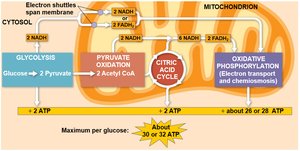
Reduction/Oxidation Reactions
Oxidation: Loss of electrons.
Reduction: Gain of electrons.
NAD+/NADH and FAD/FADH2 are electron carriers involved in these reactions.
ATP Production
Substrate-level phosphorylation: Direct transfer of phosphate to ADP during glycolysis and citric acid cycle.
Oxidative phosphorylation: ATP synthesis powered by electron transport chain and chemiosmosis.
Fermentation
Fermentation is an anaerobic process that allows glycolysis to continue in the absence of oxygen.
Lactic acid fermentation: Pyruvate is converted to lactic acid; net 2 ATP per glucose.
Alcoholic fermentation: Pyruvate is converted to ethanol and CO2; net 2 ATP per glucose.
Photosynthesis
Overview and Equation
Photosynthesis is the process by which plants convert carbon dioxide, water, and sunlight into glucose and oxygen.
Overall equation:
Structure of the Leaf and Chloroplast
Photosynthesis occurs in the chloroplasts, primarily in the mesophyll cells of leaves.
Key structures: thylakoid membrane (site of light reactions), stroma (site of Calvin cycle), stomata (gas exchange).
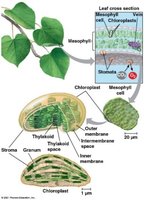
Electromagnetic Spectrum and Pigments
Visible light is absorbed by pigments such as chlorophyll a and b.
Chlorophyll absorbs violet, blue, and red light; reflects green.
Accessory pigments broaden the spectrum of light absorption.
Stages of Photosynthesis
Light Reactions
Light reactions occur in the thylakoid membranes and convert solar energy to chemical energy (ATP and NADPH).
Photosystems (PS II and PS I) absorb light and transfer electrons through electron transport chains.
Water is split, releasing O2 and providing electrons.
ATP is produced via chemiosmosis; NADP+ is reduced to NADPH.
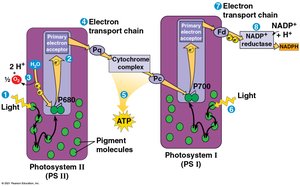
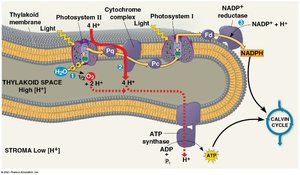
Calvin Cycle (Light Independent Reactions)
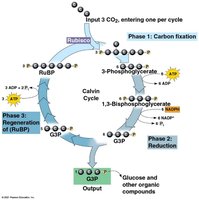
The Calvin cycle occurs in the stroma and uses ATP and NADPH to fix carbon dioxide into glucose.
Three phases: Carbon fixation, Reduction, Regeneration of RuBP.
Direct product is G3P (glyceraldehyde-3-phosphate), which can be used to form glucose and other carbohydrates.
Alternative Mechanisms of Photosynthesis
Photorespiration: O2 substitutes for CO2 in rubisco, reducing photosynthetic efficiency.
C4 plants: Incorporate CO2 into four-carbon compounds in mesophyll cells, which are transported to bundle sheath cells for the Calvin cycle.
CAM plants: Open stomata at night to fix CO2 into organic acids; release CO2 during the day for the Calvin cycle.
Summary Table: Cellular Respiration Stages
Stage | Location | Reactants | Products | ATP Yield |
|---|---|---|---|---|
Glycolysis | Cytosol | Glucose | 2 Pyruvate, 2 NADH | 2 ATP |
Pyruvate Oxidation | Mitochondrial Matrix | 2 Pyruvate | 2 Acetyl CoA, 2 NADH, 2 CO2 | 0 ATP |
Citric Acid Cycle | Mitochondrial Matrix | 2 Acetyl CoA | 6 NADH, 2 FADH2, 2 ATP, 4 CO2 | 2 ATP |
Oxidative Phosphorylation | Inner Mitochondrial Membrane | NADH, FADH2 | ATP, H2O | 26-28 ATP |
Summary Table: Photosynthesis Stages
Stage | Location | Reactants | Products |
|---|---|---|---|
Light Reactions | Thylakoid Membrane | H2O, Light | ATP, NADPH, O2 |
Calvin Cycle | Stroma | CO2, ATP, NADPH | G3P (glucose precursor) |
Additional info: Academic context was added to clarify the structure and function of metabolic pathways, cellular respiration, and photosynthesis, including definitions, equations, and summary tables for exam preparation.
