 뒤로
Gene Expression: From Gene to Protein (Chapter 17 Study Notes)
스터디 가이드 - 스마트 노트
 자료에 맞춘 맞춤형 노트, 핵심 정의, 예시, 맥락을 확장해 제공합니다.
Gene Expression: From Gene to Protein
Overview of Gene Expression
Gene expression is the process by which information encoded in DNA directs the synthesis of proteins, ultimately determining an organism's traits. Proteins serve as the link between genotype and phenotype, and gene expression involves two main stages: transcription and translation.
Transcription: The synthesis of RNA from a DNA template.
Translation: The synthesis of a polypeptide using information in the mRNA.
Ribosomes: Cellular structures where translation occurs.
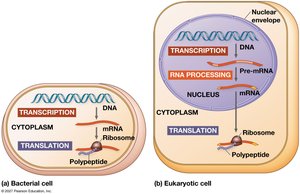

Basic Principles of Transcription and Translation
RNA acts as the bridge between genes and protein synthesis. Transcription produces messenger RNA (mRNA), which carries genetic information from DNA to the ribosome, where translation occurs.
Transcription: Occurs in the nucleus (eukaryotes) or cytoplasm (prokaryotes).
Translation: Occurs in the cytoplasm at ribosomes.
The Triplet Code and Codons
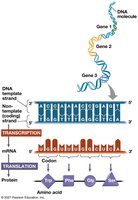
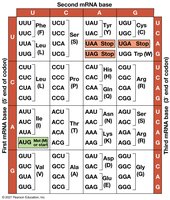
The genetic code is based on triplets of nucleotides called codons. Each codon specifies a particular amino acid or a stop signal for translation.
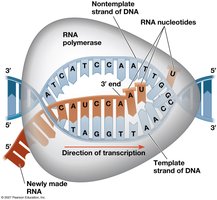
Template strand: The DNA strand used to synthesize RNA.
Coding strand: The DNA strand whose sequence matches the RNA (except T is replaced by U).
Redundancy: Multiple codons can code for the same amino acid.
Reading frame: Codons must be read in the correct groupings for proper protein synthesis.
Molecular Components of Transcription
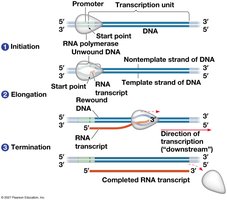
Transcription is catalyzed by RNA polymerase, which separates DNA strands and assembles RNA nucleotides. The process follows base-pairing rules, with uracil (U) replacing thymine (T) in RNA.
Promoter: DNA sequence where RNA polymerase binds.
Terminator: Sequence signaling the end of transcription (in bacteria).
Transcription unit: The stretch of DNA transcribed into RNA.
RNA Processing in Eukaryotes
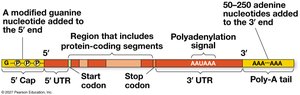
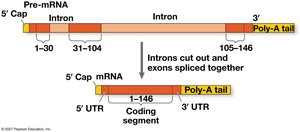
In eukaryotic cells, the primary RNA transcript (pre-mRNA) undergoes processing before leaving the nucleus. This includes modification of both ends and removal of non-coding regions (introns).
5' Cap: Modified guanine nucleotide added to the 5' end.
Poly-A tail: Addition of adenine nucleotides to the 3' end.
RNA splicing: Removal of introns and joining of exons.
Alternative splicing: Allows production of multiple proteins from one gene.
Translation: The Basic Concept
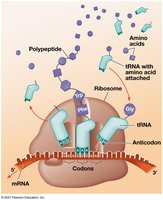
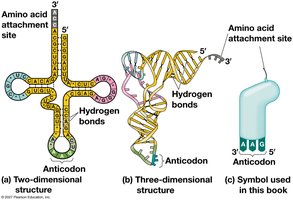
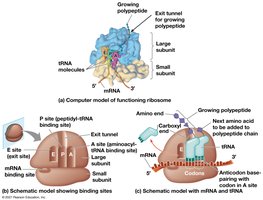
Translation is the process by which mRNA is decoded to build a polypeptide. Transfer RNA (tRNA) molecules bring amino acids to the ribosome, matching their anticodon to the mRNA codon.
tRNA: Carries specific amino acids and has an anticodon complementary to mRNA codons.
Ribosome: Facilitates the pairing of tRNA anticodon with mRNA codon and catalyzes peptide bond formation.
Stages of Translation
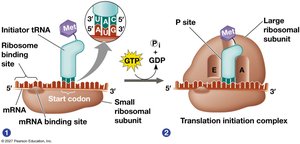
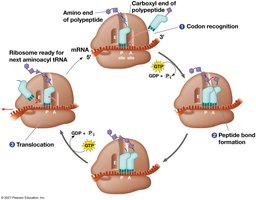
Translation occurs in three stages: initiation, elongation, and termination. Each stage involves specific molecular interactions and energy requirements.
Initiation: Assembly of the translation initiation complex at the start codon.
Elongation: Addition of amino acids to the growing polypeptide chain.
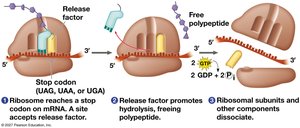
Termination: Release of the completed polypeptide when a stop codon is reached.
Protein Folding and Post-Translational Modifications
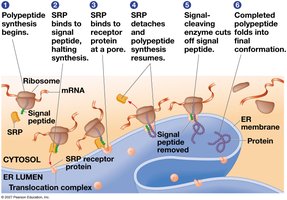
After translation, polypeptides fold into their functional three-dimensional shapes. Some proteins undergo further modifications, such as cleavage or addition of chemical groups, to become fully functional.
Primary structure: Determined by the gene's nucleotide sequence.
Secondary and tertiary structure: Result from folding and coiling of the polypeptide.
Post-translational modifications: May include phosphorylation, glycosylation, or cleavage.
Summary of Transcription and Translation in Eukaryotic Cells
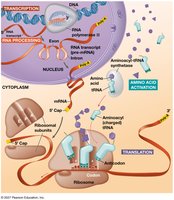
Transcription and translation are spatially separated in eukaryotic cells, with transcription and RNA processing occurring in the nucleus and translation in the cytoplasm.
Mutations and Their Effects on Protein Structure and Function
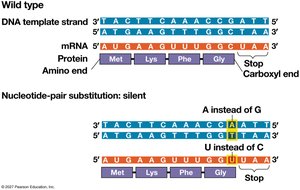
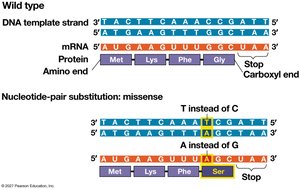
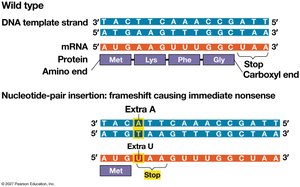
Mutations are changes in the genetic material that can affect protein structure and function. Point mutations alter a single nucleotide pair, while insertions and deletions can disrupt the reading frame.
Silent mutations: No effect on the protein due to redundancy in the genetic code.
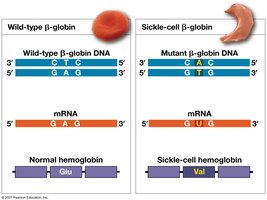
Missense mutations: Change one amino acid to another.
Nonsense mutations: Change an amino acid codon to a stop codon, often resulting in a nonfunctional protein.
Frameshift mutations: Caused by insertions or deletions, altering the reading frame.
Mutagens and Gene Editing
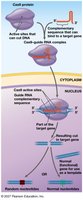
Mutations can arise spontaneously or be induced by mutagens, which are physical or chemical agents. Modern gene editing techniques, such as CRISPR-Cas9, allow precise modification of genes to correct disease-causing mutations.
Mutagens: Include radiation, chemicals, and carcinogens.
CRISPR-Cas9: A bacterial defense mechanism adapted for targeted gene editing in research and medicine.
Defining a Gene
A gene is a region of DNA that can be expressed to produce a final functional product, either a polypeptide or an RNA molecule. This definition reflects the complexity and versatility of gene function in modern biology.
Codon Table for mRNA
The codon table is used to translate mRNA sequences into amino acids. Each codon corresponds to a specific amino acid or a stop signal.
Codon | Amino Acid | Type |
|---|---|---|
AUG | Met | Start |
UUU | Phe | Standard |
UAA | Stop | Stop |
UAG | Stop | Stop |
UGA | Stop | Stop |
GCU | Ala | Standard |
CGU | Arg | Standard |
GAU | Asp | Standard |
UUU | Phe | Standard |
UUG | Leu | Standard |
Key Equations
Transcription and translation involve the following general equations:
Transcription:
Translation:
Summary Table: Types of Mutations
Mutation Type | Effect | Example |
|---|---|---|
Silent | No change in amino acid | GAA → GAG (both code for Glu) |
Missense | Change in one amino acid | GAA → GUA (Glu → Val) |
Nonsense | Change to stop codon | UAC → UAA (Tyr → Stop) |
Frameshift | Altered reading frame | Insertion or deletion |
Example: Sickle-cell disease is caused by a missense mutation in the β-globin gene, changing glutamic acid to valine.
Additional info: Some explanations and table entries were expanded for clarity and completeness based on standard biology textbook content.
