 뒤로
Gene Expression: From Gene to Protein (Chapter 17) - Mini Study Guide Part1
스터디 가이드 - 스마트 노트
 자료에 맞춘 맞춤형 노트, 핵심 정의, 예시, 맥락을 확장해 제공합니다.
Gene Expression: From Gene to Protein
Overview of Gene Expression
Gene expression is the process by which information encoded in DNA directs the synthesis of proteins, which are responsible for an organism's traits. This process involves two main stages: transcription and translation. Proteins serve as the link between genotype and phenotype.
Transcription: DNA is used as a template to synthesize RNA.
Translation: RNA is used to synthesize a polypeptide (protein).
Central Dogma: The directional flow of genetic information is DNA → RNA → Protein.

Basic Principles of Transcription and Translation
Transcription and translation are fundamental processes in gene expression. RNA acts as the bridge between DNA and protein synthesis, carrying genetic information from DNA to the cellular machinery that assembles proteins.
Structure of RNA: Contains ribose sugar, uses uracil (U) instead of thymine (T), and is typically single-stranded.
Transcription: Synthesis of messenger RNA (mRNA) from DNA.
Translation: Synthesis of a polypeptide using mRNA information at the ribosome.
Differences Between Prokaryotic and Eukaryotic Gene Expression
Gene expression differs between prokaryotes and eukaryotes, mainly due to cellular structure.
Prokaryotes: Transcription and translation occur in the cytoplasm; translation can begin before transcription is finished.
Eukaryotes: Transcription occurs in the nucleus; RNA processing modifies the primary transcript into mature mRNA, which is then exported to the cytoplasm for translation.
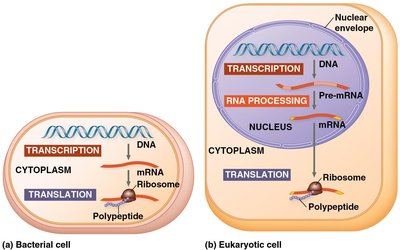
The Flow of Genetic Information
The central dogma describes the flow of genetic information in cells: DNA is transcribed into RNA, which is then translated into protein. This concept was coined by Francis Crick in 1956.
DNA → RNA → Protein
The Genetic Code
Triplet Code and Codons
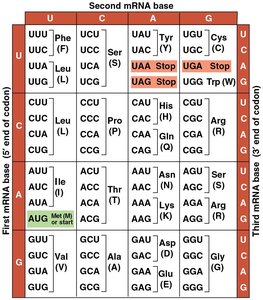
The genetic code is based on nucleotide triplets called codons, each specifying an amino acid. With four nucleotide bases and 20 amino acids, a triplet code (three bases per codon) provides 64 possible combinations.
Codon: A sequence of three nucleotides in mRNA that specifies an amino acid.
Redundancy: Multiple codons can specify the same amino acid, but each codon specifies only one amino acid (non-ambiguous).
Reading Frame: Codons must be read in the correct groupings for proper protein synthesis.
Start Codon: AUG (methionine) initiates translation.
Stop Codons: UAA, UAG, UGA signal termination of translation.
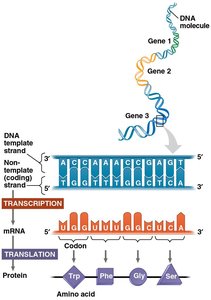
Transcription: DNA to mRNA
Transcription converts DNA triplets into complementary mRNA codons, which are then translated into amino acids to form a polypeptide.
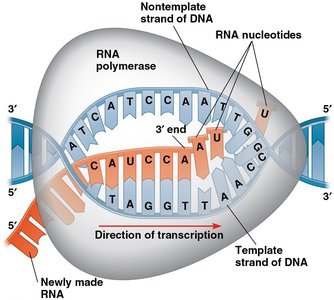
Template Strand: The DNA strand used to synthesize mRNA.
Coding Strand: The DNA strand with a sequence identical to mRNA (except T is replaced by U).
Antiparallel Synthesis: mRNA is synthesized in the 5′ to 3′ direction, complementary to the template strand.
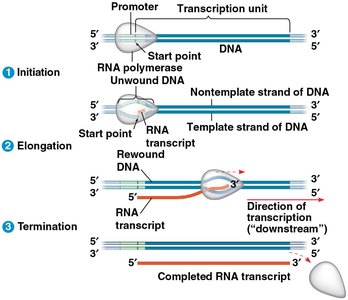
Transcription: A Closer Look
Stages of Transcription
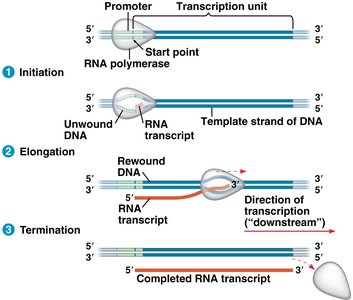
Transcription occurs in three stages: initiation, elongation, and termination. RNA polymerase is the enzyme responsible for synthesizing RNA from the DNA template.
Initiation: RNA polymerase binds to the promoter region, unwinds DNA, and begins RNA synthesis.
Elongation: RNA polymerase moves along the DNA, adding nucleotides to the growing RNA strand.
Termination: RNA polymerase releases the completed RNA transcript.
Promoters and Transcription Initiation
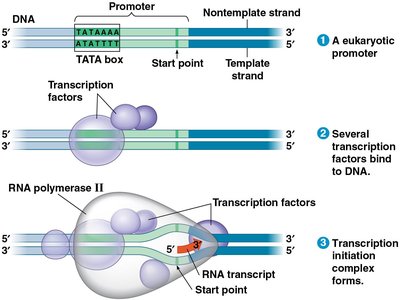
The promoter is a DNA sequence that signals the start of transcription. In eukaryotes, transcription factors help RNA polymerase bind to the promoter and initiate transcription. The TATA box is a common promoter element in eukaryotic genes.
Promoter: DNA sequence where RNA polymerase binds.
Transcription Factors: Proteins required for RNA polymerase binding in eukaryotes.
TATA Box: A promoter sequence rich in thymine and adenine.
Elongation and Termination of Transcription
During elongation, RNA polymerase unwinds DNA and synthesizes RNA. After passing, the DNA helix reforms. Termination differs between prokaryotes and eukaryotes.
Elongation: RNA polymerase adds nucleotides to the 3′ end of RNA, synthesizing in the 5′ → 3′ direction.
Termination in Bacteria: RNA polymerase stops at a terminator sequence; mRNA is immediately functional.
Termination in Eukaryotes: RNA polymerase II transcribes a polyadenylation signal (AAUAAA); pre-mRNA is released and processed.
Key Terms and Concepts
Gene Expression: The process by which DNA directs protein synthesis.
Transcription: Synthesis of RNA from DNA template.
Translation: Synthesis of protein from mRNA.
Codon: Three-nucleotide sequence in mRNA specifying an amino acid.
Promoter: DNA sequence signaling start of transcription.
RNA Polymerase: Enzyme synthesizing RNA from DNA.
Transcription Factors: Proteins aiding RNA polymerase binding in eukaryotes.
TATA Box: Promoter element in eukaryotic genes.
Polyadenylation Signal: AAUAAA sequence marking termination in eukaryotes.
Sample Exam Questions
What is the sequence of the nontemplate strand if the template strand is 3′-GCCACGTATCA-5′?
What is the sequence of the resulting transcript if the nontemplate strand reads 5′-TTCACTGGTTCA?
How many nucleotides are in a codon?
What is the initiation codon?
Which codons are stop codons?
How many effective codons are there for the synthesis of 20 amino acids?
What are the salient features of the genetic code?
Summary Table: Genetic Code Features
Feature | Description |
|---|---|
Universal | Same code used by almost all organisms |
Degenerate | Multiple codons can specify the same amino acid |
Non-overlapping | Codons are read one after another, not overlapping |
Non-ambiguous | Each codon specifies only one amino acid |
Additional info: Academic context was added to clarify the stages of transcription, the role of RNA polymerase, and the differences between prokaryotic and eukaryotic gene expression. The summary table was inferred from the salient features of the genetic code discussed in the notes.
