 뒤로
뒤로General Biology Study Notes: Metabolism, Photosynthesis, Cellular Respiration, and Molecular Genetics
스터디 가이드 - 스마트 노트
 자료에 맞춘 맞춤형 노트, 핵심 정의, 예시, 맥락을 확장해 제공합니다.
Metabolism and Energy Transformations
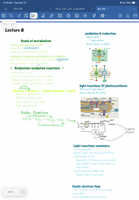
Basics of Metabolism
Metabolism encompasses all chemical reactions occurring within living organisms, enabling them to grow, reproduce, and maintain their structures. These reactions are organized into metabolic pathways, which are sequences of enzymatically catalyzed steps.
Catabolism: Breakdown of molecules to release energy.
Anabolism: Synthesis of complex molecules from simpler ones, requiring energy input.
ATP: The primary energy currency in cells, used to drive endergonic reactions.
Redox Reactions in Metabolism
Redox reactions involve the transfer of electrons between molecules, playing a central role in energy transformations.
Oxidation: Loss of electrons from a molecule.
Reduction: Gain of electrons by a molecule.
Electron carriers: Molecules like NAD+ and FAD that shuttle electrons during metabolic reactions.
Light Reactions of Photosynthesis
Photosynthesis is the process by which plants, algae, and some bacteria convert light energy into chemical energy. The light reactions occur in the thylakoid membranes and generate ATP and NADPH for the Calvin cycle.
Photosystem II: Absorbs light, splits water, and releases oxygen.
Electron transport chain: Transfers electrons, creating a proton gradient for ATP synthesis.
Photosystem I: Absorbs light and reduces NADP+ to NADPH.
Example: The Z-scheme describes the flow of electrons from water to NADP+ during the light reactions.
Cellular Respiration and Fermentation
Overview of Cellular Respiration
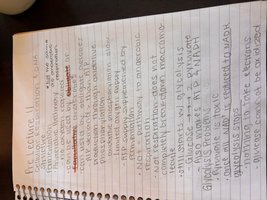
Cellular respiration is the process by which cells extract energy from glucose and other organic molecules. It consists of glycolysis, the citric acid cycle, and oxidative phosphorylation.
Glycolysis: Occurs in the cytoplasm; breaks down glucose into pyruvate, producing ATP and NADH.
Citric Acid Cycle: Occurs in the mitochondria; oxidizes acetyl-CoA to CO2, generating NADH and FADH2.
Oxidative Phosphorylation: Uses electron transport chain and chemiosmosis to produce ATP.
Fermentation
Fermentation is an anaerobic process that allows glycolysis to continue in the absence of oxygen by regenerating NAD+.
Lactic acid fermentation: Converts pyruvate to lactate.
Alcohol fermentation: Converts pyruvate to ethanol and CO2.
Citric Acid Cycle Summary
The citric acid cycle (Krebs cycle) is a series of reactions that generate high-energy electron carriers for the electron transport chain.
Inputs: Acetyl-CoA, NAD+, FAD, ADP
Outputs: CO2, NADH, FADH2, ATP
Molecular Basis of Inheritance
Structure of DNA
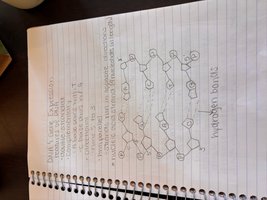
DNA is a double helix composed of two antiparallel strands held together by hydrogen bonds between complementary bases.
Nucleotides: Consist of a phosphate group, deoxyribose sugar, and a nitrogenous base (A, T, G, C).
Base pairing: Adenine pairs with thymine; guanine pairs with cytosine.
Antiparallel orientation: One strand runs 5' to 3', the other 3' to 5'.
DNA Replication
DNA replication is the process by which cells duplicate their genetic material before cell division. It is semiconservative, meaning each new DNA molecule contains one old and one new strand.
Origin of replication: Specific sequence where replication begins.
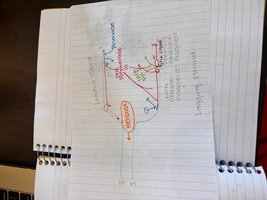
Helicase: Unwinds the DNA helix.
Primase: Synthesizes RNA primers.
DNA polymerase: Adds nucleotides to the growing DNA strand.
Leading strand: Synthesized continuously.
Lagging strand: Synthesized in Okazaki fragments.
Transcription and Translation
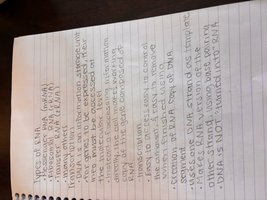
Transcription is the synthesis of RNA from a DNA template, while translation is the synthesis of protein from an RNA template.
Transcription: RNA polymerase binds to promoter, synthesizes mRNA.
Translation: Ribosome reads mRNA and assembles amino acids into a polypeptide.
RNA vs. DNA: RNA contains ribose and uracil; DNA contains deoxyribose and thymine.
Enzymes and Regulation of Metabolism
Enzyme Structure and Function
Enzymes are biological catalysts that speed up chemical reactions by lowering activation energy.
Active site: Region where substrate binds.
Induced fit: Enzyme changes shape to accommodate substrate.
Specificity: Enzymes are specific to their substrates.
Regulation of Enzyme Activity
Enzyme activity can be regulated by various mechanisms to ensure proper metabolic control.
Allosteric regulation: Binding of molecules at sites other than the active site affects enzyme activity.
Feedback inhibition: End product of a pathway inhibits an earlier step.
Competitive inhibition: Inhibitor competes with substrate for active site.
Additional info:
Some explanations and diagrams were expanded for clarity and completeness.
Tables and diagrams were recreated based on academic context and logical inference.
