 뒤로
뒤로Green Algae and Land Plants: Evolution, Diversity, and Importance
스터디 가이드 - 스마트 노트
 자료에 맞춘 맞춤형 노트, 핵심 정의, 예시, 맥락을 확장해 제공합니다.
Chapter 28: Green Algae and Land Plants
Introduction to Viridiplantae
The Viridiplantae clade encompasses both green algae and land plants, which are essential photosynthetic organisms in aquatic and terrestrial environments. Green algae are primarily found in freshwater habitats, while land plants dominate terrestrial ecosystems. The evolutionary transition from aquatic green algae to terrestrial land plants marked a significant development in Earth's biological history.
Green algae are important photosynthesizers in freshwater habitats.
Land plants are key photosynthesizers in terrestrial environments.
Land plants were the first organisms able to thrive with tissues fully exposed to air, transforming terrestrial life.
Evolutionary Relationship Between Green Algae and Land Plants
Green algae have traditionally been classified as protists, but they are now recognized as the closest living relatives to land plants. The transition from aquatic to terrestrial life occurred when land plants evolved from green algae, fundamentally changing the nature of life on Earth.
Before land plants, terrestrial life was limited to bacteria, archaea, and single-celled protists.
Green algae and land plants share several key traits, including chloroplast structure, thylakoid arrangement, cell wall composition, and starch synthesis.
Key Similarities Between Green Algae and Land Plants
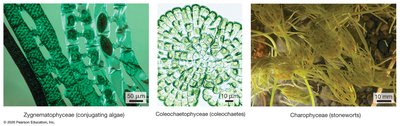
Freshwater green algae are hypothesized to be closely related to land plants based on morphological and genetic evidence. Three green algal groups are most similar to land plants:
Zygnematophyceae (conjugating algae)
Coleochaetophyceae (coleochaetes)
Charophyceae (stoneworts)
These groups are largely multicellular and inhabit freshwater environments, supporting the hypothesis that land plants evolved from freshwater green algae.
Morphological Diversity of Green Algae
Green algae exhibit a wide range of morphological traits and ecological associations:
Species can be unicellular, multicellular, or colonial.
They inhabit marine, freshwater, and moist terrestrial habitats, with most being aquatic.
Green algae often live in close association with other organisms, such as planktonic protists and fungi (in lichens).
Lichens are stable associations between green algae or cyanobacteria and fungi, commonly found in terrestrial environments lacking soil.
Approximately 85% of lichen species involve green algae.
Key Lineages of Green Algae
Overview of Major Green Algal Groups
Green algae are classified into several key lineages, each with distinct reproductive strategies, life cycles, and ecological relevance. The following table summarizes the main characteristics of four important green algal groups:
Lineage | Known Species | Habitat | Reproduction | Life Cycle | Ecological Relevance |
|---|---|---|---|---|---|
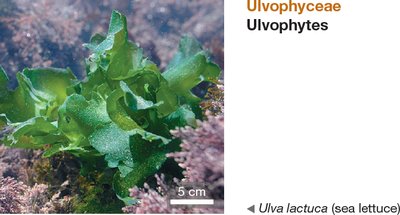
Ulvophyceae (Ulvophytes) | 4000 | Marine, Freshwater | Sexual & Asexual; motile spores & gametes; external fertilization | Zygotes are only diploid stage in unicellular species; alternation of generations in multicellular species | Primary producers in freshwater and coastal areas |
Charophyceae (Stoneworts) | 6000 | Freshwater (lakes) | Sexual & Asexual; motile spores & sperm; eggs retained and nourished | Zygotes are only diploid stage; no alternation of generations | Form beds on lake bottoms; food for waterfowl; shelter for fish; closely related to land plants |
Coleochaetophyceae (Coleochaetes) | 19 | Freshwater | Sexual & Asexual; motile spores & sperm; eggs retained and nourished | Zygotes are only diploid stage; no alternation of generations | Closely related to land plants; heavily studied |
Zygnematophyceae (Conjugating algae) | 2700 | Freshwater | Sexual & Asexual; conjugation between filaments; gametes pass through tubes | Zygotes are only diploid stage; no alternation of generations | Recent evidence of close relationship to land plants; heavily studied |
Why Do Biologists Study Green Algae and Land Plants?
Importance of Land Plants
Land plants are vital to human life and the biosphere. They are fascinating organisms that provide essential resources and ecosystem services:
Humans rely on plants for food, fuel, fibers (for clothing), building materials, and pharmaceuticals.
Agriculture, forestry, and horticulture are major industries based on plants.
Plants play a crucial role in oxygen production, carbon cycling, and habitat formation.
Summary Roadmap of Chapter 28
Major Themes in Plant Diversification
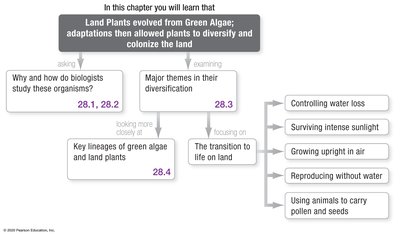
This chapter explores the evolution of land plants from green algae and the adaptations that enabled plants to diversify and colonize terrestrial environments. Key topics include:
Controlling water loss
Surviving intense sunlight
Growing upright in air
Reproducing without water
Using animals to carry pollen and seeds
Additional info:
Green algae and land plants are collectively referred to as Viridiplantae.
Alternation of generations is a key evolutionary innovation in multicellular green algae and land plants.
DNA sequence analysis is a primary method for determining evolutionary relationships among algal groups and land plants.
