 뒤로
Membrane Transport and Cell Signaling: Chapter 5 Study Guide
스터디 가이드 - 스마트 노트
 자료에 맞춘 맞춤형 노트, 핵심 정의, 예시, 맥락을 확장해 제공합니다.
Membrane Transport and Cell Signaling
Introduction to the Plasma Membrane
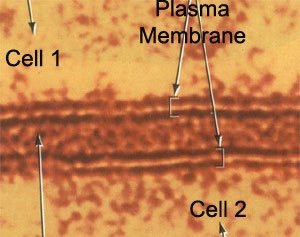
The plasma membrane is a fundamental structure in all cells, responsible for separating the internal environment from the external surroundings. It maintains cellular homeostasis and regulates the passage of materials through selective permeability.
Selective Permeability: Only certain substances can cross the membrane, allowing the cell to control its internal composition.
Homeostasis: The membrane helps maintain stable internal conditions.
Structure: The plasma membrane is composed of a phospholipid bilayer with embedded proteins.
Fluid Mosaic Model
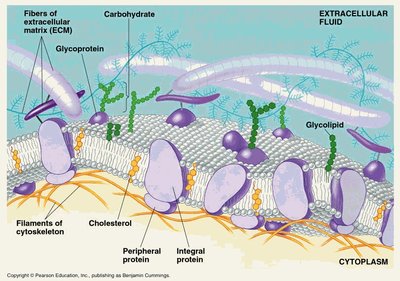
The Fluid Mosaic Model describes the dynamic nature of the plasma membrane, where proteins float in or on the fluid lipid bilayer. This model explains how the membrane is both flexible and functional.
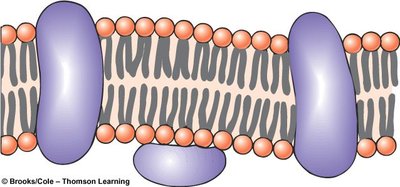
Phospholipid Bilayer: Phospholipids are amphipathic, with hydrophilic heads and hydrophobic tails, forming two layers in water.
Proteins: Integral proteins span the membrane, while peripheral proteins are attached to its surface.
Fluidity: Molecules can move laterally within the membrane, contributing to its flexibility.
Membrane Proteins
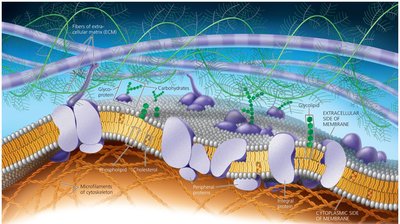
Proteins embedded in the plasma membrane are crucial for its specific functions, including transport, signaling, and structural support.
Integral Proteins: Firmly bound and often span the membrane; involved in transport and signaling.
Peripheral Proteins: Loosely attached to the membrane surface; often involved in cell signaling or structural support.
Membrane Fluidity and Cholesterol
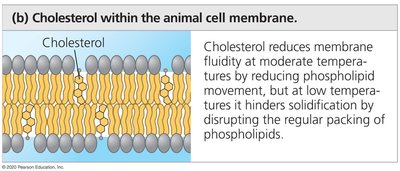
The fluidity of the plasma membrane is essential for its function. Cholesterol acts as a "fluidity buffer," maintaining membrane stability across temperature changes.
Cholesterol: Reduces fluidity at moderate temperatures and prevents solidification at low temperatures.
Phospholipid Movement: Phospholipids are in constant motion, while proteins move more slowly.
Movement Through Membranes
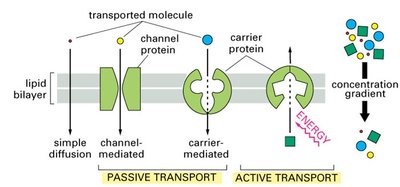
Plasma membranes are selectively permeable, allowing the cell to regulate the entry and exit of substances. Transport proteins facilitate the movement of hydrophilic molecules.
Transport Proteins: Include carrier proteins (change shape to move molecules) and channel proteins (form channels for passage).
Types of Transport: Passive (no energy required) and active (energy required).
Passive Transport
Diffusion
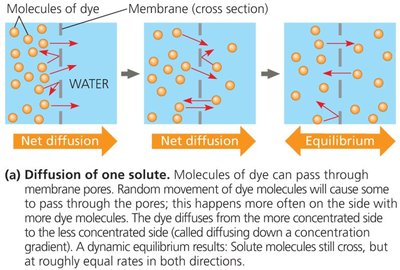
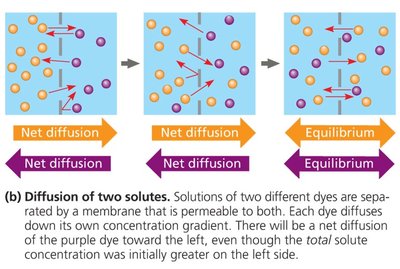
Diffusion is the movement of molecules from an area of high concentration to an area of low concentration, driven by potential energy differences.
Dynamic Equilibrium: Molecules continue to move, but there is no net change in distribution.
Simple Diffusion: Small, nonpolar molecules move directly through the membrane.
Facilitated Diffusion: Transport proteins assist the movement of larger or polar molecules down their concentration gradient.
Osmosis
Osmosis is the diffusion of water across a selectively permeable membrane. Water moves from areas of high concentration to low concentration.
Tonicity: Describes the ability of a solution to cause a cell to gain or lose water.
Isotonic: Equal solute concentrations; no net water movement.
Hypotonic: Lower solute concentration; cell gains water.
Hypertonic: Higher solute concentration; cell loses water.
Water Balance in Plant Cells
Plant cells maintain water balance through their cell walls. In hypotonic solutions, cells become turgid; in isotonic solutions, they become flaccid; in hypertonic solutions, plasmolysis occurs.
Turgid: Swollen cell due to water intake.
Flaccid: Limp cell due to no net water movement.
Plasmolysis: Cell membrane pulls away from the cell wall due to water loss.
Active Transport
Direct Active Transport
Active transport requires energy (usually ATP) to move substances against their concentration gradient. The sodium-potassium pump is a classic example.
Sodium-Potassium Pump: Moves 3 Na+ out and 2 K+ in, maintaining electrochemical gradients.
Cotransport
Cotransport involves the coupling of the "downhill" diffusion of one solute to the "uphill" transport of another. For example, H+/glucose cotransport uses the energy from H+ moving down its gradient to transport glucose against its gradient.
Bulk Transport
Exocytosis and Endocytosis
Bulk transport moves large molecules across the membrane using vesicles. Exocytosis releases materials, while endocytosis brings them into the cell.
Exocytosis: Vesicles fuse with the membrane to release contents outside the cell.
Endocytosis: The membrane forms vesicles to bring materials into the cell.
Types of Endocytosis: Phagocytosis (cell eating), pinocytosis (cell drinking), receptor-mediated endocytosis.
Cell Signaling
Overview of Cell Signaling
Cell signaling enables cells to communicate and coordinate activities. It involves the plasma membrane and can occur via direct contact or signaling molecules.
Signal Transmission: Synthesis, release, and transport of signaling molecules (e.g., neurotransmitters, hormones).
Three Main Processes: Signal reception, signal transduction, and cellular response.
Reception
Reception is the process of receiving an incoming signal. Receptors on the target cell bind with signaling molecules (ligands), and this process is highly selective.
Lock and Key Model: Only matching signal molecules bind to specific receptors.
Types of Receptors: Ion channel-linked, G protein-linked, and intracellular receptors.
Signal Transduction
Signal transduction converts an extracellular signal into an intracellular response through a chain of molecular interactions. Each component can be active or inactive, and the signal is passed on by protein shape changes.
Response
The final step in cell signaling is the cellular response, which alters some cell process, such as opening/closing the plasma membrane, changing metabolic activity, or altering gene expression.
Summary Table: Types of Membrane Transport
Type | Energy Required? | Direction | Example |
|---|---|---|---|
Simple Diffusion | No | Down gradient | O2 crossing membrane |
Facilitated Diffusion | No | Down gradient | Glucose via transport protein |
Osmosis | No | Down gradient | Water movement |
Active Transport | Yes (ATP) | Against gradient | Sodium-potassium pump |
Bulk Transport | Yes | Variable | Exocytosis, endocytosis |
Key Equations
Concentration Gradient:
Osmosis:
Where is water potential, is solute potential, and is pressure potential.
Additional info:
Membrane transport is essential for nutrient uptake, waste removal, and cell communication.
Cell signaling pathways are often targets for pharmaceuticals and are critical in understanding diseases.
