 뒤로
Mendel and the Gene: Principles of Inheritance
스터디 가이드 - 스마트 노트
 자료에 맞춘 맞춤형 노트, 핵심 정의, 예시, 맥락을 확장해 제공합니다.
Chapter 14: Mendel and the Gene
Overview of Mendelian Genetics
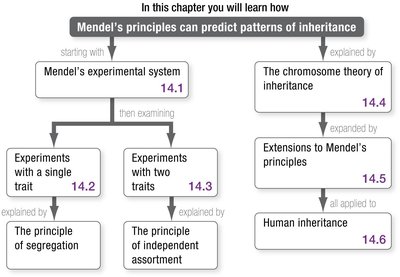
This chapter explores how Mendel's principles can predict patterns of inheritance, starting with his experimental system and expanding to the chromosome theory of inheritance and extensions to Mendel's principles. The study of inheritance is foundational to understanding genetics and heredity in biology.
Historical Context and Competing Hypotheses
Before Mendel, two main hypotheses attempted to explain heredity:
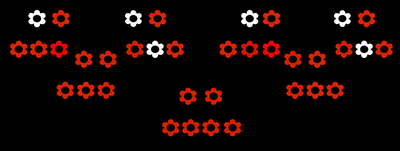
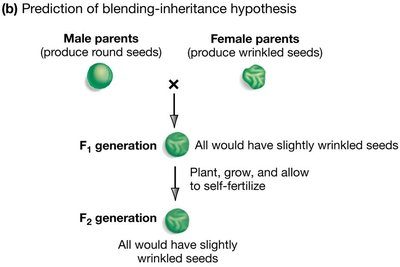
Blending Inheritance: Parental traits blend so offspring have intermediate traits.
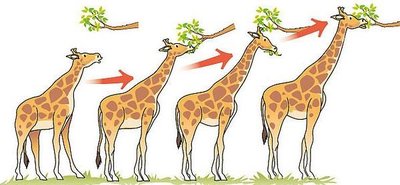
Inheritance of Acquired Characteristics: Parental traits are modified through use and then passed on to offspring.
Examples of blending inheritance include flower color mixing, while inheritance of acquired characteristics is illustrated by the idea that giraffes' necks lengthen as they stretch for food and this trait is passed to their offspring.
Gregor Mendel: The Father of Genetics
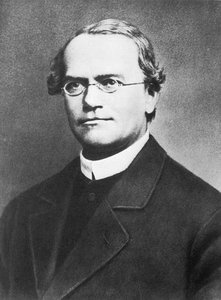
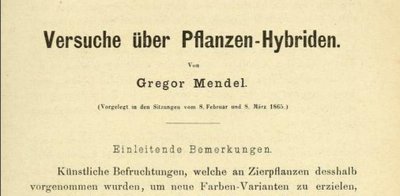
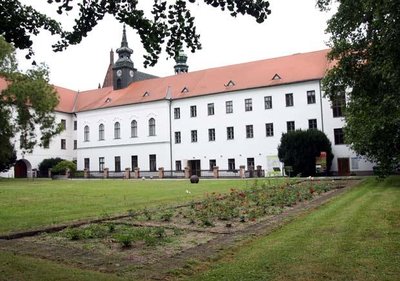
Gregor Mendel was an Austrian monk who used quantitative analysis in plant breeding experiments to develop the concept of the gene. His work laid the foundation for the chromosome theory of inheritance.
Mendel's experiments were conducted on garden peas (Pisum sativum).
He wanted to understand heredity—the transmission of traits from parents to offspring.
Traits are any observable characteristics of an individual.
Mendel's Model Organism: Garden Pea
Mendel chose garden peas for their ease of cultivation, short generation time, and ability to produce large numbers of seeds. Peas have many polymorphic traits, making them ideal for genetic studies.
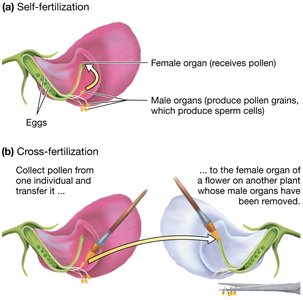
Peas can self-fertilize or be cross-fertilized.
True-breeding lines exhibit the same trait generation after generation.
Cross-fertilization allows for hybridization between different pure lines.
Traits of Pea Plants
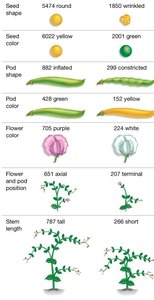
Mendel worked with seven easily recognizable traits, each with two distinct phenotypes:
Seed shape, seed color, pod shape, pod color, flower color, flower and pod position, stem length
Phenotype: Observable features of an individual
True-breeding lines: Produced offspring identical to themselves
Hybrids: Offspring from crosses between pure lines
Mendel's Experiments with a Single Trait (Monohybrid Cross)
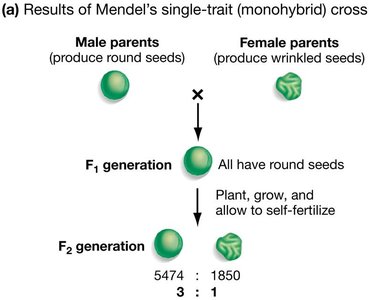
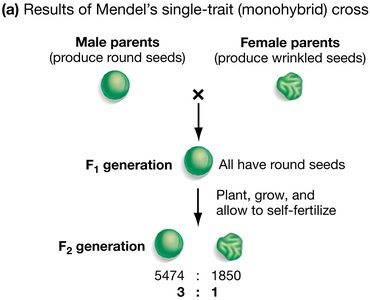
Mendel crossed pure lines differing in one trait (e.g., round vs. wrinkled seeds). The parental generation (P) produced the F1 generation, which all had round seeds. The F2 generation showed a 3:1 ratio of round to wrinkled seeds.
Dominant trait: Displayed in F1 generation (round seeds)
Recessive trait: Masked in F1, reappeared in F2 (wrinkled seeds)
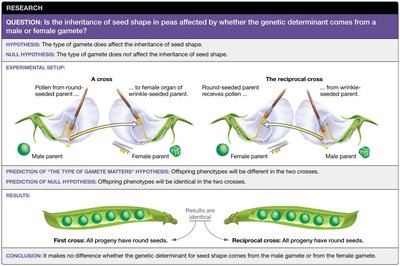
Reciprocal Crosses
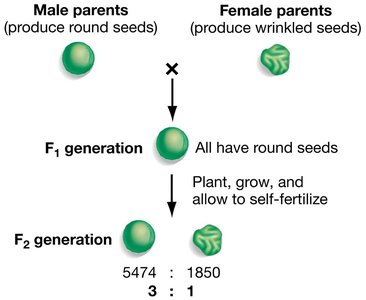
Mendel performed reciprocal crosses to test if sex influenced inheritance. The results were identical, showing that sex did not affect inheritance for the traits Mendel studied.
Dominant and Recessive Traits
For all seven traits, the F1 generation displayed a trait distinctly like one parent. Dominant traits are displayed in F1, while recessive traits are masked but reappear in F2.
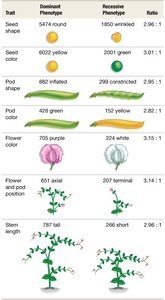
Summary Table: F2 Phenotypes from Monohybrid Crosses
The table below summarizes the dominant and recessive phenotypes and their ratios observed in Mendel's monohybrid crosses.
Trait | Dominant Phenotype | Recessive Phenotype | Ratio |
|---|---|---|---|
Seed shape | Round | Wrinkled | 2.96:1 |
Seed color | Yellow | Green | 3.01:1 |
Pod shape | Inflated | Constricted | 2.96:1 |
Pod color | Green | Yellow | 2.82:1 |
Flower color | Purple | White | 3.15:1 |
Flower/pod position | Axial | Terminal | 3.14:1 |
Stem length | Tall | Short | 2.96:1 |
Particulate Inheritance
Mendel's results were inconsistent with blended inheritance and acquired characteristics. He proposed the hypothesis of particulate inheritance: hereditary determinants act as discrete, unchanging particles.
Hereditary determinants do not blend or change through use.
They are inherited as distinct units (genes).
Genes, Alleles, and Genotypes
Genes are hereditary determinants for traits. Each individual has two versions of each gene, called alleles. The combination of alleles is the genotype, which affects the phenotype.
Alleles: Different versions of a gene
Genotype: Combination of alleles in an individual
Phenotype: Observable trait
The Principle of Segregation
Mendel developed the principle of segregation to explain the 3:1 ratio in F2 individuals:
Two members of each gene pair must segregate into different gamete cells during egg and sperm formation.
Each gamete contains one copy of each gene (one allele).
Homozygotes and Heterozygotes
Homozygotes have two of the same allele (e.g., RR or rr). Heterozygotes have one dominant and one recessive allele (e.g., Rr). Crossing heterozygotes produces:
Genotype: ¼ RR, ½ Rr, ¼ rr
Phenotype: ¾ round, ¼ wrinkled
Summary Table: Mendel's Model for Monohybrid Crosses
Mendel's Claims | Comments |
|---|---|
Peas have two copies of each gene and may have two different alleles. | True for many organisms. |
Genes are particles of inheritance that do not blend together. | Genes do not change when transmitted between generations. |
Each gamete contains one copy of each gene. | Principle of segregation. |
Each parent contributes equally to offspring genotype. | Offspring acquire two of each gene, one from each parent. |
Some alleles are dominant to others. | Dominant phenotype is displayed in heterozygotes. |
Punnett Squares
The Punnett square is a diagram used to predict the results of Mendelian crosses:
Write each unique gamete genotype for one parent along the top.
Write each unique gamete genotype for the other parent down the side.
Fill in each box with the gamete genotypes above and to the left.
Calculate proportions or ratios of each offspring genotype and phenotype.
Mendel's Experiments with Two Traits (Dihybrid Cross)
Mendel used dihybrid crosses to determine whether alleles of different genes segregate together or independently. His results supported the principle of independent assortment:
Alleles of different genes are transmitted independently of one another (usually).
Dihybrid cross produces four possible phenotypes in a 9:3:3:1 ratio.
Testcrosses
A testcross involves crossing a parent with a dominant phenotype but unknown genotype with a parent that contributes only recessive alleles. Analyzing offspring phenotypes reveals the unknown genotype.
Chromosome Theory of Inheritance
The chromosome theory of inheritance arose from observations of meiosis:
Genes are located on chromosomes at specific loci.
Physical separation of alleles during meiosis I explains Mendel's principle of segregation.
Genes for different traits assort independently if they are on different chromosomes or far apart on the same chromosome.
Extensions and Exceptions to Mendel's Principles
While Mendel's work is foundational, many variations exist:
Sex-linked traits
Incomplete dominance
Multiple allele traits
Polygenic traits (controlled by many genes)
Key Terms in Mendelian Genetics
Term | Definition | Example/Comment |
|---|---|---|
Autosomal inheritance | Patterns of inheritance for genes not on a sex chromosome | Mendel studied autosomal patterns |
Gene | Hereditary factor influencing a trait | Region of DNA coding for protein or RNA |
Allele | Particular form of a gene | Diploids may have same or different alleles |
Genotype | Listing of alleles in an individual | Diploids: two alleles per gene; haploids: one |
Phenotype | Observable traits | From molecules to whole organism |
Homozygous | Two of the same allele | Refers to a particular gene |
Heterozygous | Two different alleles | Refers to a particular gene |
Dominant allele | Produces phenotype in heterozygous and homozygous genotypes | Does not imply high frequency or fitness |
Recessive allele | Produces phenotype only in homozygous genotypes | Recessive phenotype disappears in heterozygotes |
Pure line | Individuals identical in phenotype, produce identical offspring | Homozygous for gene in question |
Hybrid | Offspring from crosses between homozygous parents with different genotypes | Heterozygous |
Polymorphic trait | Trait appears commonly in two or more forms | Flower color in peas: purple or white |
Reciprocal cross | Cross with male and female phenotypes reversed | Tests if sex influences trait transmission |
Testcross | Cross of homozygous recessive and dominant phenotype with unknown genotype | Determines if dominant parent is homozygous or heterozygous |
X-linked | Gene located on X chromosome | Different inheritance patterns in males and females |
Y-linked | Gene located on Y chromosome | Most Y-linked genes determine male-specific development |
Summary
Mendel's principles of inheritance—segregation and independent assortment—form the basis of classical genetics. These principles explain how traits are transmitted from parents to offspring and how genetic variation arises. Extensions to Mendel's work, including sex-linked inheritance, incomplete dominance, and polygenic traits, further enrich our understanding of heredity.
