 뒤로
Mendelian and Complex Genetics: Study Guide
스터디 가이드 - 스마트 노트
 자료에 맞춘 맞춤형 노트, 핵심 정의, 예시, 맥락을 확장해 제공합니다.
Mendelian and Complex Genetics
Genetic Traits and Their Classification
Genetic traits are inherited characteristics that can be observed in organisms. These traits are classified based on their variability and the ease of observation.
Invariant traits: Traits that are the same in all individuals of a species.
Variable traits: Traits that differ among individuals of the same species.
Physical traits: Easily observable traits, such as the shape of a dog's face.
Biochemical traits: Traits that are more difficult to observe, such as susceptibility to diabetes.
Behavioral traits: Behaviors with some genetic basis, such as introversion or extroversion.
Genes, Alleles, Genotype, and Phenotype
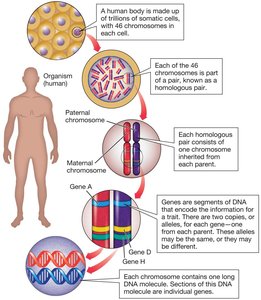
Genes are the basic units of heredity, consisting of stretches of DNA located on chromosomes. Each gene can exist in different forms called alleles, which contribute to the diversity of traits.
Gene: A segment of DNA that contains information for a particular trait.
Allele: Different versions of a gene (e.g., fur color in dogs).
Genotype: The pair of alleles for a given trait that codes for the phenotype; the genetic makeup of an individual.
Phenotype: The physical expression of a trait; what can be observed in an individual.
Human Life Cycle and Chromosomes
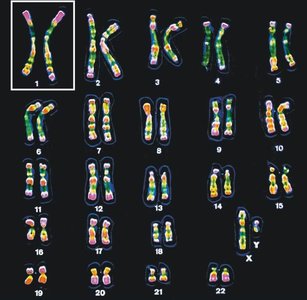
The human life cycle involves the alternation between diploid somatic cells and haploid gametes. Chromosomes are arranged in pairs, and each pair consists of homologous chromosomes inherited from each parent.
Somatic cells: Diploid (2n), containing two copies of each chromosome.
Gametes: Haploid (1n), containing one copy of each chromosome.
Karyotype: The arrangement of chromosomes by length, used to identify chromosomal abnormalities.
Homologous chromosomes: Chromosome pairs that have the same genes but may have different alleles.
Gregor Mendel and the Foundations of Genetics
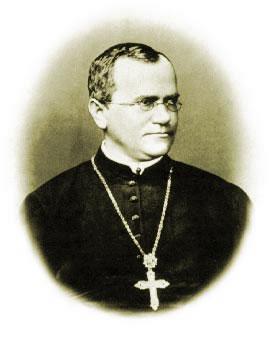
Gregor Mendel, known as the father of modern genetics, conducted experiments with pea plants to study heredity. He identified the basic principles of inheritance, including the concepts of genes, traits, and true-breeding plants.
Character: A heritable feature that varies among individuals (e.g., flower color).
Trait: Each variant of a character (e.g., purple flowers).
True-breeding: Plants that self-pollinate and show no variation for a particular trait.
Mendel's Experiments and Laws
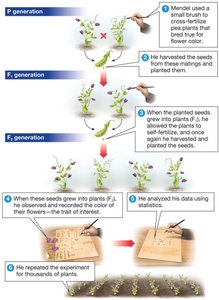
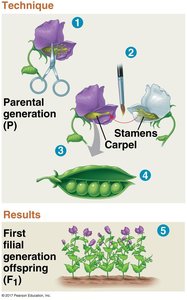
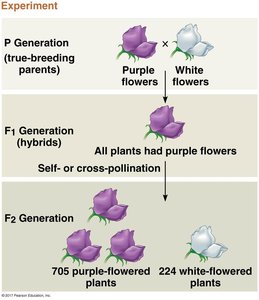
Mendel performed hybridization experiments by crossing contrasting pure-breeding strains. He defined the parental (P), first filial (F1), and second filial (F2) generations and observed the inheritance patterns of traits.
Hybridization: Crossing two contrasting pure-breeding strains.
P Generation: Parental generation of true-breeding plants.
F1 Generation: Offspring of crossing two contrasting true-breeders.
F2 Generation: Offspring of crossing two members of the F1 generation.
Genotype and Phenotype Examples
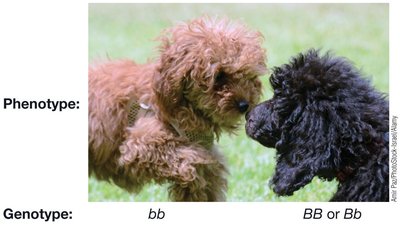
The genotype determines the phenotype, but different genotypes can produce the same phenotype if one allele is dominant.
Homozygous: Two copies of the same allele (e.g., BB or bb).
Heterozygous: Two different alleles (e.g., Bb); the dominant allele determines the phenotype.
Mendel's Law of Segregation
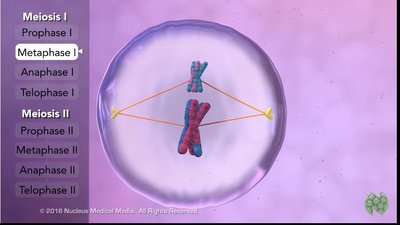
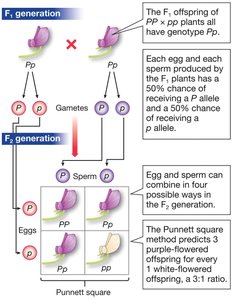
Mendel's law of segregation states that for each gene, an individual's two alleles are segregated into different haploid gametes during meiosis. Each gamete receives only one allele for each gene.
Law of Segregation: The two alleles for each gene separate during gamete formation.
Meiosis: The process that ensures random segregation of alleles.
Punnett Squares and Predicting Inheritance
Punnett squares are grid-like diagrams used to predict the results of genetic crosses. They show all possible ways that alleles can combine through fertilization.
Punnett square: A tool for visualizing genetic crosses and calculating genotype and phenotype ratios.
Genotype ratio: The proportion of different genotypes among offspring.
Phenotype ratio: The proportion of different phenotypes among offspring.
Mendel's Law of Independent Assortment
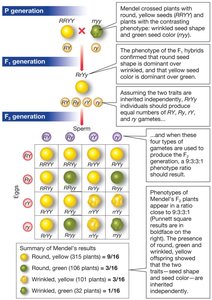
During gamete formation, each pair of alleles segregates independently of all other pairs. This means traits are inherited independently from one another, especially when considering two or more traits at the same time.
Law of Independent Assortment: Alleles for different genes are distributed to gametes independently.
Dihybrid cross: A cross involving two traits, showing independent assortment.

Meiosis and Genetic Variation
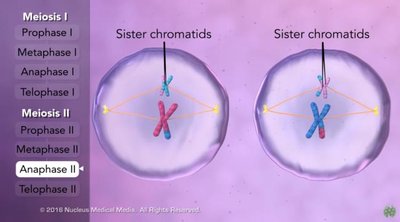
Meiosis is the process that generates genetic variation through the independent assortment and segregation of chromosomes. Anaphase II is key for separating sister chromatids and producing four distinct haploid daughter cells.
Meiosis I: Homologous chromosomes separate.
Meiosis II: Sister chromatids separate, resulting in four unique gametes.

Chromosome Theory of Inheritance
The chromosome theory of inheritance explains the mechanism underlying Mendel's laws. Chromosomes are paired, and each homologous chromosome carries one allele for a gene. Alleles are shuffled, recombined, and separated randomly into gametes during meiosis.
Chromosome theory: Genes are located on chromosomes, which segregate and assort independently.
Fertilization: Random fusion of gametes creates unique individuals.
Probability in Genetics
Genetic outcomes are determined by probability, which is calculated as the number of ways a certain event can occur divided by the total number of possible outcomes. The rules of addition and multiplication are used to calculate probabilities in genetic crosses.
Rule of Addition: Used when an outcome can occur in two different ways ("OR" statement).
Rule of Multiplication: Used when two independent events occur together ("AND" statement).
Complex Inheritance and Environmental Effects
Not all genes follow Mendel's rules. The environment can influence gene expression, so phenotype is not always strictly dependent on genotype. Genes establish a range of possible phenotypes, and both nature and nurture cooperate to establish phenotypes.
Environmental effects: External and internal conditions can affect genetic expression (e.g., temperature, CO2 levels, sunlight).
Example: Siamese cat coat color is influenced by temperature.
Chromosomes and Sex Determination
Genes are located on chromosomes, including sex chromosomes (X and Y). The sex chromosome present in the sperm determines the gender of the embryo. Some genetic disorders are due to mutant recessive alleles on the X chromosome and are typically seen in males.
Sex chromosomes: XX (female), XY (male).
SRY gene: Sex-determining region of Y chromosome, responsible for testis function and sperm production.
X-linked disorders: Hemophilia, Duchenne's muscular dystrophy, red-green color blindness.
Chromosomal Abnormalities
Alterations in chromosome number or structure can lead to genetic disorders. Aneuploidy is the alteration of chromosome number due to nondisjunction during meiosis. Structural changes include deletion, duplication, inversion, and translocation.
Aneuploidy: One gamete is missing a chromosome, or has two for one pair.
Trisomy: Three copies of a chromosome (e.g., Trisomy 21 = Down's Syndrome).
Monosomy: Only one copy of a chromosome.
Polyploidy: More than two complete sets of chromosomes.
Structural changes: Deletion, duplication, inversion, translocation, reciprocal translocation.
DNA: The Genetic Material
Genes are located on chromosomes, which are composed of DNA. Experiments by T.H. Morgan, Frederick Griffith, and Erwin Chargaff established that DNA is the genetic material and provided evidence for the double helix structure.
Chargaff's law: A=T and G=C, providing hints about base-pairing in DNA.
Double helix: Two strands of DNA are anti-parallel, with sugars and phosphates facing outward and nitrogen bases facing inward.
Base pairing: A pairs with T (2 H-bonds), C pairs with G (3 H-bonds).
Summary Table: Mendelian vs. Complex Inheritance
Inheritance Type | Key Features | Examples |
|---|---|---|
Mendelian | Single gene, dominant/recessive alleles, predictable ratios | Purple/white flower color in peas |
Complex | Multiple genes, environmental influence, unpredictable ratios | Height, diabetes susceptibility |
