 뒤로
6 Mendelian Genetics and Statistical Analysis in Heredity
스터디 가이드 - 스마트 노트
 자료에 맞춘 맞춤형 노트, 핵심 정의, 예시, 맥락을 확장해 제공합니다.
Heredity and Mendelian Genetics
Key Terms in Heredity
Understanding heredity requires familiarity with several foundational terms in genetics. These terms describe the inheritance of traits and the genetic makeup of organisms.
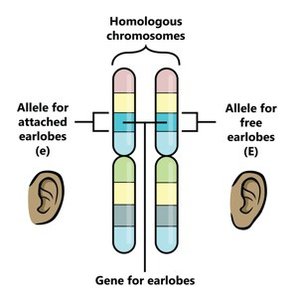
Allele: A variant form of a gene. Each gene resides at a specific locus on a chromosome and can exist in multiple forms (alleles).
Dominant allele: An allele that masks the expression of another allele at the same locus. Represented by a capital letter (e.g., A).
Recessive allele: An allele whose expression is masked by a dominant allele. Represented by a lowercase letter (e.g., a).
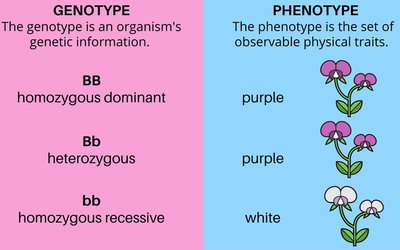
Genotype: The genetic constitution of an organism, often represented by allele pairs (e.g., AA, Aa, aa).
Phenotype: The observable physical or physiological traits of an organism, determined by its genotype.
Homozygous: Having two identical alleles for a particular gene (e.g., AA or aa).
Heterozygous: Having two different alleles for a particular gene (e.g., Aa).
P generation: The parental generation in a genetic cross.
F1 generation: The first filial generation, offspring of the P generation.
F2 generation: The second filial generation, offspring of the F1 generation.
Mendel's Laws of Inheritance
Gregor Mendel's experiments with pea plants established the basic principles of heredity. His laws explain how traits are transmitted from parents to offspring.
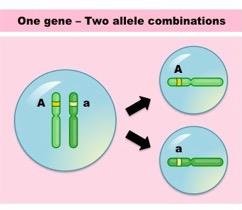
Law of Segregation: During gamete formation, the two alleles for a gene separate so that each gamete receives only one allele.
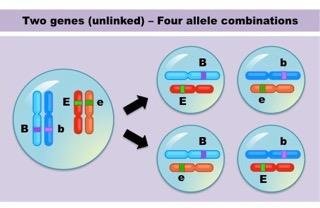
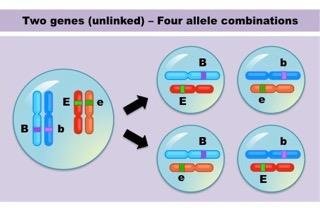
Law of Independent Assortment: Alleles of different genes are distributed independently of one another during gamete formation.
Monohybrid and Dihybrid Crosses
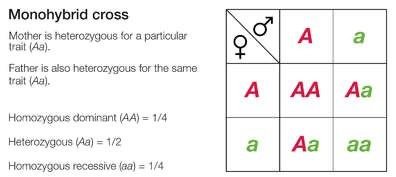
Genetic crosses are used to predict the inheritance of traits. A monohybrid cross involves one gene, while a dihybrid cross involves two genes.
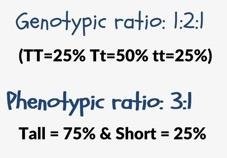
Monohybrid Cross: Examines the inheritance of a single trait. The expected genotypic ratio in the F2 generation is 1:2:1, and the phenotypic ratio is 3:1.
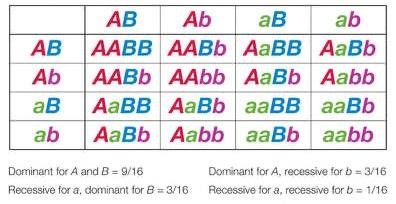
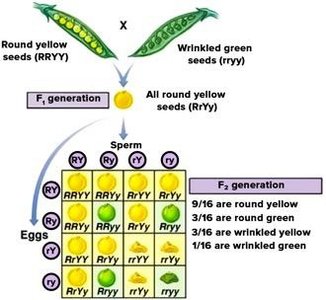
Dihybrid Cross: Examines the inheritance of two traits. The expected phenotypic ratio in the F2 generation is 9:3:3:1.
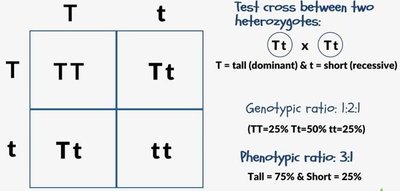
Test Crosses
A test cross is used to determine the genotype of an organism with a dominant phenotype by crossing it with a homozygous recessive individual.
Purpose: To reveal whether the dominant phenotype is homozygous or heterozygous.
Example: Crossing a tall pea plant (unknown genotype) with a short pea plant (tt).
Statistical Analysis in Genetics: Chi-Square Test
Chi-Square Test Overview
The chi-square (χ²) test is a statistical method used to compare observed results with expected results based on a hypothesis. It is commonly used in genetics to determine if experimental data fit Mendelian ratios.
Formula: The chi-square statistic is calculated as follows:
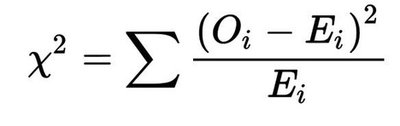
Oi: Observed value for category i
Ei: Expected value for category i
Interpreting Chi-Square Results
To interpret the chi-square value, compare it to a critical value from a chi-square table, considering the degrees of freedom and the desired significance level (p-value).
Degrees of Freedom (df): Calculated as the number of categories minus one (df = N - 1).
p-value: The probability that the observed deviation from expected results is due to chance.
Critical Value: If the calculated χ² is greater than the critical value, the hypothesis is rejected.


Example: Chi-Square Calculation in Genetics
Consider a monohybrid cross with the following observed and expected values:
Phenotype | Observed (O) | Expected (E) | O-E | (O-E)2 | (O-E)2/E |
|---|---|---|---|---|---|
Purple Flowers | 705 | 696.75 | 8.25 | 68.0625 | 0.0977 |
White Flowers | 224 | 232.25 | -8.25 | 68.0625 | 0.2931 |
Total | 929 | 929 | χ² = 0.3907 |
Compare χ² to the critical value for 1 degree of freedom at the desired significance level to determine if the observed results fit the expected Mendelian ratio.
Summary of Exam Concepts
Perform and interpret monohybrid and dihybrid crosses
Perform and interpret test crosses
Calculate and interpret chi-square (χ²) values
Understand and explain Mendel’s laws
Hint: Frequencies, percentages, fractions, and whole numbers are not the same. χ² is not asking you to solve for x.
Additional info: The notes cover Mendelian genetics, statistical analysis of genetic data, and the interpretation of experimental results, all of which are essential for General Biology students.
