 뒤로
Metabolic Pathways, Cellular Respiration, and Energy Transfer in Biology
스터디 가이드 - 스마트 노트
 자료에 맞춘 맞춤형 노트, 핵심 정의, 예시, 맥락을 확장해 제공합니다.
Metabolic Pathways
Linear and Cyclic Pathways
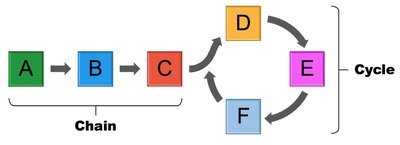
Metabolic pathways are sequences of chemical reactions occurring within a cell, catalyzed by enzymes, and organized as either linear (chain) or cyclic (cycle) processes. These pathways are fundamental to cellular metabolism, enabling the transformation of molecules and the transfer of energy.
Linear (Chain) Pathways: Molecules are converted stepwise from one form to another, ending with a final product.
Cyclic Pathways: The pathway forms a loop, regenerating the starting molecule after a series of transformations.
Enzymes: Each step is catalyzed by a specific enzyme, ensuring efficiency and regulation.
Example: Glycolysis is a linear pathway; the citric acid cycle is cyclic.
Anabolic vs. Catabolic Pathways
Energy Flow and Molecular Transformation
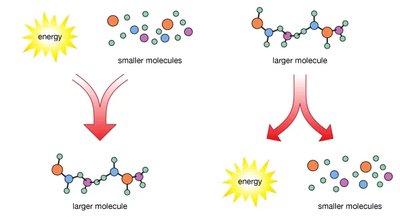
Metabolic pathways are classified as anabolic or catabolic based on their energy requirements and the direction of molecular transformation.
Anabolic Pathways: Build larger molecules from smaller ones; require energy input (endergonic, ΔG > 0).
Catabolic Pathways: Break down larger molecules into smaller ones; release energy (exergonic, ΔG < 0).
Key Point: Anabolic reactions are essential for biosynthesis (e.g., protein synthesis), while catabolic reactions provide energy (e.g., cellular respiration).
Example: Photosynthesis is anabolic; glycolysis and cellular respiration are catabolic.
Redox Reactions in Cellular Respiration
Oxidation and Reduction
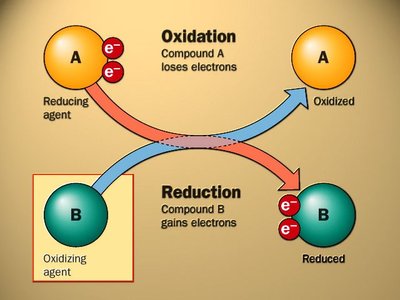
Cellular respiration involves a series of redox (oxidation-reduction) reactions, where electrons are transferred between molecules, facilitating energy release and storage.
Oxidation: Loss of electrons from a molecule; the molecule becomes oxidized.
Reduction: Gain of electrons by a molecule; the molecule becomes reduced.
Redox Pair: One molecule acts as a reducing agent (donates electrons), the other as an oxidizing agent (accepts electrons).
Example: In cellular respiration, glucose is oxidized to CO2, and O2 is reduced to H2O.
Cellular Respiration: Overview and Energy Transfer
General Reaction and ATP Production
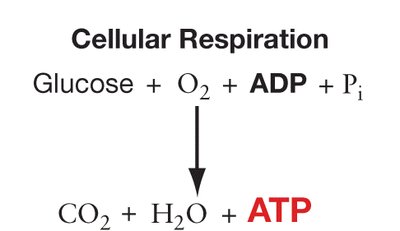
Cellular respiration is a catabolic pathway that converts the energy stored in glucose into ATP, the cell's energy currency, through a series of redox reactions.
Overall Reaction:
ATP Synthesis: Energy released from glucose oxidation is used to synthesize ATP from ADP and inorganic phosphate (Pi).
Stages: Glycolysis, Pyruvate Processing, Citric Acid Cycle, Electron Transport Chain.
Example: Each glucose molecule yields up to 36-38 ATP molecules in eukaryotes.
Electron Carriers: NADH and FADH2
Role in Energy Transfer
Electron carriers such as NAD+ and FAD are essential for shuttling electrons and protons during cellular respiration, facilitating the transfer of energy to ATP.
NAD+: Accepts electrons and a proton to become NADH.
FAD: Accepts electrons and protons to become FADH2.
Function: These carriers transport electrons to the electron transport chain, where ATP is generated.
Example: NADH and FADH2 are produced during glycolysis and the citric acid cycle.
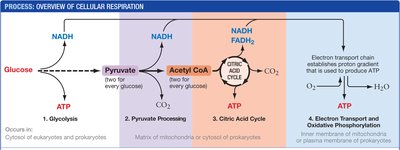
Stages of Cellular Respiration
Pathway Overview
Cellular respiration consists of four main stages, each contributing to the breakdown of glucose and the production of ATP.
Glycolysis: Occurs in the cytosol; glucose is split into two pyruvate molecules, producing ATP and NADH.
Pyruvate Processing: Pyruvate is converted to Acetyl CoA, releasing CO2 and generating NADH.
Citric Acid Cycle: Acetyl CoA enters the cycle, producing CO2, ATP, NADH, and FADH2.
Electron Transport Chain: NADH and FADH2 donate electrons, driving ATP synthesis and forming H2O.
Energetic Coupling and Gibbs Free Energy
Energy Transfer in Metabolism
Energetic coupling links exergonic and endergonic reactions, allowing cells to harness energy released from catabolic processes to drive anabolic reactions.
Exergonic Reaction: Releases energy (ΔG < 0), e.g., glucose oxidation.
Endergonic Reaction: Requires energy input (ΔG > 0), e.g., ATP synthesis.
Gibbs Free Energy: quantifies the spontaneity of a reaction; negative values indicate spontaneous processes.
Example: Cellular respiration couples the exergonic oxidation of glucose to the endergonic synthesis of ATP.
Summary Table: Metabolic Pathways and Energy Transfer
Pathway Type | Energy Change | Example |
|---|---|---|
Anabolic | Endergonic (ΔG > 0) | Protein synthesis, Photosynthesis |
Catabolic | Exergonic (ΔG < 0) | Cellular respiration, Glycolysis |
Key Terms and Definitions
Metabolic Pathway: Series of enzyme-catalyzed reactions transforming molecules within a cell.
Anabolic Pathway: Builds complex molecules; requires energy.
Catabolic Pathway: Breaks down molecules; releases energy.
Redox Reaction: Chemical reaction involving electron transfer.
ATP (Adenosine Triphosphate): Main energy carrier in cells.
NADH/FADH2: Electron carriers in cellular respiration.
Additional info:
Energetic coupling is essential for cellular metabolism, allowing cells to perform work by linking energy-releasing and energy-consuming reactions.
Feedback inhibition regulates metabolic pathways, preventing overproduction of end products.
