 뒤로
뒤로Metabolism, Cellular Respiration, and Photosynthesis: Study Guide (Chapters 6-8)
스터디 가이드 - 스마트 노트
 자료에 맞춘 맞춤형 노트, 핵심 정의, 예시, 맥락을 확장해 제공합니다.
Metabolism and Energy Transformation
Metabolism and Metabolic Pathways
Metabolism refers to all chemical reactions that occur within living organisms to sustain life. These reactions are organized into metabolic pathways, where the product of one reaction serves as the substrate for the next.
Catabolic pathways: Break down complex molecules into simpler ones, releasing energy (e.g., cellular respiration).
Anabolic pathways: Build complex molecules from simpler ones, requiring energy input (e.g., protein synthesis).
Forms of Energy
Energy exists in several forms relevant to biological systems:
Kinetic energy: Energy of motion.
Thermal energy: Energy associated with random movement of atoms and molecules.
Potential energy: Stored energy due to position or structure.
Chemical energy: Potential energy stored in chemical bonds.
Free Energy and Thermodynamics
The change in free energy (ΔG) determines whether a reaction is spontaneous. The laws of thermodynamics govern energy transformations:
First law: Energy cannot be created or destroyed, only transformed.
Second law: Every energy transfer increases the entropy (disorder) of the universe.
Entropy is a measure of disorder; free energy is the energy available to do work.
Exergonic and Endergonic Reactions
Exergonic reactions: Release energy; ΔG is negative (spontaneous).
Endergonic reactions: Require energy input; ΔG is positive (non-spontaneous).
ATP and Energy Coupling
ATP (adenosine triphosphate) is the cell's energy currency. Energy coupling uses exergonic reactions to drive endergonic ones, often via ATP hydrolysis.
Phosphorylated intermediate: A molecule with a phosphate group attached, making it more reactive.
Phosphorylation: Transfer of a phosphate group to a molecule.
Enzymes and Catalysis
Enzymes are biological catalysts that speed up reactions by lowering activation energy. The enzyme's shape determines its specificity.
Activation energy: The energy required to start a reaction.
Active site: Region on the enzyme where the substrate binds.
Induced fit: The enzyme changes shape to fit the substrate.
Inhibitors: Molecules that decrease enzyme activity.
Feedback inhibition: End product inhibits an earlier step in the pathway.
Enzyme Conditions
Enzymes function best under optimal conditions of pH and temperature. For example, pepsin works in acidic conditions (stomach), while trypsin works in basic conditions (intestine).
Cellular Respiration
Overview and Equation
Cellular respiration is the process by which cells extract energy from glucose. The overall equation is:
Redox Reactions
Redox reactions involve the transfer of electrons:
Oxidation: Loss of electrons.
Reduction: Gain of electrons.
Stages of Cellular Respiration
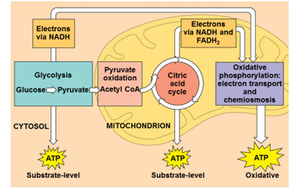
Glycolysis: Occurs in the cytosol; glucose is split into pyruvate, producing ATP and NADH.
Pyruvate oxidation: Pyruvate is converted to Acetyl CoA in the mitochondria.
Citric acid cycle: Acetyl CoA enters the cycle, producing NADH, FADH2, CO2, and ATP.
Oxidative phosphorylation: Includes electron transport chain and chemiosmosis; produces most ATP.
Electron Transport Chain and Chemiosmosis
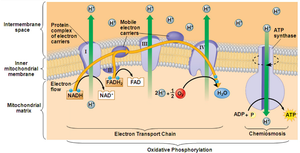
The electron transport chain (ETC) is located in the inner mitochondrial membrane. Electrons from NADH and FADH2 are transferred through protein complexes, ultimately reducing oxygen to water. The energy released pumps protons into the intermembrane space, creating a gradient used by ATP synthase to generate ATP.
NAD+ and NADH
NAD+: Oxidized form; accepts electrons during glycolysis and citric acid cycle.
NADH: Reduced form; carries electrons to the ETC.
Location of Processes in Mitochondria
Glycolysis: Cytosol
Pyruvate oxidation: Mitochondrial matrix
Citric acid cycle: Mitochondrial matrix
Oxidative phosphorylation: Inner mitochondrial membrane
Fermentation
Fermentation occurs when oxygen is absent. Glycolysis continues, and pyruvate is converted to lactate (in animals) or ethanol (in yeast). Only 2 ATP are produced per glucose.
Lactate: Can be transported to the liver for conversion back to pyruvate.
Photosynthesis
Light Reactions
Photosynthesis occurs in chloroplasts and consists of light reactions and the Calvin cycle. Light reactions capture energy from sunlight to produce ATP and NADPH.
The Calvin Cycle (Dark Reactions)
The Calvin cycle uses ATP and NADPH to fix carbon dioxide into organic molecules. It is called a "dark reaction" because it does not require light directly.
Carbon fixation: Begins with the enzyme Rubisco.
Location: Stroma of the chloroplast.
Photosynthetic Pigments
Chlorophyll a: Main pigment for photosynthesis.
Chlorophyll b: Accessory pigment.
Accessory pigments: Absorb additional wavelengths.
Photosystems and Light Energy
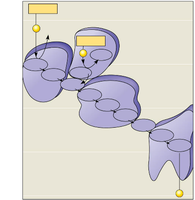
Photosystems are complexes that capture light energy. Photosystem II and Photosystem I work together to transfer electrons and produce ATP and NADPH.
Photon: A particle of light.
Reaction-center complex: Contains special chlorophyll molecules.
Primary electron acceptor: Receives excited electrons.
Steps in Photosystem Function
Light energy excites electrons in chlorophyll.
Electrons are transferred to the primary electron acceptor.
Electron transport chain generates ATP and NADPH.
Additional info: The study guide emphasizes conceptual understanding and recommends using Mastering Biology for practice questions.
