 뒤로
Molecular Basis of Inheritance: DNA as Genetic Material
스터디 가이드 - 스마트 노트
 자료에 맞춘 맞춤형 노트, 핵심 정의, 예시, 맥락을 확장해 제공합니다.
Molecular Basis of Inheritance
Historical Foundations of Genetic Material
The discovery of the molecular basis of inheritance began with Mendel's work on genetics and continued with experiments that identified DNA as the carrier of hereditary information. Early 20th-century scientists debated whether proteins or nucleic acids were responsible for inheritance, given the complexity of proteins compared to DNA's four nucleotides.
Mendel's Laws: Established basic principles of inheritance using pea plants.
T. H. Morgan's Work: Demonstrated that genes are located on chromosomes using Drosophila melanogaster (fruit flies).
Chromosome Composition: Chromosomes are made of proteins and nucleic acids, leading to debate about which carried genetic information.
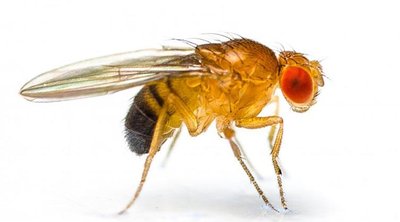
Proteins vs. DNA: Early Hypotheses
In the early 1900s, proteins were thought to be the genetic material due to their complexity and diversity. DNA, with only four nucleotides, was considered too simple to account for the variety of life.
Protein Complexity: 20 amino acids allow for many combinations.
DNA Simplicity: Only four nucleotides (A, T, G, C).
Scientific Reasoning: More combinations in proteins suggested greater capacity for carrying information.
Griffith's Transformation Experiment (1928)
Frederick Griffith's experiment with Streptococcus pneumoniae demonstrated that a substance from dead bacteria could transform living bacteria, suggesting the presence of a "transforming principle." This experiment raised the question of whether DNA or protein was responsible for heredity.
Rough Strain (II-R): Non-virulent, mouse lives.
Smooth Strain (III-S): Virulent, mouse dies.
Heat-Killed Smooth Strain: Non-virulent, mouse lives.
Rough + Heat-Killed Smooth: Mouse dies, indicating transformation.
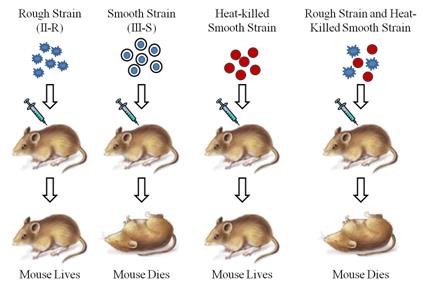
Viruses and the Nature of Genetic Material
Viruses are simple structures composed of DNA (or RNA) surrounded by a protein coat. They infect cells and force them to produce new virus particles, making them ideal for studying the nature of genetic material.
Virus Structure: Genetic material (DNA or RNA) inside a protein coat.
Role in Genetics: Viruses helped clarify whether DNA or protein carried genetic information.
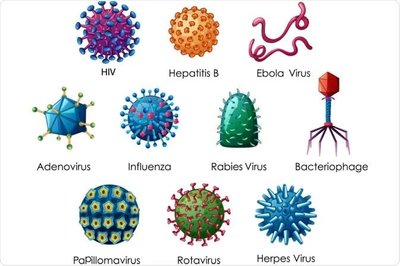
Hershey-Chase Experiment (1952)
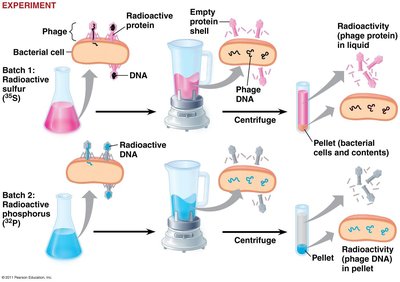
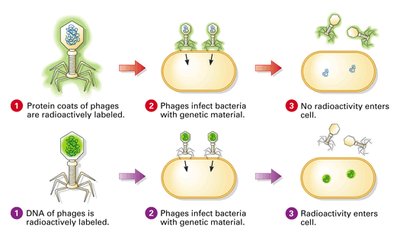
The Hershey-Chase experiment used bacteriophages (viruses that infect bacteria) to determine whether DNA or protein is the genetic material. They labeled protein coats with radioactive sulfur (35S) and DNA with radioactive phosphorus (32P), then tracked which component entered the bacterial cell.
Radioactive Labeling: Protein labeled with 35S, DNA labeled with 32P.
Experimental Steps: Phages infect bacteria; only DNA enters the cell and directs viral replication.
Conclusion: DNA, not protein, is the genetic material.
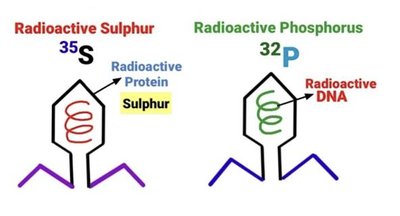
Chargaff's Rules (1950)
Erwin Chargaff analyzed the base composition of DNA in different species and discovered two key rules:
Base Composition Varies: The percentage of each base (A, T, G, C) differs among species.
Base Pair Equality: Within a species, the amount of adenine (A) equals thymine (T), and the amount of guanine (G) equals cytosine (C).
Species | % Adenine (A) | % Thymine (T) | % Guanine (G) | % Cytosine (C) |
|---|---|---|---|---|
Human | 30 | 30 | 20 | 20 |
E. coli | 26 | 26 | 24 | 24 |
Additional info: Values inferred for illustration |
Discovery of DNA Structure: Watson, Crick, and Franklin (1953)
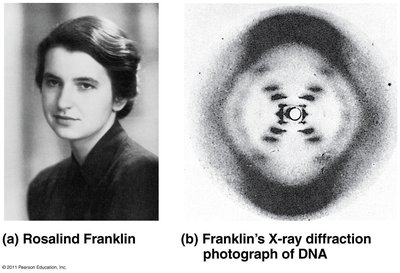
James Watson and Francis Crick, using Rosalind Franklin's X-ray diffraction data (photo 51), determined that DNA is a double helix with antiparallel strands. The structure explained how genetic information could be replicated and passed on.
Double Helix: Two strands twisted around each other.
Antiparallel Strands: Strands run in opposite directions (5' to 3' and 3' to 5').
Base Pairing: A pairs with T (2 hydrogen bonds), G pairs with C (3 hydrogen bonds).
Structure Determines Function: The arrangement of bases and the double helix allow for accurate replication.
DNA Structure and Base Pairing
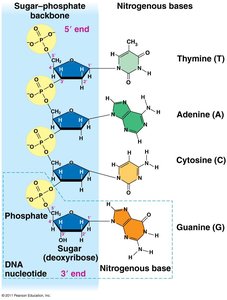
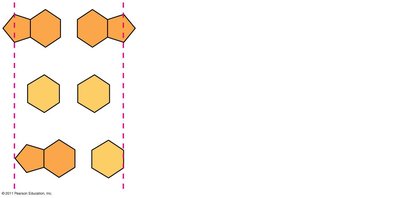
The structure of DNA consists of a sugar-phosphate backbone and nitrogenous bases. The width of the molecule is consistent due to specific base pairing: purine (A or G) pairs with pyrimidine (T or C).
Purine + Purine: Too wide for the helix.
Pyrimidine + Pyrimidine: Too narrow.
Purine + Pyrimidine: Correct width, consistent with X-ray data.
DNA Base Pair Rule
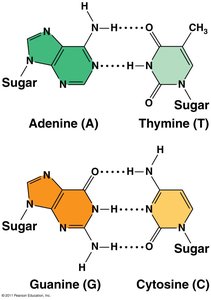
Base pairing in DNA follows specific rules:
Adenine (A) & Thymine (T): Form 2 hydrogen bonds.
Guanine (G) & Cytosine (C): Form 3 hydrogen bonds.
Mnemonic: "A-T-2" (stick letter with stick letter), "C-G-3" (curvy letter with curvy letter).
Detailed DNA Structure
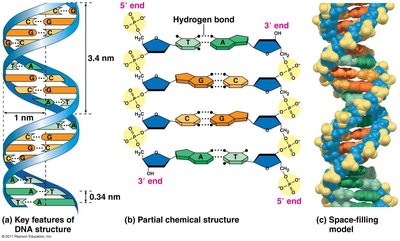
DNA can be represented in several ways: as a double helix, a partial chemical structure, or a space-filling model. The sugar-phosphate backbone is on the outside, and the nitrogenous bases are paired in the center.
Double Helix: 2 nm wide, 3.4 nm per turn, 0.34 nm between base pairs.
Backbone: Sugar and phosphate groups.
Base Pairing: A-T and G-C pairs.
Ends: 5' and 3' ends indicate directionality.
Summary Table: Key Experiments in Molecular Genetics
Experiment | Scientist(s) | Key Finding |
|---|---|---|
Mendel's Laws | Gregor Mendel | Basic principles of inheritance |
Chromosome Theory | T. H. Morgan | Genes are on chromosomes |
Transformation | Griffith | "Transforming principle" exists |
Hershey-Chase | Hershey & Chase | DNA is genetic material |
Chargaff's Rules | Erwin Chargaff | Base pair ratios |
DNA Structure | Watson, Crick, Franklin | Double helix model |
