 뒤로
Nucleic Acid Structure: DNA and RNA
스터디 가이드 - 스마트 노트
 자료에 맞춘 맞춤형 노트, 핵심 정의, 예시, 맥락을 확장해 제공합니다.
Nucleic Acid Structure
Introduction to Nucleic Acids
Nucleic acids are essential macromolecules that store and transmit genetic information in all living organisms. The two main types are DNA (deoxyribonucleic acid) and RNA (ribonucleic acid). DNA stores hereditary information, while RNA assists in protein production.
DNA: Contains genes, which are discrete units of hereditary information consisting of specific nucleotide sequences.
RNA: Functions mainly in protein synthesis.
Nucleotides: The Monomers of Nucleic Acids
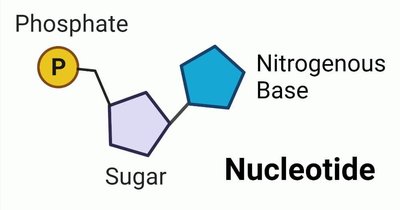
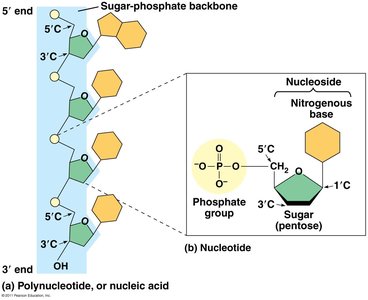
Nucleic acids are polymers made up of monomers called nucleotides. Each nucleotide consists of three components: a phosphate group, a pentose sugar (5-carbon), and a nitrogenous base.
Phosphate group: Provides structural support and links nucleotides together.
Pentose sugar: Deoxyribose in DNA, ribose in RNA.
Nitrogenous base: Four types in DNA (A, T, C, G); four types in RNA (A, U, C, G).
Pentose Sugars: Deoxyribose vs. Ribose
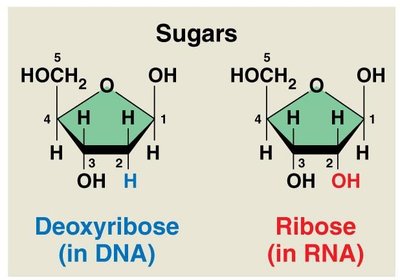
The pentose sugar distinguishes DNA from RNA. Deoxyribose lacks a hydroxyl group on the 2nd carbon (has –H instead of –OH), while ribose has a hydroxyl group.
Deoxyribose: Found in DNA; lacks an –OH group at the 2' carbon.
Ribose: Found in RNA; has an –OH group at the 2' carbon.
Nitrogenous Bases: Purines and Pyrimidines
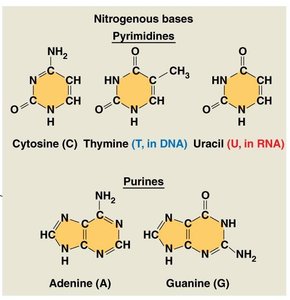
Nitrogenous bases are carbon rings containing nitrogen. They are classified as purines (adenine, guanine) and pyrimidines (cytosine, thymine, uracil).
Pyrimidines: Cytosine (C), Thymine (T, DNA only), Uracil (U, RNA only)
Purines: Adenine (A), Guanine (G)
Complementary Base Pairing
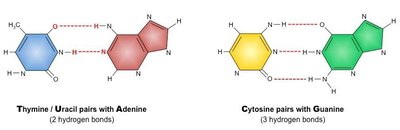
The bases pair in a specific manner, forming hydrogen bonds:
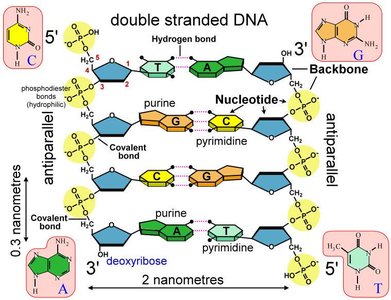
Adenine (A) pairs with Thymine (T) in DNA (2 hydrogen bonds)
Adenine (A) pairs with Uracil (U) in RNA (2 hydrogen bonds)
Cytosine (C) pairs with Guanine (G) in both DNA and RNA (3 hydrogen bonds)
Carbon Numbering in Pentose Sugars
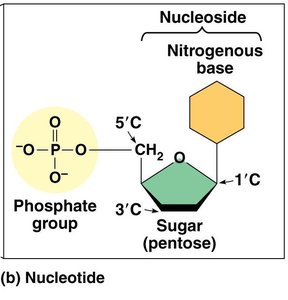
The carbons in the pentose sugar are numbered to distinguish their roles in nucleotide structure and polymerization. The carbon double-bonded to oxygen (carbonyl group) is #1. Sugar carbons are labeled with primes (1', 2', 3', 4', 5') to differentiate from base carbons.
1' C: Attaches the nitrogenous base
2' C: Distinguishes deoxyribose from ribose
3' C: Attaches to the next nucleotide’s phosphate group
4' C: Forms the ring
5' C: Not in the ring, attaches to the phosphate group
Nucleosides and Nucleotides
Nucleoside: Sugar + base
Nucleotide: Phosphate group + nucleoside
Formation involves dehydration reactions, creating covalent bonds between components. 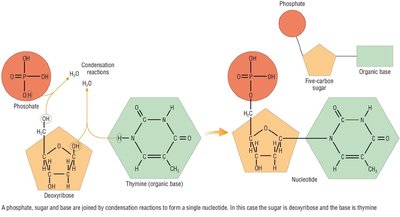
Polynucleotide Formation
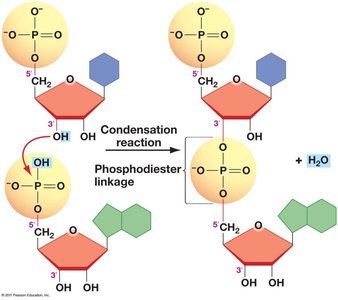
Nucleotides are linked by dehydration reactions between the 3' hydroxyl group of one nucleotide and the phosphate group of the next, forming a phosphodiester bond. This creates the sugar-phosphate backbone of nucleic acids.
Directionality: Polynucleotides have a 5' end (phosphate) and a 3' end (hydroxyl).
DNA Structure
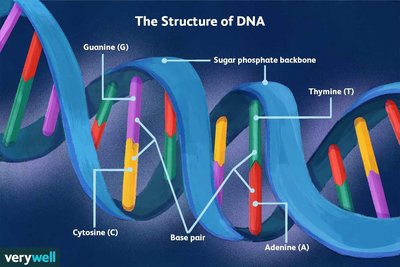
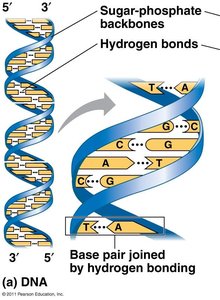
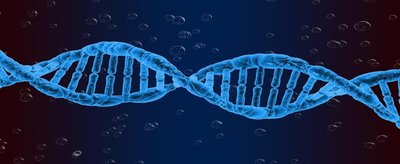
DNA usually exists as two strands of polynucleotides, with complementary bases pairing between the strands. The two strands form a double helix and are antiparallel (run in opposite 5' to 3' directions).
Double helix: Two antiparallel strands twisted together
Base pairing: A-T and C-G
Hydrogen bonds: Hold the strands together
RNA Structure
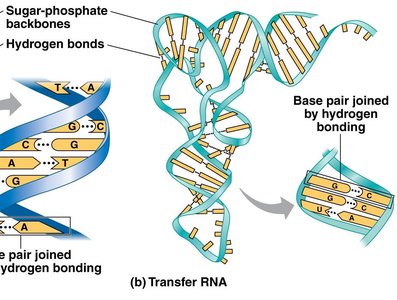
RNA usually exists as a single polynucleotide strand. Bases in one part of the strand can hydrogen bond to complementary bases in another part, creating complex structures.
Single-stranded: RNA is not double-stranded like DNA
Complex folding: Allows RNA to form secondary structures (e.g., tRNA, rRNA)
Comparison of DNA and RNA
Feature | DNA | RNA |
|---|---|---|
Strands | Double-stranded | Single-stranded |
Location | Nucleus | Nucleus & Cytoplasm |
Bases | A, G, C, T | A, G, C, U |
Sugar | Deoxyribose | Ribose |
DNA and RNA Processes: The Central Dogma
DNA and RNA participate in three major processes:
DNA Replication: DNA makes a copy of itself for cell division (occurs in the nucleus).
Transcription: DNA creates messenger RNA (mRNA) in the nucleus.
Translation: RNA is translated to produce a protein in the cytoplasm.
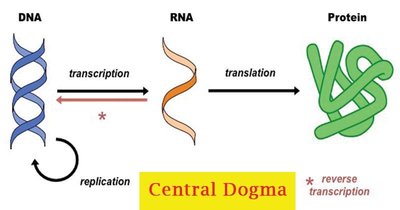 Additional info: The central dogma of molecular biology describes the flow of genetic information: DNA → RNA → Protein. Reverse transcription (RNA → DNA) occurs in some viruses. ----------------------------------------
