 뒤로
Patterns of Inheritance: Mendelian Genetics and Pedigree Analysis
스터디 가이드 - 스마트 노트
 자료에 맞춘 맞춤형 노트, 핵심 정의, 예시, 맥락을 확장해 제공합니다.
Patterns of Inheritance
Introduction to Mendelian Genetics
Mendelian genetics forms the foundation of classical inheritance, describing how traits are passed from parents to offspring. Gregor Mendel's experiments with pea plants established key principles that are still used to solve genetics problems today.
Mendel’s Unique Approach: Mendel used controlled crosses and statistical analysis, focusing on discrete traits.
Character vs. Trait: A character is a general feature (e.g., flower color), while traits are specific forms (e.g., purple or white flowers).
Mendel’s Experiments and Conclusions
Mendel’s experiments involved crossing true-breeding plants and analyzing the resulting generations.
True-breeding: Plants that consistently produce offspring with the same trait.
P-generation: Parental generation, true-breeding for a trait.
F1 generation: First filial generation, all showed the dominant trait.
F2 generation: Second filial generation, showed a 3:1 ratio of dominant to recessive traits.
Law of Segregation: Each individual has two alleles for each gene, which segregate during gamete formation.
Traits and Alleles
Alleles are different versions of a gene, and their combination determines the genotype and phenotype.
Allele: Variant form of a gene.
Locus: The physical location of a gene on a chromosome.
Diploid: Two alleles per character.
Haploid: One allele per character.
Meiosis: Alleles segregate so each gamete receives one allele per gene.
Solving Monohybrid Genetics Problems
Monohybrid crosses involve a single character. The steps to solve these problems include writing allele keys, determining parent genotypes, gametes, and using Punnett squares.
Genotype: Genetic makeup (e.g., PP, Pp, pp).
Phenotype: Observable trait (e.g., purple or white flowers).
Punnett Square Example
Crossing a homozygous purple (PP) with a white (pp) plant:
Genotype ratio:
Phenotype ratio: Purple : White
Dihybrid Crosses and Independent Assortment
Dihybrid crosses track two characters simultaneously and demonstrate the law of independent assortment.
Dihybrid: Two characters (e.g., seed color and shape).
Genotype Example: (diploid parent), (haploid gamete).
Foil Technique: Used to determine possible gametes from a parent with genotype .
Dihybrid Cross Example
Crossing :
All offspring are (heterozygous for both traits).
Crossing :
Phenotype ratio: 9:3:3:1 (yellow-round : yellow-wrinkled : green-round : green-wrinkled)
Rules of Probability in Genetics
Probability rules help predict the likelihood of specific genotypes and phenotypes in offspring.
Multiplication Rule: Probability of independent events occurring together is the product of their probabilities.
Addition Rule: Probability of either event occurring is the sum of their probabilities.
Pedigree Analysis
Pedigrees are diagrams that show inheritance patterns across generations, useful for tracking traits in families.
Symbols: Squares = males, circles = females, shaded = affected.
Generation Number: Top row is generation I.
Affected Individuals: Usually shaded.
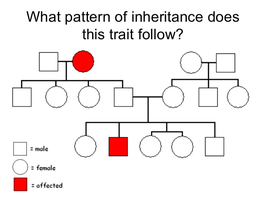
Pedigree Practice Problem 1: Tay Sachs Disease
Tay Sachs is a recessive disorder. The pedigree shows affected individuals in different generations.
Genotype of affected individual in generation 1: Homozygous recessive.
Genotype of female in generation II with children: Carrier or unaffected, depending on offspring.
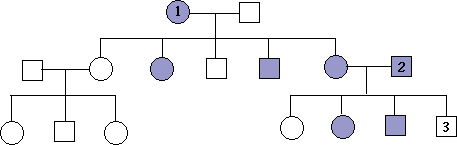
Pedigree Practice Problem 2: Achondroplasia Dwarfism
Achondroplasia is a dominant disorder. The pedigree shows affected individuals in multiple generations.
Genotypes of labeled individuals: 1, 2, and 3 can be determined based on their affected status and family relationships.
Determining Dominant vs. Recessive Inheritance in Pedigrees
Dominant traits appear in every generation, while recessive traits may skip generations. Careful analysis of shaded and unshaded individuals helps determine the inheritance pattern.
Beyond Mendel: Extensions of Inheritance
Some traits do not follow simple Mendelian rules. The following table summarizes key extensions:
Vocabulary | Description | Example |
|---|---|---|
Multiple alleles | More than two alleles exist for a gene | ABO blood types |
Incomplete dominance | Heterozygote shows intermediate phenotype | Red and white snapdragons produce pink |
Codominance | Both alleles are fully expressed | AB blood type |
Polygenic inheritance | Trait controlled by multiple genes | Skin color |
Pleiotropy | One gene affects multiple traits | Sickle cell disease |
Nature vs Nurture | Both genetics and environment influence traits | Height, intelligence |
Additional info: Pedigree analysis is a critical tool in medical genetics for identifying carriers and predicting disease risk. Probability calculations are essential for predicting outcomes in both monohybrid and dihybrid crosses.
